Facts
On June 21, 2004, the Muffasil Police conducted a raid at the house of the accused based on confidential information regarding an illegal Mini Gun Factory
Source reference: para. 4During the raid, 7–8 persons allegedly fled the scene, and police claimed to recover unassembled pistols, equipment, and blank cartridges
Source reference: para. 4A seizure list was prepared, witnessed only by police personnel as no villagers joined the search
Source reference: para. 4The Trial Court convicted Appellant No. 1 (Appellant No. 2 having died during pendency) under Sections 25(1-AA) and 26(2) of the Arms Act, sentencing him to seven years of simple imprisonment
Source reference: para. 3The Appellant challenged this on grounds of lack of independent witnesses, failure to prove conscious possession, and inconsistent testimonies
Source reference: para. 6-7Issues
1. Whether the prosecution established "conscious possession" of illegal arms and manufacturing equipment against the appellant in a joint household
Source reference: para. 21, 272. Whether the non-compliance with the procedural safeguards under Section 100 of the Cr.P.C. regarding independent witnesses vitiated the search and seizure
Source reference: para. 20, 263. Whether the prosecution proved the ingredients of manufacturing or sale under Section 25(1-AA) to sustain the conviction
Source reference: para. 18, 27Law Applied
The court applied Section 25(1-AA) and 26(2) of the Arms Act, 1959
Source reference: para. 17It relied on Samir Ahmed Rafiqahmed Ansari v. State of Gujarat regarding the necessity of cogent evidence for manufacturing or sale under Section 25(1-AA)
Source reference: para. 18The principle of "conscious possession" was derived from Gunwantlal v. State of Madhya Pradesh and Sanjay Dutt v. State Through CBI, Bombay (II), requiring the prosecution to prove intention and knowledge beyond mere physical custody
Source reference: para. 21-22Section 100 of the Cr.P.C. was applied concerning the mandatory requirement of associating independent witnesses during search and seizure
Source reference: para. 20Reasoning
The Court found that the prosecution failed to establish the Appellant's "conscious possession" or "dominion" over the seized items
Source reference: para. 21, 27Since the premises were joint property and multiple individuals fled, the police could not pinpoint the Appellant's exclusive control or knowledge of the hidden items
Source reference: para. 20, 27Regarding Section 25(1-AA), the court noted a total lack of evidence showing the Appellant was active in manufacturing or selling arms, following the precedent in Samir Ahmed
Source reference: para. 18, 27While police personnel are competent witnesses (Anil @ Andya Sadashiv Nandoskar), the court held that their testimony in this case lacked credibility due to significant procedural lapses: the failure to record the names of villagers who refused to join the search, the failure to identify the fleeing suspects, and the fact that the expert found the seized pistols "non-effective"
Source reference: para. 14, 20, 26The cumulative effect of these infirmities created a reasonable doubt
Source reference: para. 27Holding
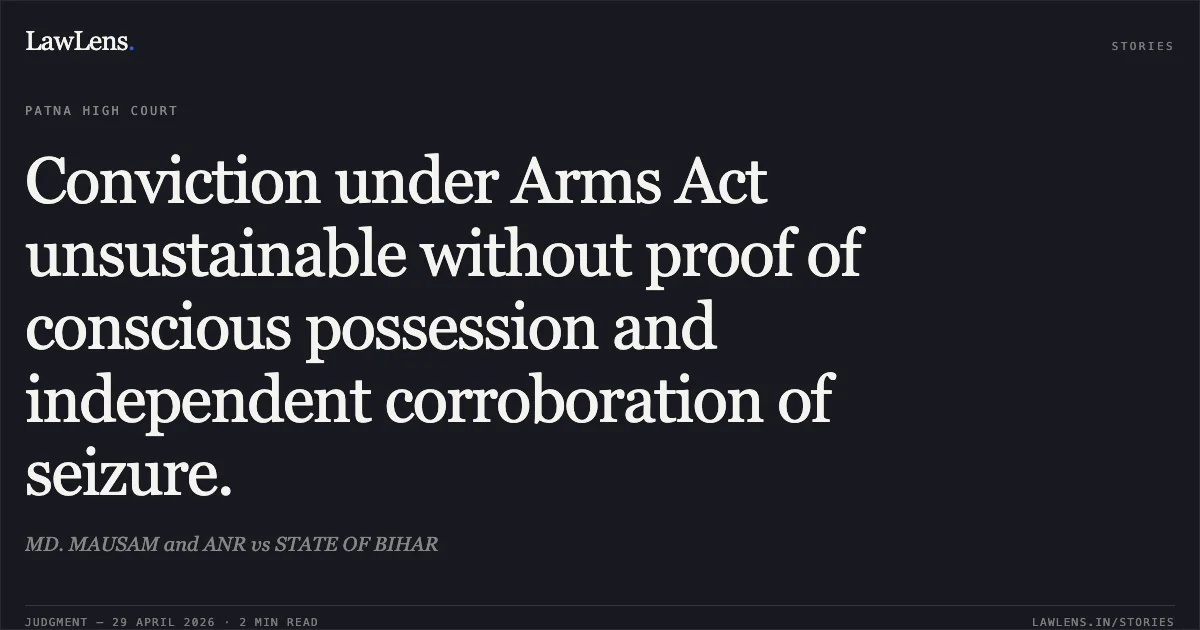
The Court held that the prosecution failed to prove the charges beyond a reasonable doubt
It answered that mere recovery without proving "conscious possession" in a shared dwelling is insufficient for conviction
Source reference: para. 27The appeal was allowed, and the judgment of conviction dated 19.12.2009 and the order of sentence dated 21.12.2009 were set aside
Source reference: para. 28-29The Appellant was discharged from his bail bonds, and any fines paid were ordered to be refunded
Source reference: para. 29Acts & Sections Cited
14 provisions across 3 statutes referred to in this judgment. Each provision opens on LawLens.
Code of Criminal Procedure, 19734
Indian Penal Code, 18602
Original Court PDF
MD. MAUSAM and ANRvsSTATE OF BIHAR
Click to open original judgment
Original judgment, available to read, download and summarize on LawLens.in