Facts
On 5 June 2014, the minor victim allegedly went to a toddy shop with a friend and did not return.
Source reference: p. 2–3The appellant was stated to have taken her on his bicycle on the representation that he would drop her home.
Source reference: p. 2–3The victim was subsequently found injured near a field adjoining a forested area and allegedly disclosed that the appellant had taken her to a secluded place and sexually assaulted her.
Source reference: p. 2–3The victim’s mother lodged the fardbeyan, leading to registration of Rosera P.S. Case No. 160 of 2014 under Section 376 IPC and Section 4 of the POCSO Act.
Source reference: p. 3After investigation, the appellant was charged under Section 376(1) IPC and Section 6 of the POCSO Act.
Source reference: p. 3–4The prosecution examined seven witnesses, including the victim, her mother, her maternal uncle, and two members of the medical board.
Source reference: p. 3–4The victim identified the appellant in court and stated that she was 11 years old, while the medical board assessed her age as between 8 and 9 years and opined that the medical findings were suggestive of rape.
Source reference: p. 4The trial court convicted and sentenced the appellant on 28–29 November 2017.
Source reference: p. 1–2During the appeal, the State reported that the appellant had completed his sentence and was released on 28 September 2024 after paying the fine of ₹50,000; consequently, the appeal survived only against the conviction.
Source reference: p. 1–2Issues
1. Whether the prosecution proved beyond reasonable doubt that the appellant committed the offence punishable under Section 376(1) of the IPC and Section 6 of the POCSO Act.
Source reference: para. 82. Whether the trial court’s judgment of conviction suffered from any perversity or illegality warranting appellate interference.
Source reference: para. 8–9Law Applied
The Court applied Section 376(1) of the Indian Penal Code, concerning punishment for rape, and Section 6 of the Protection of Children from Sexual Offences Act, 2012, concerning aggravated penetrative sexual assault.
Source reference: paras. 4–5, 8The Court assessed the prosecution case on the basis of the testimony of the victim and supporting witnesses, together with the medical evidence regarding sexual assault and the victim’s minority.
Source reference: paras. 4–5, 8It held that where the evidence of the victim, her supporting witnesses, and medical examination sufficiently establishes the prosecution case beyond reasonable doubt, the conviction may be sustained.
Source reference: paras. 4–5, 8No precedent was cited in the judgment.
Source reference: paras. 4–5, 8Reasoning
The Court found the testimony of the victim, her mother, and her maternal uncle to be consistent and supportive of the prosecution case.
Source reference: para. 8Although two prosecution witnesses were declared hostile, the Court relied on the evidence of the material witnesses and the medical board members.
Source reference: para. 8The victim identified the appellant during trial, and the medical board assessed her age at 8–9 years and found medical features suggestive of rape.
Source reference: p. 4On this evidentiary basis, the Court concluded that the prosecution had established the appellant’s guilt beyond reasonable doubt and that the trial court’s findings were neither perverse nor illegal.
Source reference: para. 8Holding
The High Court answered the issues in favour of the prosecution.
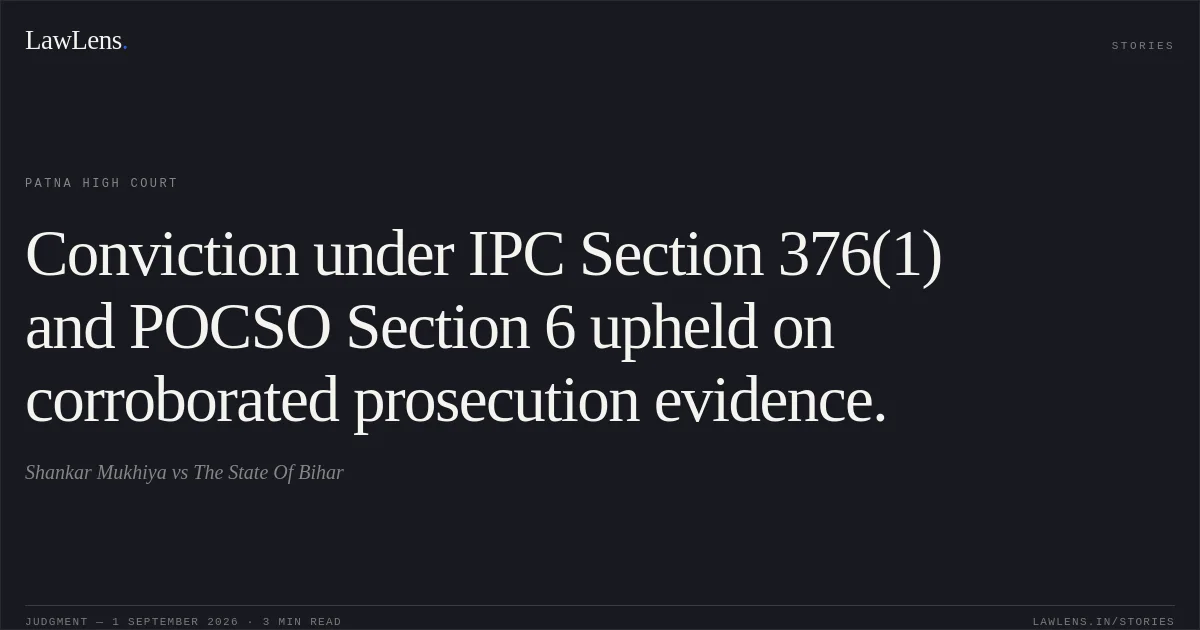
It upheld the appellant’s conviction under Section 376(1) IPC and Section 6 of the POCSO Act, finding no ground for appellate interference with the judgment dated 28 November 2017.
Source reference: para. 9Since the appellant had already completed his sentence and had been released after payment of the fine, the appeal was disposed of without granting any further relief.
Source reference: p. 1–2; para. 10Acts & Sections Cited
3 provisions across 2 statutes referred to in this judgment. Each provision opens on LawLens.
Indian Penal Code, 18601
Original Court PDF
Shankar MukhiyavsThe State Of Bihar
Click to open original judgment
Original judgment, available to read, download and summarize on LawLens.in