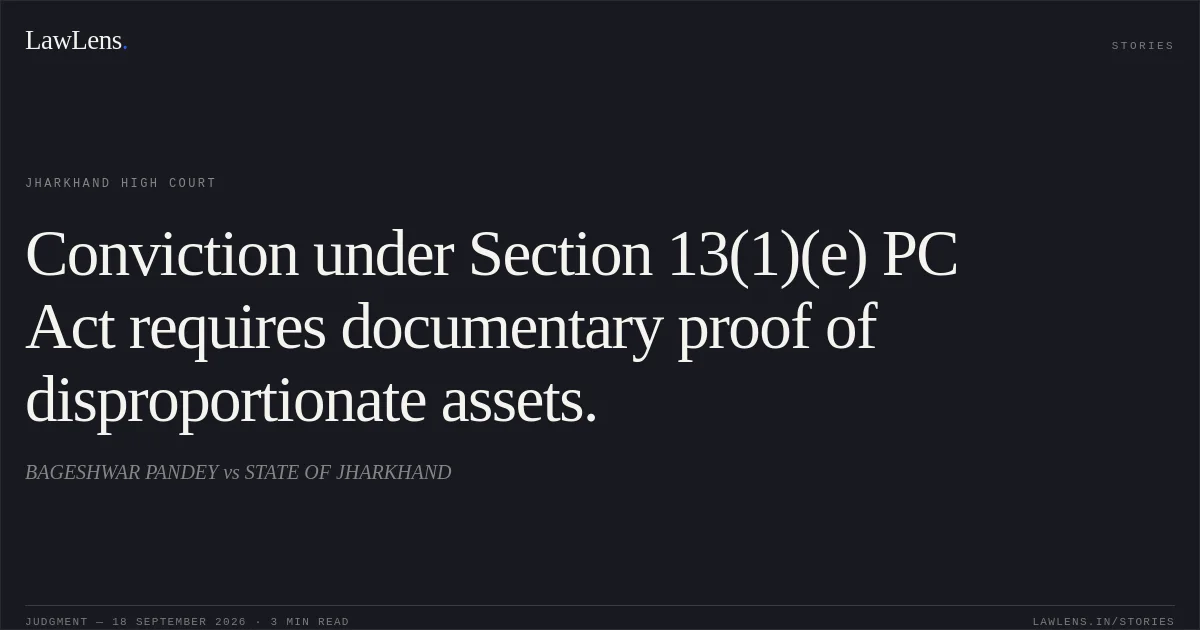
Facts
The appellant, a Forest Department employee who served between 1963 and 1988, was prosecuted for allegedly possessing movable and immovable assets disproportionate to his known sources of income.
Source reference: no citationThe prosecution alleged that land and other properties valued at approximately Rs. 1,29,000/- had been acquired in the names of the appellant, his wife, and his sons, besides movable assets including a scooter, gun, and generator; the alleged disproportionate assets were stated to be worth Rs. 1,17,690/-.
Source reference: paras. 3–4After investigation, a charge-sheet was submitted under Sections 13(2) read with 13(1)(e) of the Prevention of Corruption Act, 1988.
Source reference: paras. 2, 4–5The Special Judge, Vigilance, convicted the appellant under Section 13(1)(e) and sentenced him to two years’ imprisonment by judgment dated 13 November 2003.
Source reference: paras. 2, 4–5The appellant challenged the conviction, contending that the prosecution had produced no documentary proof of the properties, income, or alleged disproportion.
Source reference: para. 6Issues
1. Whether the prosecution established the statutory ingredients of an offence under Section 13(1)(e) of the Prevention of Corruption Act, 1988, including possession of pecuniary resources or property disproportionate to the appellant’s known sources of income.
Source reference: paras. 9, 13–152. Whether the appellant’s conviction and sentence required interference because the prosecution failed to substantiate the alleged disproportionate assets through reliable and corroborative evidence.
Source reference: paras. 9, 16Law Applied
The Court applied Section 13(1)(e) of the Prevention of Corruption Act, 1988, as it stood before the 2018 amendment, which criminalised a public servant’s possession, or possession on his behalf, of pecuniary resources or property disproportionate to his known sources of income and for which he could not satisfactorily account.
Source reference: para. 12The prosecution was required to prove: (i) that the accused was a public servant; (ii) the nature and extent of the pecuniary resources or property in his possession; (iii) his known sources of income; and (iv) that the resources or property were objectively disproportionate to those sources.
Source reference: para. 13Only after these foundational ingredients were satisfactorily established would the burden shift to the accused to account for the disproportionate assets.
Source reference: paras. 14–15Reasoning
The Court found that the prosecution failed to establish the foundational ingredients of Section 13(1)(e).
Source reference: para. 16Although the witnesses referred to properties, bank passbooks, and articles allegedly found during the search, the prosecution did not produce documentary evidence proving the ownership, valuation, acquisition, income, or precise computation of the alleged disproportionate assets.
Source reference: paras. 10, 16The evidence also indicated that the appellant possessed ancestral and agricultural land and had income from agriculture and other activities, but the prosecution did not objectively demonstrate how the alleged assets exceeded his known lawful income.
Source reference: paras. 6, 10–11Consequently, the burden could not shift to the appellant merely on the basis of uncorroborated oral testimony; the trial court had erred by relying on such evidence without adequate documentary corroboration.
Source reference: para. 16Holding
The High Court held that the prosecution had failed to prove beyond the required standard that the appellant possessed pecuniary resources or property disproportionate to his known sources of income under Section 13(1)(e) of the Prevention of Corruption Act, 1988.
The conviction and sentence imposed by the trial court were set aside, and the appellant was acquitted.
Source reference: para. 16As he was on bail, he was discharged from the liabilities of his bail bonds and his sureties were also discharged.
Source reference: paras. 16–18Acts & Sections Cited
1 provisions across 1 statute referred to in this judgment. Each provision opens on LawLens.
Prevention of Corruption Act, 19881
Original Court PDF
BAGESHWAR PANDEYvsSTATE OF JHARKHAND
Click to open original judgment
Original judgment, available to read, download and summarize on LawLens.in
![Article 311(2)(b) cannot be invoked on presumptions; cogent reasons must establish departmental inquiry impracticability.. Gaurav Kumar vs DELHI POLICE. CAT - ['Delhi']. LawLens](/stories/thumbnails/article-311-2-b-cannot-be-invoked-on-presumptions-cogent-reasons-must-establish-department-d62b8f66fc2542b1a4a889245ee4d5ed.webp)
![Old Pension Scheme claims require reconsideration under subsequent instructions where compassionate appointment applications preceded 1 January 2004.. SMT ATLESH vs NORTH CENTRAL RAILWAY. CAT - ['Allahabad']. LawLens](/stories/thumbnails/old-pension-scheme-claims-require-reconsideration-under-subsequent-instructions-where-comp-c18c8f9a4894412ba7633c7be2188ea7.webp)