Facts
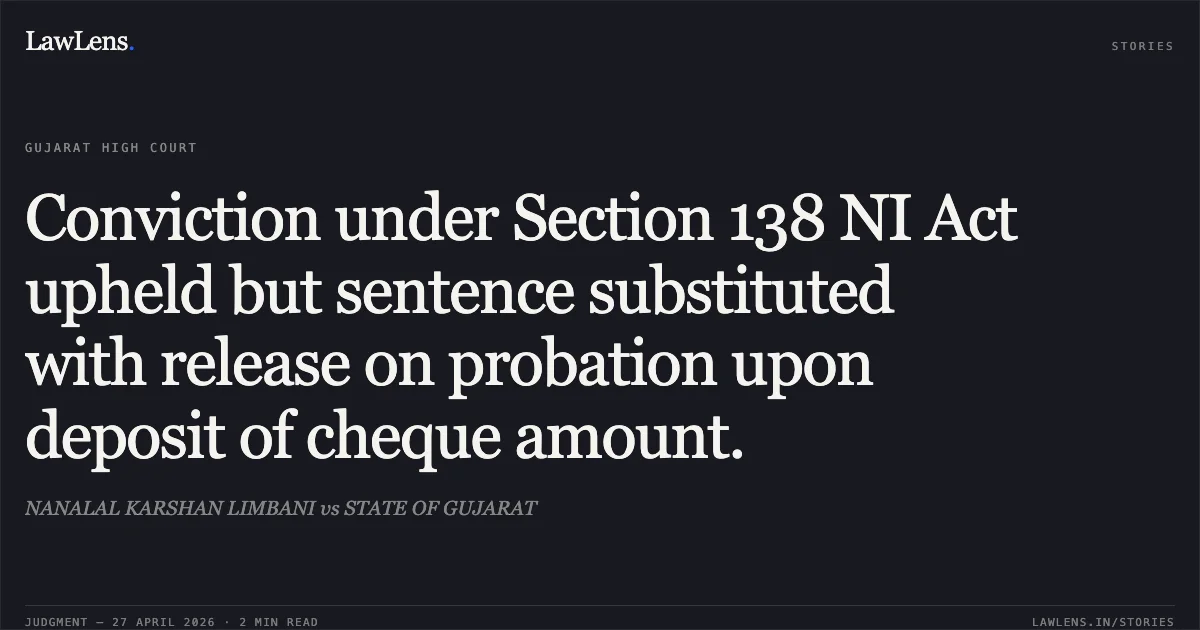
The applicant was convicted by the 2nd Additional Judicial Magistrate First Class, Bhuj, for an offence under Section 138 of the Negotiable Instruments (NI) Act in Private Criminal Case No. 1000 of 2007
Source reference: p. 1-2He was sentenced to one year of simple imprisonment and a fine of Rs. 5,000. This judgment was upheld by the Sessions Judge, Kutch-Bhuj, in Criminal Appeal No. 7 of 2010 on January 25, 2012
Source reference: p. 2The applicant filed the present Revision Application and was subsequently taken into custody following the issuance of a non-bailable warrant on March 24, 2026
Source reference: p. 2During the proceedings, the applicant expressed readiness to deposit the cheque amount of Rs. 70,000
Source reference: p. 2Issues
1. Whether the concurrent findings of conviction under Section 138 of the NI Act warrant interference in revisional jurisdiction after the accused has offered to deposit the cheque amount
Source reference: p. 2-32. Whether the benefit of the Probation of Offenders Act, 1958, can be extended to an accused convicted under Section 138 of the NI Act
Source reference: p. 3Law Applied
The Court applied Section 138 of the Negotiable Instruments Act, noting that the offence is quasi-criminal and compoundable, intended to ensure monetary payment rather than retribution
Source reference: p. 2-3It relied on the scope of Revisional Jurisdiction under Sections 397 and 401 of the CrPC, which restricts the court from re-analyzing evidence in the absence of perversity
Source reference: p. 3The court applied the precedent of the Hon’ble Supreme Court in Sanjabij Tari v. Kishore S. Borcar, 2025 INSC 1158, and Sections 4 and 6 of the Probation of Offenders Act, 1958, regarding the release of offenders on probation of good conduct
Source reference: p. 3-4Reasoning
The Court observed that since the applicant volunteered to deposit the full cheque amount (Rs. 70,000), the primary objective of the NI Act—ensuring the credibility of cheques—was satisfied
Source reference: p. 2-3Holding that revisional jurisdiction does not permit a de novo trial or re-interpretation of evidence without proof of perversity, the Court maintained the conviction
Source reference: p. 3However, considering the quasi-criminal nature of the offence and the payment made, the Court determined that imprisonment was unnecessary. Following the Supreme Court’s direction in Sanjabij Tari, the Court modified the sentence by substituting incarceration with a probation bond, ensuring the applicant remains liable to serve the sentence only if the conditions of the one-year good conduct period are breached
Source reference: p. 3-4Holding
The High Court maintained the conviction but modified the sentence. The applicant was directed to be released on probation of good conduct under Section 4 of the Probation of Offenders Act upon executing a bond of Rs. 20,000 with one surety for a period of one year
The applicant was ordered to deposit Rs. 70,000 before the Registry, which Respondent No. 2 is permitted to withdraw. Consequently, the non-bailable warrant was cancelled, and the Jail Authority was directed to release the applicant forthwith upon fulfillment of the deposit and bond conditions
Source reference: p. 2, 4Acts & Sections Cited
4 provisions across 3 statutes referred to in this judgment. Each provision opens on LawLens.
Code of Criminal Procedure, 19732
Negotiable Instruments Act, 18811
Probation of Offenders Act, 19581
Original Court PDF
NANALAL KARSHAN LIMBANIvsSTATE OF GUJARAT
Click to open original judgment
Original judgment, available to read, download and summarize on LawLens.in


