Facts
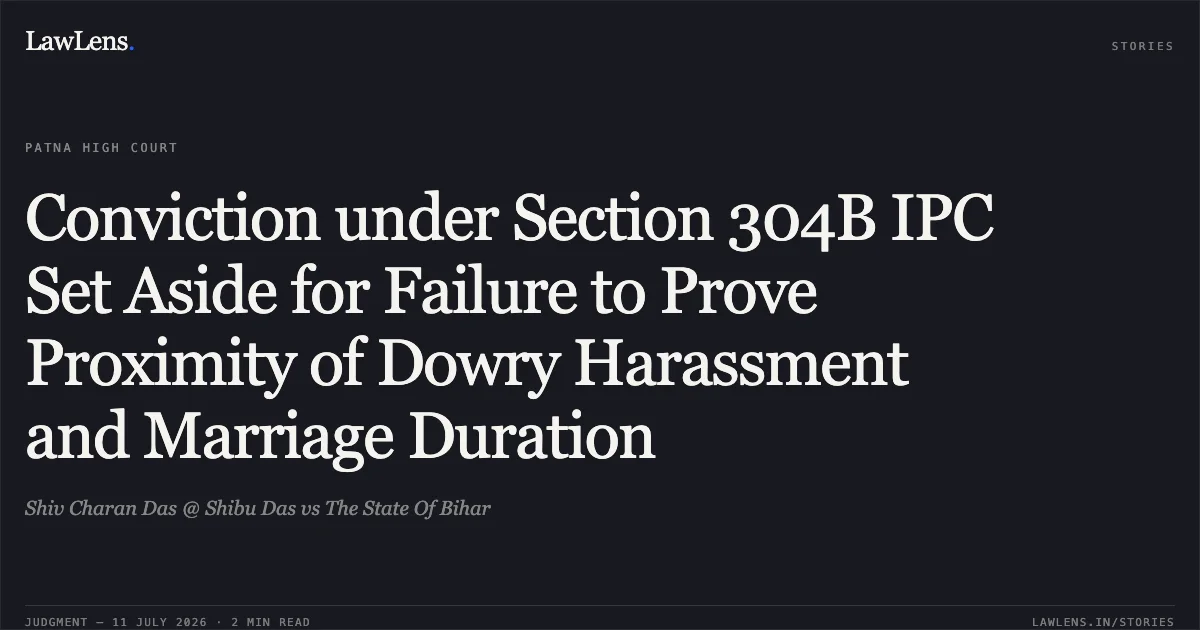
The appellant/husband challenged his conviction under Section 304B/34 of the Indian Penal Code (IPC) and a 10-year rigorous imprisonment sentence
Source reference: p. 1The prosecution alleged that the deceased, Anita Devi, was married to the appellant approximately 5-6 years prior to her death and was subsequently tortured for dowry (motorcycle and ₹50,000)
Source reference: p. 2-3On 21.03.2008, the deceased was found dead with multiple injuries at her matrimonial home
Source reference: p. 3The defense contended that the death resulted from an accidental fall from a roof and that the Investigating Officer (I.O.) was never examined, causing prejudice
Source reference: p. 5-6Issues
1. Whether the prosecution proved the essential ingredients of "dowry death" under Section 304B IPC beyond reasonable doubt
Source reference: p. 5-62. Whether the statutory presumption under Section 113B of the Indian Evidence Act can be invoked if the prosecution fails to establish that the victim was subjected to cruelty "soon before her death"
Source reference: p. 8-93. Whether the non-examination of the Investigating Officer and lack of proof regarding the date of marriage are fatal to the prosecution case
Source reference: p. 7Law Applied
The court primarily applied Section 304B of the IPC, which defines dowry death as a death caused by burns, bodily injury, or unnatural circumstances within seven years of marriage, provided the woman was subjected to cruelty by her husband or relatives in connection with dowry demands "soon before her death"
Source reference: p. 5-6It further relied on Section 113B of the Indian Evidence Act, 1872, regarding the rebuttable presumption of dowry death
Source reference: p. 7-8The court cited Gudhiya Devi v. State of Bihar (2021) and Bakshish Ram & Another v. The State of Punjab (2013) to emphasize that the prosecution must prove all essential ingredients before the burden of proof shifts to the accused
Source reference: p. 6, 8Reasoning
The court found several critical lapses in the prosecution's case. First, there was no oral or documentary evidence to establish the specific date of marriage, making it impossible to verify if the death occurred within the statutory seven-year limit
Source reference: p. 7Second, the prosecution failed to demonstrate that the deceased was subjected to torture or harassment "soon before her death" specifically in connection with dowry demands
Source reference: p. 8-9Third, the non-examination of the Investigating Officer deprived the appellant of the opportunity to cross-examine on material contradictions and the physical state of the crime scene
Source reference: p. 7The court reasoned that since the "sine qua non" (cruelty soon before death) was not established by cogent evidence, the statutory presumption under Section 113B of the Evidence Act could not be triggered against the appellant
Source reference: p. 8-9Holding
The court held that the prosecution failed to establish the charges beyond a shadow of reasonable doubt due to a complete lack of evidence regarding harassment for dowry and procedural infirmities
The direct answer to the issues was that the conviction could not be sustained in law. The court allowed the appeal, set aside the judgment of conviction dated 06.10.2015 and the order of sentence dated 09.10.2015, acquitted the appellant of all charges, and discharged him from his bail bonds
Source reference: p. 9-10Acts & Sections Cited
1 provisions across 1 statute referred to in this judgment. Each provision opens on LawLens.
Indian Penal Code, 18601
Original Court PDF
Shiv Charan Das @ Shibu DasvsThe State Of Bihar
Click to open original judgment
Original judgment, available to read, download and summarize on LawLens.in