Facts
Dineshbhai Dharamdas married accused No. 2, Poonamben @ Jyotiben, first under Arya Samaj rites on 13 April 2003 and subsequently according to customary rites.
Source reference: pp. 1–3The marriage was opposed by both families. After the spouses separated, proceedings under Section 125 of the Code of Criminal Procedure were instituted by Poonamben.
Source reference: pp. 1–3The prosecution alleged that the accused harassed and threatened Dineshbhai, refused to allow Poonamben to return with him, and told him to die when he visited their house on 10 November 2004. Dineshbhai thereafter consumed pesticide and died.
Source reference: pp. 1–3His sister lodged a complaint alleging offences under Sections 306 and 114 of the Indian Penal Code.
Source reference: pp. 1–3The trial court acquitted all accused on 17 March 2006 in Criminal Case No. 22 of 2005.
Source reference: pp. 1–3During the appeal, accused Nos. 2 and 4 died and the appeal against them abated; the appeal continued against accused Nos. 1 and 3.
Source reference: pp. 6–8The prosecution relied primarily on the evidence of the deceased’s sisters, a purported suicide note, medical evidence, and police testimony.
Source reference: pp. 7–8Issues
Whether the trial court was justified in acquitting the accused of offences under Sections 306 and 114 of the IPC.
Source reference: p. 6, para. 11Whether the trial court properly appreciated the oral and documentary evidence led by the prosecution.
Source reference: p. 6, para. 11Whether the impugned acquittal suffered from illegality, irregularity, or perversity warranting appellate interference.
Source reference: p. 6, para. 11Law Applied
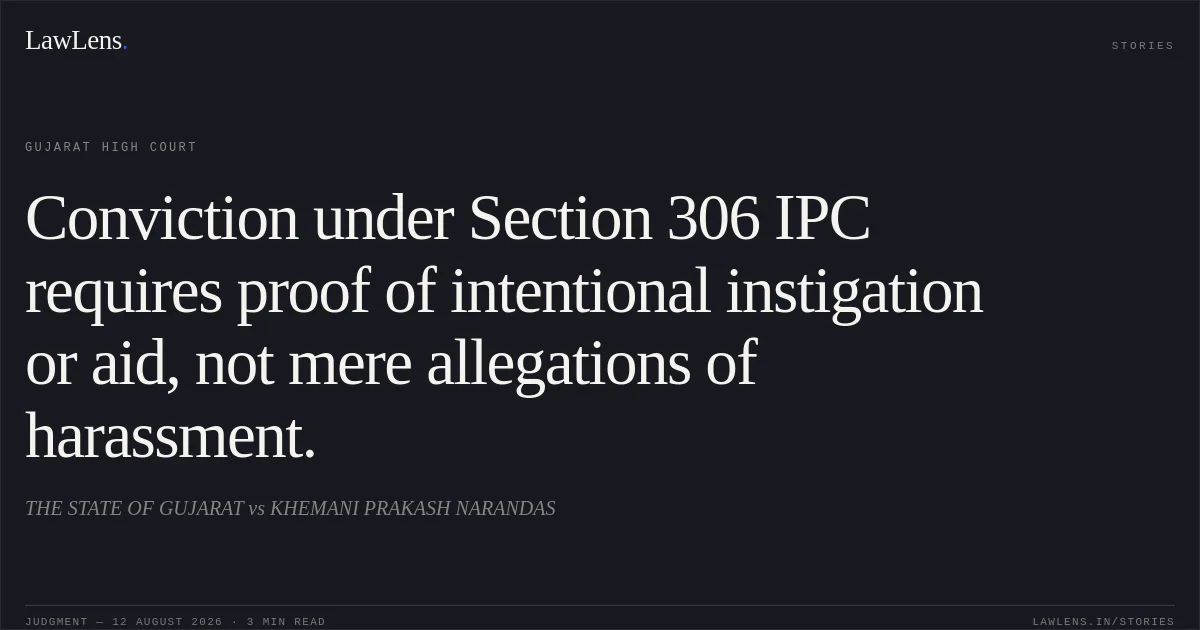
The Court applied Sections 306 and 107 of the IPC: Section 306 requires proof that the accused abetted the commission of suicide, while Section 107 defines abetment through instigation, conspiracy accompanied by an act or illegal omission, or intentional aid.
Source reference: pp. 23–24, para. 16Mere harassment, quarrelsome words, or the existence of matrimonial and legal disputes do not by themselves establish the intentional instigation or aid necessary for abetment; the prosecution must prove a proximate and intentional act connecting the accused with the suicide, as explained in Gangula Mohan Reddy v. State of Andhra Pradesh , (2010) 1 SCC 750.
Source reference: p. 9, para. 15In an appeal against acquittal, the appellate court may reappreciate the evidence, but the accused carry a strengthened or “double” presumption of innocence, and an acquittal should not be disturbed where two reasonable views are possible, in accordance with Chandrappa v. State of Karnataka , (2007) 4 SCC 415, Rajesh Prasad v. State of Bihar , (2022) 3 SCC 471, Babu Sahebagouda Rudragoudar v. State of Karnataka , (2024) 8 SCC 149, and Ramesh v. State of Karnataka , (2024) 9 SCC 169.
Source reference: pp. 24–27, paras. 17–20The Court also observed that the statutory presumptions under Sections 113A and 113B of the Evidence Act were inapplicable on the facts.
Source reference: pp. 11, 22–23Reasoning
The High Court held that the prosecution failed to prove the essential ingredients of abetment.
Source reference: pp. 7–8, 12–13, 18–20The alleged suicide note was produced approximately two months and thirteen days after the incident, its authorship was not established through handwriting evidence, and its contents did not sufficiently identify any intentional instigation or conduct leaving the deceased with no alternative but to commit suicide.
Source reference: pp. 7–8, 12–13, 18–20The complainant’s allegations were materially inconsistent with her earlier police statement and were undermined by the medical evidence showing that accused No. 2 was present at the hospital, despite the complainant’s denial of that fact.
Source reference: pp. 12–14The independent witness did not depose that the accused had harassed or instigated the deceased, and the prosecution did not establish where the pesticide was consumed or that it was consumed inside the accused’s house.
Source reference: pp. 15–16, 20–21The evidence of the investigating officer further showed that the deceased’s relatives had not initially stated that the accused had harassed him.
Source reference: pp. 11–12, 17–18Consequently, the evidence created, at most, suspicion regarding the accused’s conduct and did not prove intentional instigation, conspiracy, or aid beyond reasonable doubt.
Source reference: pp. 23–27, paras. 16–20Applying the restrictive standard governing appeals against acquittal, the Court found no perversity or manifest illegality in the trial court’s evaluation of the evidence.
Source reference: pp. 23–27, paras. 16–20Holding
The High Court answered all issues against the State.
It held that the prosecution had failed to establish beyond reasonable doubt that accused Nos. 1 and 3 abetted Dineshbhai’s suicide or committed the charged offences under Sections 306 and 114 of the IPC.
Source reference: pp. 27–28, paras. 21–23Finding no illegality, irregularity, or perversity in the trial court’s judgment, the Court dismissed the State’s appeal and confirmed the order of acquittal.
Source reference: pp. 27–28, paras. 21–23The bail bonds were cancelled, and the record and proceedings were directed to be returned to the trial court.
Source reference: pp. 27–28, paras. 21–23Acts & Sections Cited
6 provisions across 2 statutes referred to in this judgment. Each provision opens on LawLens.
Code of Criminal Procedure, 19733
Indian Penal Code, 18603
Original Court PDF
THE STATE OF GUJARATvsKHEMANI PRAKASH NARANDAS
Click to open original judgment
Original judgment, available to read, download and summarize on LawLens.in