Facts
The appellants were prosecuted in Crime No. 156/2000 for offences under Sections 307 and 34 of the Indian Penal Code.
Source reference: para. 1–3Following investigation and trial in Sessions Trial No. 35/2002, the Additional Judge to the Court of the Additional Sessions Judge, Naugaon, convicted them under Section 307/34 IPC and sentenced each to three years’ rigorous imprisonment with a fine of ₹2,000, by judgment dated 16 December 2010.
Source reference: para. 1–3In appeal under Section 374(2) of the Code of Criminal Procedure, the appellants did not challenge their conviction on merits but sought reduction of sentence on the grounds that the incident occurred in 2000, they had undergone substantial incarceration, and appellant Kuttu @ Ashok Dixit was suffering from serious ailments.
Source reference: para. 4–6The State supported the conviction and sentence.
Source reference: para. 4–6Issues
Whether the conviction of the appellants under Section 307 read with Section 34 IPC was sustainable on the evidence and materials on record.
Source reference: para. 7Whether, considering the period already undergone, the age of the case, the nature of the injuries, and the medical condition of appellant Kuttu @ Ashok Dixit, the sentence of three years’ rigorous imprisonment should be reduced to the period already undergone.
Source reference: para. 8–9Law Applied
The Court exercised its appellate jurisdiction under Section 374(2) of the Code of Criminal Procedure, 1973, to examine the correctness of the conviction and sentence.
Source reference: para. 1, 7Section 307 IPC applies to an attempt to commit murder, while Section 34 IPC attributes joint liability where a criminal act is done by several persons in furtherance of their common intention.
Source reference: para. 1–3Even where the accused limits the appeal to the question of sentence, the appellate court retains a legal obligation to independently scrutinize the correctness and legality of the conviction.
Source reference: para. 7In determining sentence, the Court may consider the nature of the offence and injuries, the period of incarceration already undergone, the prolonged pendency of the matter, and relevant mitigating circumstances such as the accused’s medical condition.
Source reference: para. 8Reasoning
The Court independently examined the trial judgment and the evidence, and found that the prosecution case was corroborated by witness testimony and other material on record.
Source reference: para. 7It held that the trial court’s finding of guilt was based on cogent reasoning and was not perverse or illegal; therefore, the conviction under Section 307/34 IPC required no interference.
Source reference: para. 7On sentencing, however, the Court considered that the incident had occurred approximately 26 years earlier, the appellants had already undergone substantial custody during trial and after conviction, no fatal injury had been sustained by the injured person, and appellant Kuttu @ Ashok Dixit was suffering from serious health problems.
Source reference: para. 4, 8These circumstances justified a lenient modification of the custodial sentence.
Source reference: para. 4, 8Holding
The appeal was partly allowed to the extent of sentence.
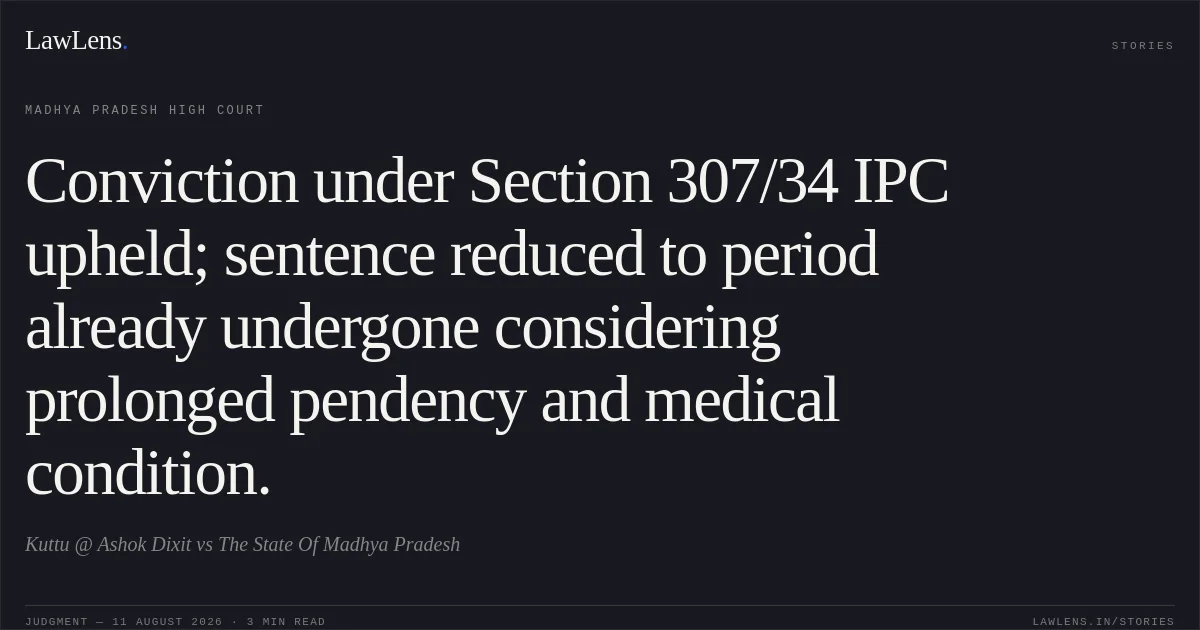
The appellants’ conviction under Section 307/34 IPC was affirmed, but their sentence of three years’ rigorous imprisonment was reduced to the period already undergone.
Source reference: para. 9The fine of ₹2,000 imposed by the trial court was maintained and directed to be deposited within two months, subject to adjustment of any amount already deposited.
Source reference: para. 10As the appellants were on bail, their bail bonds were discharged; the trial court’s order concerning the seized property was affirmed, and the appeal was disposed of accordingly.
Source reference: para. 11–16Acts & Sections Cited
3 provisions across 2 statutes referred to in this judgment. Each provision opens on LawLens.
Code of Criminal Procedure, 19731
Indian Penal Code, 18602
Original Court PDF
Kuttu @ Ashok DixitvsThe State Of Madhya Pradesh
Click to open original judgment
Original judgment, available to read, download and summarize on LawLens.in