Facts
The prosecution alleged that on October 2, 2002, the appellants assaulted the informant (P.W. 4) with stones and bricks following a verbal altercation regarding a land deal
Source reference: para. 9The informant sustained two head injuries and alleged that the appellants also snatched Rs. 7,500 from him
Source reference: para. 9The Trial Court (Sessions Case No. 20 of 2005) convicted the appellants under Sections 341, 325/34, and 307/34 of the IPC, sentencing them to a maximum of seven years of rigorous imprisonment
Source reference: para. 1The appellants challenged this conviction, arguing that the injuries were simple, there was no intention to kill, and the medical evidence (specifically an X-ray report obtained a month after the incident) was unreliable
Source reference: para. 3Issues
1. Whether the conviction under Section 307/34 IPC (Attempt to Murder) is sustainable in the absence of evidence proving intention or knowledge to cause death
Source reference: para. 28-292. Whether the conviction under Section 325/34 IPC (Grievous Hurt) can be upheld when the finding of a "fracture" is based on an unverified X-ray report from a non-radiologist
Source reference: para. 22, 363. Whether the ingredients of Section 341 IPC (Wrongful Restraint) were sufficiently established by the evidence
Source reference: para. 40Law Applied
The court applied Section 307 IPC, noting that the determinative factor is the intention or knowledge of the accused rather than the nature of the injury
Source reference: para. 26It relied on State of M.P. v. Kashiram (2009) to establish that conviction under Section 307 is justified if an intent is coupled with an overt act, regardless of whether the injury is life-threatening
Source reference: para. 26Regarding "grievous hurt," the court applied Sections 320 and 325 IPC, emphasizing that a fracture must be proven beyond reasonable doubt to classify a hurt as grievous
Source reference: para. 11-12For wrongful restraint, Section 341 IPC was applied to instances where a person is prevented from proceeding in a direction they have a right to go
Source reference: para. 40Reasoning
The High Court found that the incident occurred on the "spur of the moment" without prior preparation, negating the specific intent required for Section 307
Source reference: para. 30-31It noted significant exaggerations in the informant's testimony; while he claimed injuries to his legs and chest, the medical report only confirmed two head injuries
Source reference: para. 32-34Regarding Section 325, the court observed that the "grievous" nature of the injury was based on a supplementary report (Ext-1/2) derived from an X-ray taken one month post-incident by a private practitioner who was not a radiologist
Source reference: para. 17, 36Crucially, the X-ray plate lacked identification markers linking it to the victim, and the doctor (P.W. 2) admitted he was not an expert
Source reference: para. 17-18Consequently, the court held that the "grievous" nature was not proved and downgraded the offense to Section 323 (Simple Hurt)
Source reference: para. 22-23The conviction under Section 341 was upheld as the evidence showed the appellants physically restrained the informant during the assault
Source reference: para. 40Holding
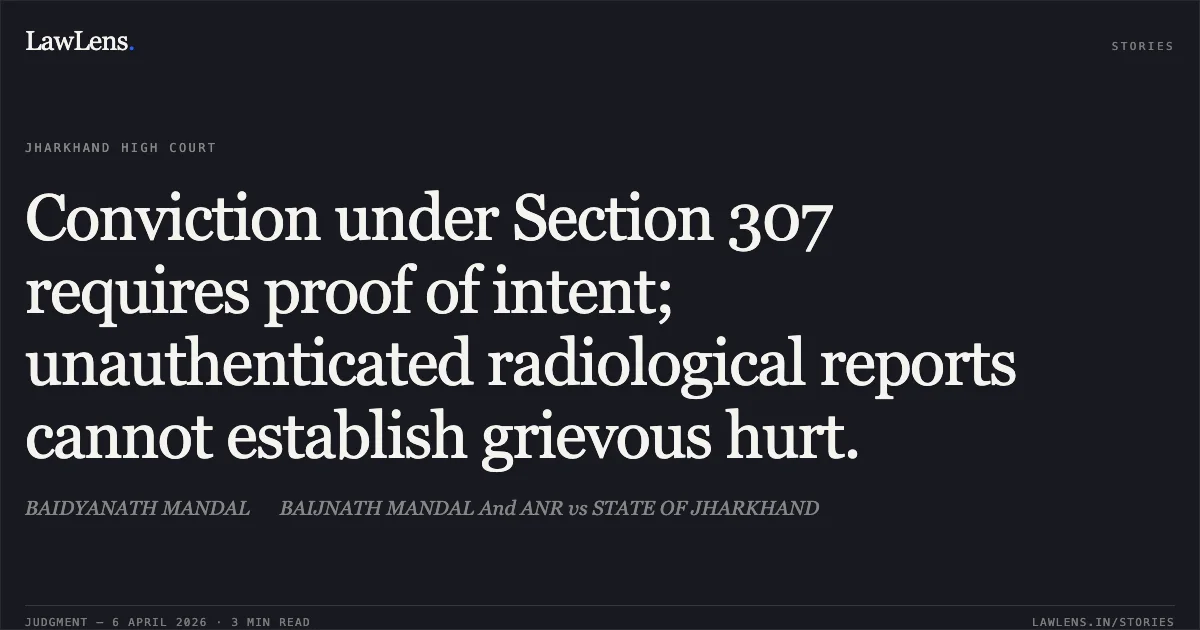
The High Court allowed the appeal in part. It acquitted the appellants of the charge under Section 307/34 IPC, giving them the benefit of doubt regarding intent
The conviction under Section 325/34 IPC was modified to Section 323/34 IPC (voluntarily causing hurt)
Source reference: para. 23The conviction under Section 341/34 IPC was upheld
Source reference: para. 40Considering the 23-year duration of the litigation and the lack of criminal antecedents, the court reduced the sentence to the period already undergone in judicial custody (approx. 2 months), subject to a fine of Rs. 1,000 each
Source reference: para. 41-44Acts & Sections Cited
7 provisions across 1 statute referred to in this judgment. Each provision opens on LawLens.
Indian Penal Code, 18607
Original Court PDF
BAIDYANATH MANDAL BAIJNATH MANDAL And ANRvsSTATE OF JHARKHAND
Click to open original judgment
Original judgment, available to read, download and summarize on LawLens.in


