Facts
The appellant, Karan Singh, was convicted by the Trial Court for the murder of Rohtash Singh and Anchali Devi, and for injuring Km. Bhago Devi and Sama Kaur, alongside the main accused, Hawai Singh alias Hari Singh.
Source reference: para. 2, 11The prosecution alleged that on June 14, 1987, Hari Singh fired a gun at the victims while the appellant was present.
Source reference: para. 3After the shooting, the appellant allegedly dragged the dead body of Anchali Devi from the roof to Hari Singh’s house.
Source reference: para. 3, 21The appellant, a helper/servant to Hari Singh, contended he was falsely implicated due to being a witness in a separate case against the informant.
Source reference: para. 13While both were convicted, this appeal was pursued only by Karan Singh.
Source reference: para. 17Issues
1. Whether the appellant shared a "common intention" with the main accused under Section 34 of the IPC to justify his conviction for murder and attempt to murder
Source reference: para. 19, 312. Whether the medical evidence supported the prosecution's claim that the appellant participated in the crime by dragging the deceased's body
Source reference: para. 18, 28-29Law Applied
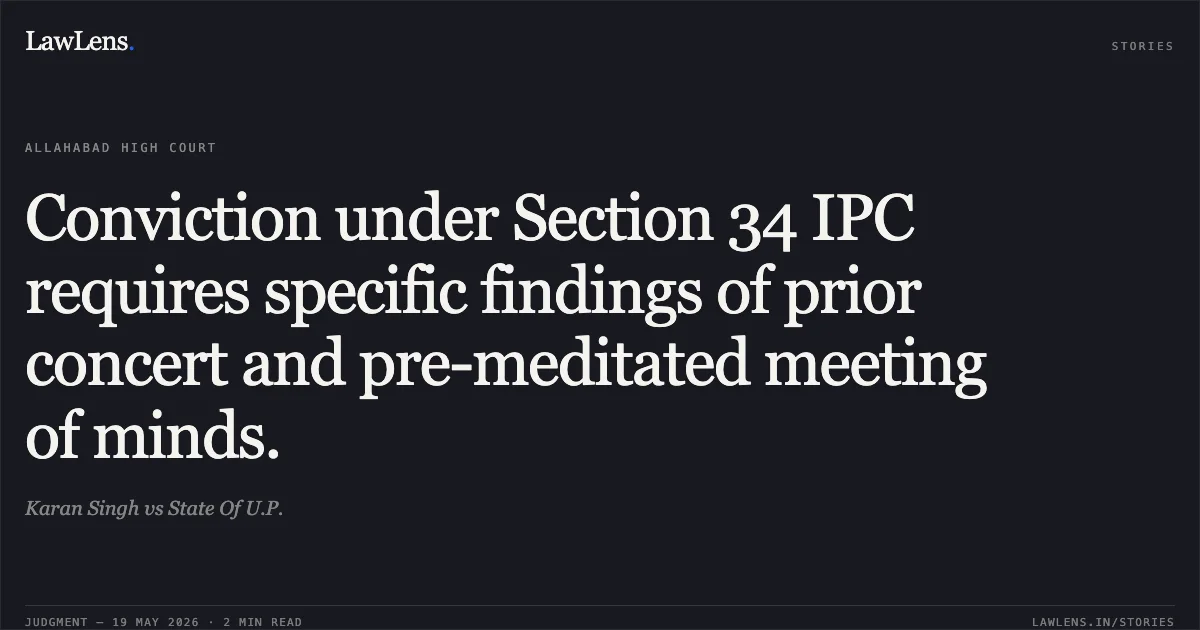
The court applied Section 34 of the Indian Penal Code (IPC), which requires a "common intention" implying a pre-arranged plan or prior concert.
Source reference: para. 31-32It relied on the landmark Constitutional Bench decision in Krishna Govind Patil v. State of Maharashtra (1963), which established that a criminal act must be done pursuant to a pre-arranged plan to invoke vicarious liability.
Source reference: para. 32Furthermore, it cited Constable 907 Surendra Singh v. State of Uttarakhand (2025) to reiterate that the prosecution must establish a prior meeting of minds and that the act was in furtherance of a shared intention.
Source reference: para. 33Reasoning
The court found that the prosecution failed to assign any active role or overt act to the appellant during the shooting; he was neither armed nor heard exhorting the main accused.
Source reference: para. 21, 24The court noted that being a "helper" or servant often leads to the general tendency of false implication alongside an employer.
Source reference: para. 26, 30Crucially, the medical testimony of Dr. A.K. Garg (PW-7) contradicted the eye-witness accounts: while witnesses claimed the appellant "dragged" the deceased down stairs, the post-mortem report showed no abrasions or contusions consistent with dragging.
Source reference: para. 28-29The court further observed that the Trial Court failed to record a specific finding regarding pre-meditation or a pre-arranged plan, which is a mandatory prerequisite for applying Section 34 IPC.
Source reference: para. 31, 34Consequently, the appellant's presence was deemed highly doubtful and suspicious.
Source reference: para. 35Holding
The court held that the appellant could not be convicted with the aid of Section 34 IPC in the absence of evidence proving a prior meeting of minds or a shared common intention.
The High Court allowed the appeal and set aside the judgment and order dated 09.06.1988. Karan Singh was acquitted of all charges under Sections 302/34, 307/34, and 449 of the IPC and discharged from his bail bonds.
Source reference: para. 36Acts & Sections Cited
8 provisions across 2 statutes referred to in this judgment. Each provision opens on LawLens.
Indian Penal Code, 18606
Code of Criminal Procedure, 19732
Original Court PDF
Karan SinghvsState Of U.P.
Click to open original judgment
Original judgment, available to read, download and summarize on LawLens.in