Facts
The appellant was convicted by the Trial Court under Section 376 of the Indian Penal Code (IPC) and sentenced to seven years of rigorous imprisonment
Source reference: para. 1The prosecution alleged that on 07.09.2011, the appellant forcibly took the prosecutrix—a mentally challenged woman with speech impairment—near a drain (nala) and committed sexual intercourse against her will
Source reference: para. 2The FIR was lodged by the prosecutrix's grandfather (PW-1)
Source reference: para. 2During the trial, the prosecutrix (PW-2) was unable to provide a clear statement due to her mental condition
Source reference: para. 9Most material witnesses, including the complainant and the prosecutrix's father, turned hostile
Source reference: paras. 10, 12The appellant challenged the conviction on grounds of lack of medical and forensic evidence and material contradictions in witness testimonies
Source reference: para. 5Issues
1. Whether the conviction under Section 376 of the IPC can be sustained in the absence of supportive testimony from the prosecutrix and key eye-witnesses
Source reference: paras. 9, 172. Whether the medical evidence and the absence of a Forensic Science Laboratory (FSL) report were sufficient to establish the guilt of the appellant beyond reasonable doubt
Source reference: paras. 15-17Law Applied
Section 376 of the IPC regarding the offense of rape
Source reference: para. 1The Court reinforced the fundamental principle of criminal jurisprudence that the prosecution must prove its case "beyond reasonable doubt"
Source reference: para. 17The Court evaluated the weight of medical evidence under the Indian Evidence Act, specifically focusing on the requirement of corroboration in cases involving victims with mental disabilities
Source reference: paras. 14, 16Section 437-A of the Cr.P.C. (corresponding to Section 481 of the Bharatiya Nagarik Suraksha Sanhita [BNSS]) regarding the requirement for an acquitted person to furnish a bond for future appearances
Source reference: para. 19Reasoning
The Court found that the Trial Court's conviction was based on a misappreciation of evidence.
Source reference: para. 9Firstly, the prosecutrix was unable to depose or provide gestures understood by the Court or her family, leading to a void in direct evidence
Source reference: para. 9Secondly, the medical testimony of Dr. Snehlata Singh (PW-10) categorically stated that no signs of forceful sexual intercourse or internal/external injuries were found, and specifically noted that no intercourse had occurred within 24 hours of the examination. This directly contradicted the prosecution’s timeline.
Source reference: paras. 14, 15Thirdly, the Court noted the total absence of an FSL or chemical examination report to link the appellant to the crime
Source reference: para. 16Finally, the Court observed that the primary witnesses (PW-1, PW-7, PW-8) turned hostile and the testimony of PW-9 regarding the appellant's apprehension contained material omissions not found in his police statement
Source reference: paras. 10, 13, 17Holding
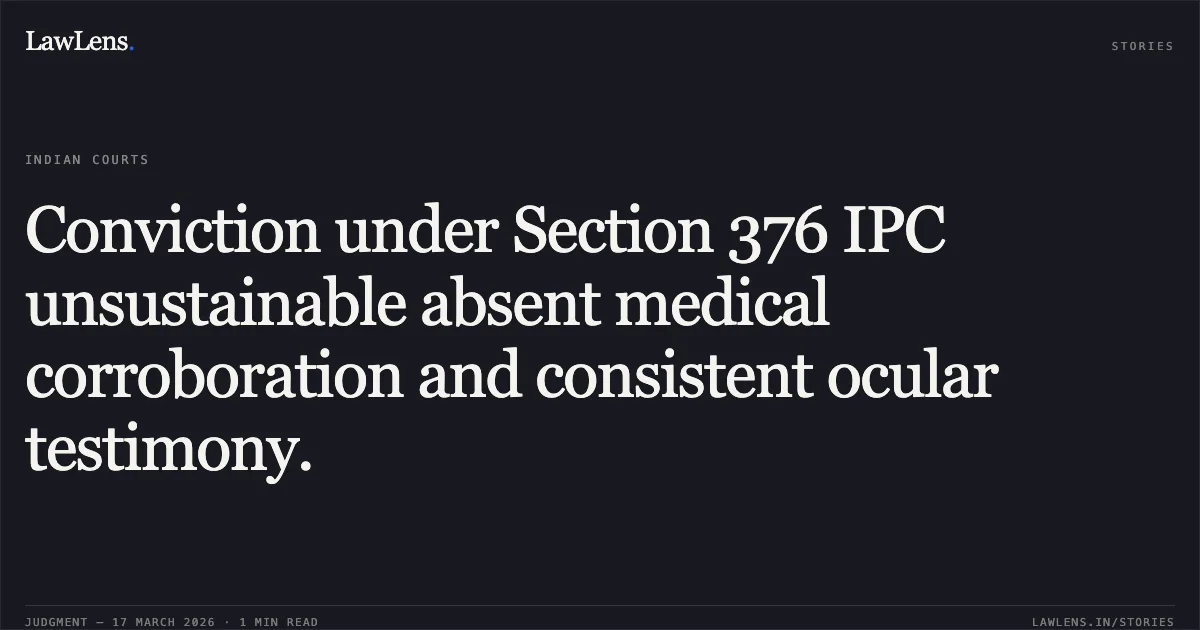
The High Court held that the prosecution failed to prove the charges beyond reasonable doubt due to the lack of legally admissible, cogent, and clinching evidence
The Court allowed the appeal, setting aside the judgment of conviction and the order of sentence. The appellant was acquitted of the charge under Section 376 IPC.
Source reference: para. 18Pursuant to Section 437-A Cr.P.C., the appellant was directed to furnish a personal bond of Rs. 25,000/- to remain effective for six months
Source reference: para. 19Acts & Sections Cited
5 provisions across 2 statutes referred to in this judgment. Each provision opens on LawLens.
Code of Criminal Procedure, 19733
Indian Penal Code, 18602
Original Court PDF
Mohan Das @ MohanvsState Of C.g.
Click to open original judgment
Original judgment, available to read, download and summarize on LawLens.in