Facts
On 2 August 1996, the appellants allegedly demanded money from Vijay Kumar Singh (PW-5) for purchasing liquor, assaulted him, attempted to drown him, and took his wristwatch and ₹50.
Source reference: paras. 2–7The complainant instituted a complaint on 9 August 1996, which was referred under Section 156(3) CrPC for registration of an FIR.
Source reference: paras. 2–7The police submitted a charge-sheet under Sections 341, 386, 307 and 34 IPC; charges were subsequently framed under Sections 341, 387 and 307/34 IPC.
Source reference: paras. 2–7The Trial Court acquitted the appellants of the Section 307 charge but convicted them under Sections 387 and 341 IPC, sentencing them to three years’ rigorous imprisonment and a fine under Section 387, and one month’s simple imprisonment under Section 341, with sentences to run concurrently.
Source reference: paras. 2–7In appeal, the appellants challenged the delay in instituting the complaint, the absence of medical evidence, inconsistencies regarding the place of occurrence, the credibility of witnesses, the non-examination of the Investigating Officer, and the failure to establish the ingredients of Sections 387 and 341 IPC.
Source reference: paras. 9–13Issues
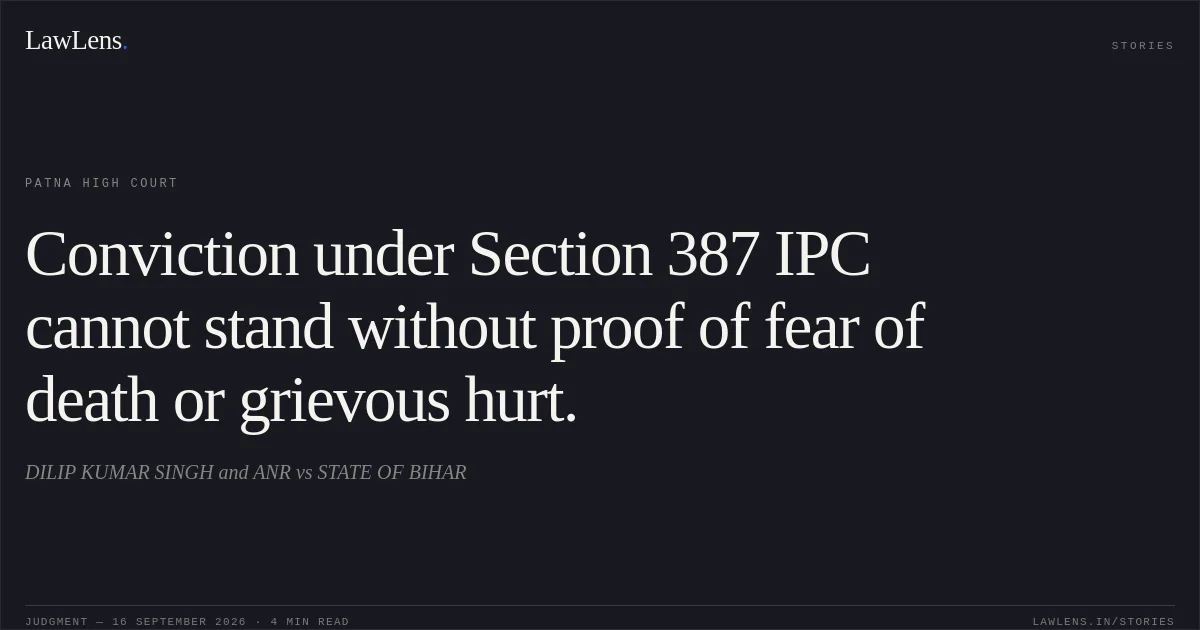
Whether the prosecution proved beyond reasonable doubt that the appellants committed extortion by putting the complainant in fear of death or grievous hurt, thereby attracting Section 387 IPC.
Source reference: paras. 11, 22Whether the prosecution established the offence of wrongful restraint under Section 341 IPC.
Source reference: para. 12Whether the delayed complaint, inconsistencies in the prosecution evidence, absence of medical and objective evidence, and non-examination of material witnesses and the Investigating Officer created a reasonable doubt entitling the appellants to acquittal.
Source reference: paras. 15–26Whether the Trial Court’s judgment was unsustainable for failing to provide adequate reasons linking the evidence to the statutory ingredients of the offences.
Source reference: para. 25Law Applied
The Court applied Section 387 IPC, which requires an attempt to put a person in fear of death or grievous hurt in order to commit extortion, and Section 341 IPC, which penalises wrongful restraint.
Source reference: paras. 11–12The prosecution bears the burden of proving guilt beyond reasonable doubt, and an accused is entitled to the benefit of reasonable doubt where the evidence is unreliable or materially deficient.
Source reference: paras. 26–27Delay in lodging an FIR or complaint is not automatically fatal, but unexplained and substantial delay assumes significance when accompanied by inconsistencies and circumstances suggesting deliberation or embellishment; the Court relied on Harilal v. State of Madhya Pradesh (Now Chhattisgarh), 2023 SCC OnLine SC 1124, and Nazibul Rahim Khan v. State of U.P., 2026 INSC 619.
Source reference: para. 23Non-examination of the Investigating Officer is not invariably fatal, but becomes significant where the prosecution evidence is doubtful and the officer’s testimony is necessary to establish the place of occurrence or clarify contradictions; the Court relied on Ravishwar Manjhi v. State of Jharkhand, (2008) 16 SCC 561, and Lahu Kamlakar Patil v. State of Maharashtra, (2013) 6 SCC 417.
Source reference: para. 24The Court also noted the appellants’ reliance on Priyanka Srivastava v. State of U.P., (2015) 6 SCC 287, concerning safeguards governing applications under Section 156(3) CrPC.
Source reference: para. 9Reasoning
The Court found the prosecution case materially doubtful. The complaint was filed seven days after the alleged occurrence without a satisfactory explanation, and the evidence disclosed inconsistencies concerning the place of occurrence and the manner of the incident.
Source reference: paras. 15, 19, 23PW-4, the complainant’s mother, was an interested witness whose account that the complainant remained unconscious for five days was inconsistent with the complainant’s own version and unsupported by other evidence.
Source reference: para. 16PW-2 appeared to be a chance witness, while PW-3’s testimony did not independently establish the alleged assault or the circumstances of the occurrence.
Source reference: paras. 17–18The prosecution produced no injury report, treatment records, or medical testimony, despite alleging that the complainant had been assaulted, rendered unconscious, and treated in hospital.
Source reference: paras. 21–22The non-examination of Lakho Singh, near whose house the occurrence allegedly took place, and the Investigating Officer further weakened the prosecution case and left the place of occurrence uncertain.
Source reference: paras. 20, 24, 26In these circumstances, the evidence did not establish that the appellants put the complainant in fear of death or grievous hurt, an essential ingredient of Section 387 IPC.
Source reference: para. 22The Trial Court also failed to analyse the statutory ingredients or provide adequate reasons for conviction.
Source reference: para. 25Holding
The High Court held that the prosecution failed to prove the charges under Sections 387 and 341 IPC beyond reasonable doubt.
The conviction and sentence imposed by the Additional Sessions Judge, Fast Track Court No. III, Katihar, on 26 March 2004 were set aside, and the appeal was allowed.
Source reference: paras. 27–29As the appellants were already on bail, they were directed to be discharged from their bail bonds, unless required in any other case.
Source reference: para. 28The Court also directed the Patna High Court Legal Services Committee to pay ₹6,500 to the Amicus Curiae as remuneration.
Source reference: para. 30Acts & Sections Cited
10 provisions across 2 statutes referred to in this judgment. Each provision opens on LawLens.
Indian Penal Code, 18607
Code of Criminal Procedure, 19733
Original Court PDF
DILIP KUMAR SINGH and ANRvsSTATE OF BIHAR
Click to open original judgment
Original judgment, available to read, download and summarize on LawLens.in