Facts
The petitioner, Kalim Ali, and respondent no. 3/complainant were son and mother, respectively.
Source reference: para. 4–6Respondent no. 3 had agreed to sell her land to a third party, and ₹10,50,000 received as sale consideration on her behalf came into the petitioner’s possession but was not initially paid to her.
Source reference: para. 4–6This led to registration of Case Crime/F.I.R. No. 290 of 2026 at Police Station Bazpur, District Udham Singh Nagar, under Sections 115(2) and 318(4) of the Bharatiya Nyaya Sanhita, 2023.
Source reference: para. 4–6During the proceedings, the parties entered into an amicable settlement, and the petitioner paid the entire amount of ₹10,50,000 to respondent no. 3.
Source reference: para. 6The parties filed a compounding application and affidavits stating that the settlement was voluntary and that no dispute or claim remained between them.
Source reference: para. 7Although the State opposed the application, respondent no. 3 consented to quashing of the FIR and consequential proceedings.
Source reference: para. 8–9Issues
Whether the High Court could exercise its jurisdiction under Article 226 of the Constitution to quash the FIR and consequential criminal proceedings for non-compoundable offences on the basis of a voluntary settlement between the parties?
Source reference: para. 4, 12–13Whether, in view of the repayment of the disputed amount and the complainant’s lack of objection, continuation of the criminal proceedings would constitute an abuse of the process of law?
Source reference: para. 11–13Law Applied
The Court exercised its constitutional jurisdiction under Article 226 to consider quashing of the FIR and consequential proceedings.
Source reference: no citationThe FIR alleged offences under Sections 115(2) and 318(4) of the Bharatiya Nyaya Sanhita, 2023.
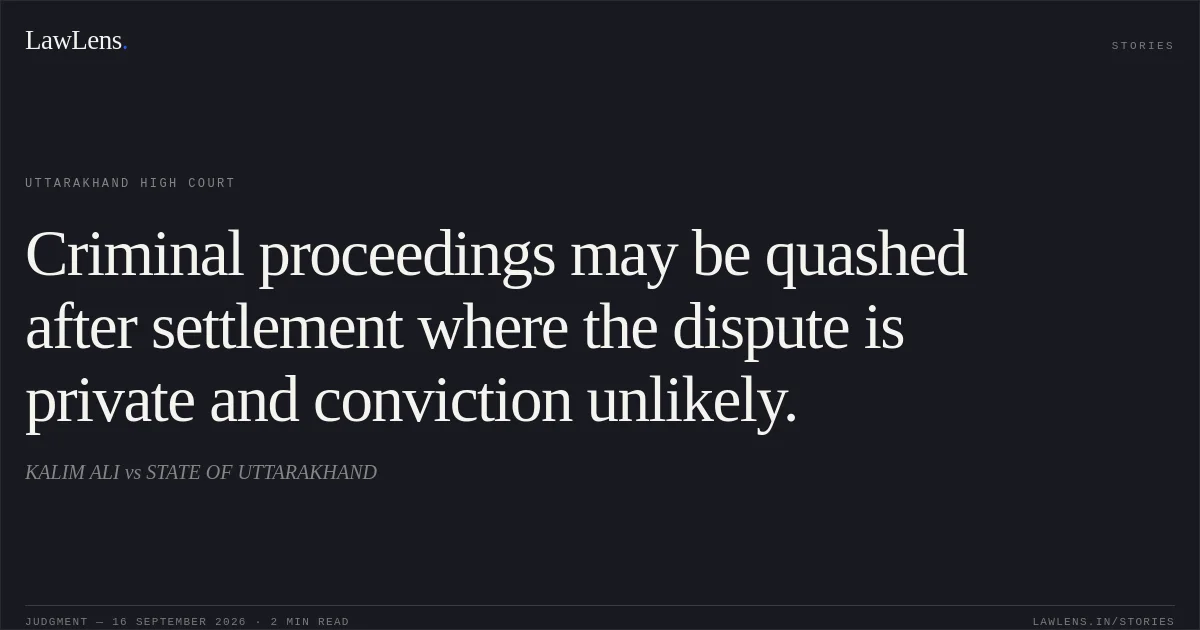
Source reference: para. 4Relying on Gian Singh v. State of Punjab, (2012) 10 SCC 303, and Narinder Singh v. State of Punjab, (2014) 6 SCC 466, the Court applied the principle that criminal proceedings may be quashed on the basis of a settlement where the dispute is essentially private or personal, the possibility of conviction is remote and bleak, and continuation of the proceedings would amount to abuse of the process of law or cause unnecessary oppression and prejudice.
Source reference: para. 12Reasoning
The Court found that the dispute arose from a private financial transaction between a mother and her son and that the entire disputed amount had been repaid to the complainant.
Source reference: para. 11, 13Respondent no. 3 expressly confirmed receipt of the money and stated that she had no objection to quashing the FIR.
Source reference: para. 9The affidavits and compounding application also demonstrated that the settlement was voluntary and free from coercion, undue influence, or inducement.
Source reference: para. 7Applying the principles in Gian Singh and Narinder Singh, the Court held that the possibility of conviction was remote and bleak and that continuing the prosecution would serve no meaningful purpose, resulting instead in harassment and prejudice to the petitioner.
Source reference: para. 12–13Holding
The Court answered the issues in favour of the petitioner.
It allowed the writ petition and quashed F.I.R./Case Crime No. 290 of 2026, registered at Police Station Bazpur, District Udham Singh Nagar, under Sections 115(2) and 318(4) of the Bharatiya Nyaya Sanhita, along with all consequential proceedings arising from it.
Source reference: para. 14The compounding application was consequently disposed of.
Source reference: para. 15Acts & Sections Cited
2 provisions across 1 statute referred to in this judgment. Each provision opens on LawLens.
Bharatiya Nyaya Sanhita, 20232
Original Court PDF
KALIM ALIvsSTATE OF UTTARAKHAND
Click to open original judgment
Original judgment, available to read, download and summarize on LawLens.in