Facts
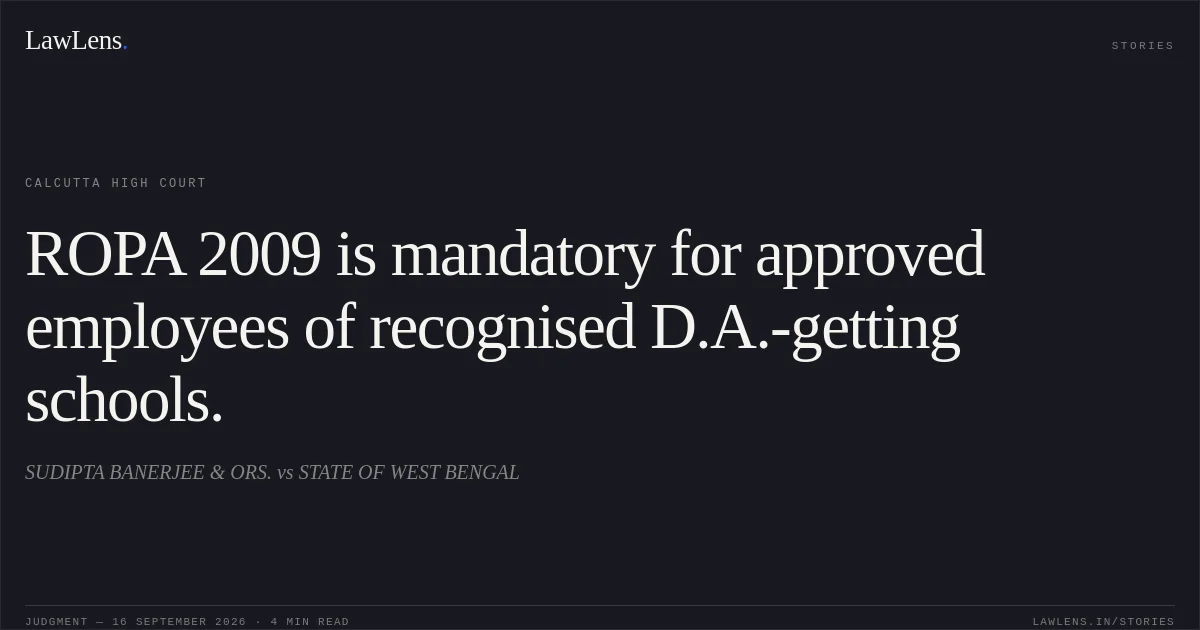
The petitioners were approved teaching and non-teaching employees of a recognised, D.A.-getting school and had superannuated between 2014 and 2016.
Source reference: paras. 1, 5–6The school had implemented ROPA 1996 but declined to implement ROPA 2009 for the petitioners, allegedly on the basis that the Government memorandum dated 21 May 2009 permitted D.A.-getting schools to choose whether to implement ROPA 2009.
Source reference: paras. 1, 5–6The petitioners relied principally on Government Order No. 641-SE(LAW)/5S-577/2001 dated 29 May 2002, issued pursuant to an earlier order of the High Court.
Source reference: para. 4The school contested maintainability under Article 226, contending that it was a privately managed institution and not “State” under Article 12.
Source reference: paras. 11–16Issues
Whether a writ petition under Article 226 was maintainable against the privately managed but recognised and D.A.-getting school for enforcement of obligations arising from the Government’s regulatory framework?
Source reference: paras. 11, 24, 28Whether Government Order No. 641-SE(LAW)/5S-577/2001 dated 29 May 2002 created a continuing obligation upon recognised D.A.-getting schools to pay approved employees according to successive pay revisions applicable to comparable employees of Government-aided schools?
Source reference: paras. 17–19Whether the Memorandum dated 21 May 2009 superseded or diluted the obligation under the 2002 Government Order, or gave schools an option to decline implementation of ROPA 2009?
Source reference: paras. 20–22, 26, 29Whether the school’s minority character and alleged financial inability justified refusal to implement ROPA 2009 for the approved employees?
Source reference: paras. 22–23, 25, 27–29Law Applied
Article 226 permits issuance of a writ against a person or body performing a public duty, including a private educational institution where the claim arises from a public-law obligation rather than a purely private contract.
Source reference: paras. 24, 28Under Government Order dated 29 May 2002, recognised D.A.-getting schools receiving the D.A. component from the State were required to pay their approved teaching and non-teaching employees at the rates prescribed for comparable employees of Government-aided schools; the reference to rates announced “from time to time” created a continuing obligation extending to future pay revisions.
Source reference: paras. 4, 17–18The Memorandum dated 21 May 2009, which primarily regulated the rate of Government-funded D.A., did not expressly repeal or supersede the 2002 Order and could not be read as conferring an option to avoid ROPA 2009.
Source reference: paras. 20, 26, 29The Court relied on Shree Sushil Kumar Pandey v. State of West Bengal, the decision in MAT No. 1320 of 2010, Rita Mukherjee v. State of West Bengal, W.P. No. 322 of 2013, and the principle in Frank Anthony Public School Employees’ Association that reasonable regulations securing teachers’ service conditions may apply even to minority institutions receiving State support.
Source reference: paras. 21–23The principles in St. Mary’s Education Society v. Rajendra Prasad Bhargava were distinguished because the present claim concerned enforcement of a public regulatory obligation, not a purely contractual service right.
Source reference: para. 24Reasoning
The Court held that the school’s recognised and D.A.-getting status, the petitioners’ approved appointments, and the State’s payment of the D.A. component brought the dispute within a specific public regulatory framework.
Source reference: paras. 17, 24, 28The 2002 Government Order was not confined to ROPA 1996; its requirement to pay at rates prescribed for comparable Government-aided employees “from time to time” necessarily covered ROPA 2009.
Source reference: paras. 17–19The 2009 Memorandum dealt with the Government’s D.A. contribution and did not expressly repeal the substantive obligation imposed on the school by the 2002 Order.
Source reference: paras. 20, 26Since both instruments could operate in separate fields, no implied repeal or supersession could be inferred.
Source reference: paras. 20, 26The Court followed the earlier decisions holding that the 2009 Memorandum did not confer a discretion upon D.A.-getting schools to retain ROPA 1996 indefinitely.
Source reference: paras. 21–22The school’s minority status did not create immunity from reasonable regulations concerning the emoluments and welfare of approved employees, particularly where the institution received State financial support.
Source reference: paras. 22–23, 28Similarly, financial hardship could explain the school’s reluctance but could not extinguish a binding regulatory obligation or make the petitioners’ entitlement dependent upon the management’s financial convenience.
Source reference: paras. 25, 27The claim therefore involved a public-law duty enforceable under Article 226.
Source reference: para. 24Holding
The writ petition was allowed.
The Court held that the petitioners were entitled to fixation of pay under ROPA 2009 from the date on which the revised scale became applicable to comparable employees of Government-aided schools and up to their respective dates of superannuation.
Source reference: para. 30The school and concerned authorities were directed to complete pay fixation within four weeks, disburse salary arrears within three months, revise the petitioners’ pension and Pension Payment Orders within four weeks, and pay any resulting pension arrears within three months from communication of the judgment.
Source reference: para. 31The writ petition and pending applications were accordingly disposed of.
Source reference: para. 32Original Court PDF
SUDIPTA BANERJEE & ORS.vsSTATE OF WEST BENGAL
Click to open original judgment
Original judgment, available to read, download and summarize on LawLens.in