Facts
The parties married on 25 October 2015 and had a daughter born on 26 August 2016.
Source reference: p.2, paras. 1–2They began living separately on 11 November 2020.
Source reference: p.2, paras. 1–2The respondent-wife filed a divorce petition under Section 13(1)(ia) of the Hindu Marriage Act, 1955 (“HMA”), together with an application under Section 24 HMA for pendente lite maintenance.
Source reference: p.2, paras. 1–2The Family Court assessed the husband’s monthly income at ₹22,000 and directed him to pay the wife ₹5,000 per month from 8 January 2021, the date of filing of the maintenance application, until disposal of the divorce petition.
Source reference: pp.1–2, para. 1; p.9, para. 14The husband challenged both the assessment of his income and the award of maintenance from the date of filing.
Source reference: pp.2–4, paras. 3–7He contended that he earned only ₹16,500 per month at his father’s photostat shop and that the wife was employed at a Bata showroom, earning ₹7,000 per month, until June 2024.
Source reference: pp.2–4, paras. 3–7The wife did not appear or file a reply before the High Court.
Source reference: p.4, para. 8Issues
1. Whether the Family Court correctly assessed the husband’s monthly income at ₹22,000 for the purpose of determining maintenance under Section 24 HMA, notwithstanding his asserted income of ₹16,500 and his employment in Haryana rather than Delhi.
Source reference: pp.8–9, paras. 16–182. Whether the wife was entitled to pendente lite maintenance from 8 January 2021 despite her admitted employment and income from March 2020 to June 2024.
Source reference: pp.10–11, paras. 22–243. Whether the quantum of ₹5,000 per month awarded by the Family Court required appellate interference.
Source reference: p.9, para. 14; p.11, para. 25Law Applied
Section 24 HMA empowers the court to award maintenance pendente lite to a spouse having no sufficient independent income for support and litigation expenses.
Source reference: pp.7–9, paras. 12–13, 16Proceedings under Section 24 are summary, and the court may make a prima facie assessment of the parties’ income, earning capacity, liabilities, qualifications and standard of living; mathematical precision is not required.
Source reference: pp.7–9, paras. 12–13, 16In Jasbir Kaur Sehgal v. District Judge, Dehradun, (1997) 7 SCC 7, the Supreme Court held that, where parties suppress or inflate their income, the court may resort to reasonable guesswork, though the assessment cannot be mathematically exact.
Source reference: pp.4–6, para. 11Rajnesh v. Neha, (2021) 2 SCC 324, requires consideration of factors including the parties’ status, the claimant’s independent income and property, the respondent’s liabilities, reasonable needs, standard of living, payment capacity and the possibility of reasonable estimation where income is not fully disclosed.
Source reference: pp.6–8, para. 12Relying on Bharat Hegde v. Saroj Hegde, 2007 SCC OnLine Del 622, the Court reiterated that truthful income may not emerge, particularly in cases involving self-employment or the unorganised sector, and that the court must take a general view.
Source reference: p.10, para. 20The appeal was maintainable under Section 19(1) of the Family Courts Act, 1984 read with Section 28 HMA.
Source reference: p.1, para. 1Reasoning
The High Court upheld the Family Court’s prima facie assessment of the husband’s income at ₹22,000 per month.
Source reference: no citationAlthough the husband relied on a salary certificate issued by his father showing earnings of ₹16,500, the certificate was unsupported by independent documentary evidence and was therefore not conclusive.
Source reference: p.9, para. 18The Court also rejected the objection to reliance on Delhi minimum-wage rates, noting that the minimum wages in Haryana were broadly similar and that the husband had produced no credible evidence demonstrating a lower earning capacity.
Source reference: p.9, para. 17Applying the principles permitting reasonable estimation of income, the Court found no basis to interfere with the quantum of ₹5,000 per month.
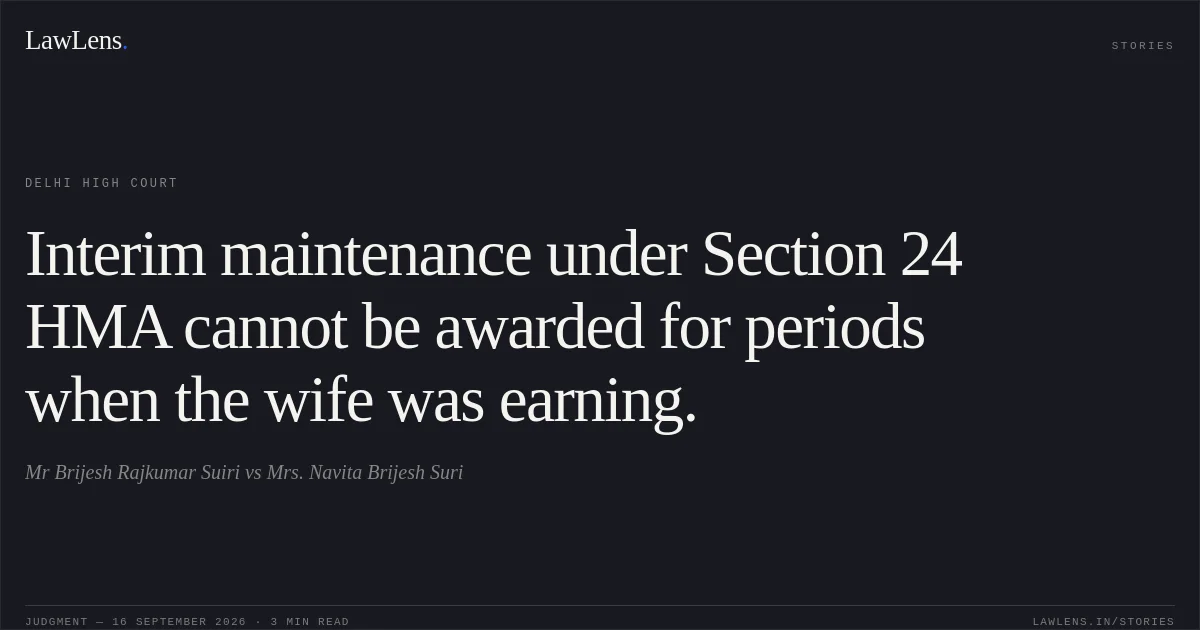
Source reference: pp.9–10, paras. 18–21However, the wife’s own pleadings established that she was financially independent and employed as a sales helper at a Bata showroom from March 2020 until June 2024, earning ₹7,000 per month.
Source reference: p.11, para. 23Consequently, she could not claim maintenance under Section 24 for the period during which she had that income.
Source reference: pp.10–11, paras. 22–24Since she became unemployed in June 2024, her entitlement commenced from 1 July 2024.
Source reference: pp.10–11, paras. 22–24Holding
The appeal was partly allowed.
The High Court affirmed the assessment of the husband’s income at ₹22,000 per month and upheld the maintenance amount of ₹5,000 per month.
Source reference: pp.11–12, paras. 24–26However, it set aside the direction granting maintenance from 8 January 2021 and directed that the wife would receive ₹5,000 per month only with effect from 1 July 2024, when she became unemployed.
Source reference: pp.11–12, paras. 24–26The remaining terms of the Family Court’s order were continued, and the appeal and pending applications were disposed of accordingly.
Source reference: pp.11–12, paras. 24–26Acts & Sections Cited
7 provisions across 5 statutes referred to in this judgment. Each provision opens on LawLens.
Family Courts Act, 19841
Hindu Marriage Act, 19553
Guardians and Wards Act, 18901
Protection of Women from Domestic Violence Act, 20051
Code of Criminal Procedure, 19731
Original Court PDF
Mr Brijesh Rajkumar SuirivsMrs. Navita Brijesh Suri
Click to open original judgment
Original judgment, available to read, download and summarize on LawLens.in