Facts
The Respondent, a flat purchaser, filed a complaint before the Real Estate Regulatory Authority seeking execution of the sale deed, transfer of ownership and possession, and compensation for delayed execution and delivery of possession under the sale agreement dated 26 May 2015.
Source reference: p.9The Regulatory Authority partly allowed the complaint and directed the Appellants-developers to execute the sale deed; it left the claim for compensation to be pursued before the Adjudicating Officer.
Source reference: p.10The Adjudicating Officer subsequently rejected the compensation claim, holding that the delay was attributable to the complainant and not the developers.
Source reference: p.10The Respondent appealed to the Odisha Real Estate Appellate Tribunal. Although the Tribunal dismissed the appeal, it held that the finding attributing delay to the complainant was erroneous and granted liberty to the Respondent to approach the Regulatory Authority for interest under the proviso to Section 18(1)(b) of the Real Estate (Regulation and Development) Act, 2016 (“RERA”).
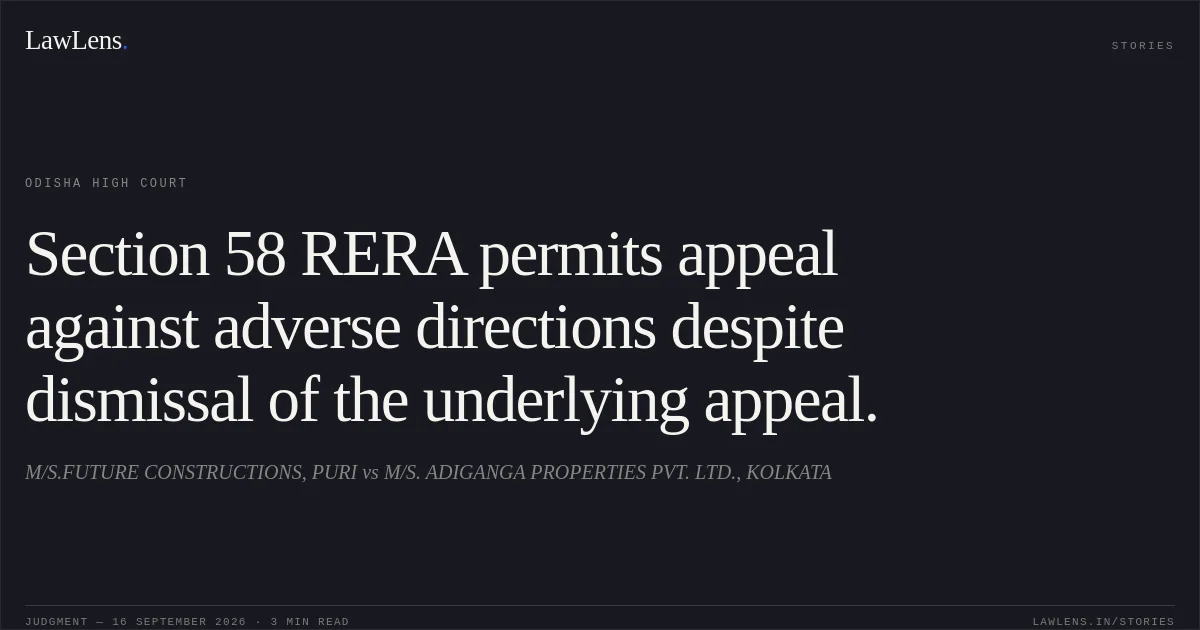
Source reference: pp.10–12The Appellants challenged that direction before the High Court under Section 58 of RERA. The Respondent raised a preliminary objection that the appeal was not maintainable because the Tribunal had dismissed the appeal in the Appellants’ favour.
Source reference: pp.2–3Issues
Whether an appeal under Section 58 of RERA is maintainable at the instance of the Appellants when the Real Estate Appellate Tribunal formally dismissed the Respondent’s appeal?
Source reference: pp.2–3, 15Whether the Tribunal’s finding that the developers were responsible for the delay, coupled with liberty to the Respondent to seek interest before the Regulatory Authority, constituted an appealable “decision or order” affecting the Appellants’ interests under Section 58 of RERA?
Source reference: pp.10–15Law Applied
The Court applied Section 58 of RERA, under which “any person aggrieved” by a decision or order of the Real Estate Appellate Tribunal may appeal to the High Court on a question of law.
Source reference: pp.13–15It relied on Ganga Bai v. Vijay Kumar, (1974) 2 SCC 393, for the principle that a right of appeal is a creature of statute and ordinarily lies against a decree or an appealable order, not against a mere finding.
Source reference: pp.3–5It further relied on State of Andhra Pradesh v. B. Ranga Reddy, (2020) 1 SCC 681, which distinguishes an appealable decree from findings recorded in support of that decree, and Banarsi v. Ram Phal, (2003) 9 SCC 606, regarding the limits on appellate modification in the absence of an appeal or cross-objection and the circumstances in which appellate directions may affect a party’s rights.
Source reference: pp.5–8The Court also referred to the meanings of “decision” and “order” under the Code of Civil Procedure, legal lexicons, and Black’s Law Dictionary, treating an order as a formal decision, direction or command capable of affecting legal interests.
Source reference: pp.13–14Reasoning
The Court distinguished between a mere adverse finding and a direction having operative legal consequences.
Source reference: no citationAlthough the Tribunal dismissed the Respondent’s appeal, it expressly held that the Adjudicating Officer’s finding attributing the delay to the complainant was erroneous.
Source reference: pp.10–12It then permitted the Respondent to reopen the claim by approaching the Regulatory Authority for interest under Section 18(1)(b) of RERA.
Source reference: p.12This direction potentially exposed the Appellants to a fresh claim that had previously been rejected by the Adjudicating Officer and therefore affected their substantive interests.
Source reference: p.15In the Court’s view, the Tribunal’s direction, read together with its finding on responsibility for the delay, was not merely an incidental observation or finding; it assumed the character of a “decision” or “order” under Section 58.
Source reference: pp.13–15Holding
The High Court rejected the Respondent’s preliminary objection and held that the appeal under Section 58 of RERA was maintainable.
The Tribunal’s finding that the Appellants were responsible for the delay and its direction granting the Respondent liberty to seek interest before the Regulatory Authority constituted an appealable decision or order affecting the Appellants’ interests.
Source reference: p.15The Court did not decide the merits of the appeal at this stage and directed that the matter be listed for hearing on the question of admission on 29 September 2026.
Source reference: p.16Acts & Sections Cited
10 provisions across 3 statutes referred to in this judgment. Each provision opens on LawLens.
Real Estate (Regulation and Development) Act, 2016.3
Code of Civil Procedure, 19086
Administrative Tribunals Act, 19851
Original Court PDF
M/S.FUTURE CONSTRUCTIONS, PURIvsM/S. ADIGANGA PROPERTIES PVT. LTD., KOLKATA
Click to open original judgment
Original judgment, available to read, download and summarize on LawLens.in