Facts
On February 18, 2012, unknown individuals stole cash, a wrist watch, and three mobile phones from the houses of the informant (P.W.1) and his neighbour (P.W.2).
Source reference: para. 4During the investigation of Simdega P.S. Case No. 24 of 2012, the Investigating Officer (P.W.5) received a tip-off that the petitioner was attempting to sell mobile phones. A raid on the petitioner's house led to the recovery of the stolen articles.
Source reference: para. 5, 12The Trial Court convicted the petitioner under Section 411 of the IPC, sentencing him to two years of Rigorous Imprisonment (R.I.).
Source reference: para. 3This conviction and sentence were upheld by the Additional Sessions Judge, Simdega, in Cr. Appeal No. 38 of 2015.
Source reference: para. 3The petitioner moved the High Court in revision, primarily pleading for a reduction in sentence.
Source reference: para. 9Issues
1. Whether the conviction of the petitioner under Section 411 of the IPC for dishonestly receiving stolen property is sustainable based on the evidence of recovery.
Source reference: para. 12-132. Whether the sentence of two years R.I. should be reduced considering the nature of the offence, the passage of time, and the period of incarceration already undergone.
Source reference: para. 9, 13Law Applied
The Court applied Section 411 of the Indian Penal Code (IPC), which penalizes the dishonest reception or retention of stolen property with knowledge or reason to believe it to be stolen.
Source reference: para. 3The Court also considered the principles of proportionality in sentencing, weighing the trivial nature of the stolen articles (mobile phones and a watch), the petitioner's clean antecedents (first offence), and the long duration of the litigation (approx. 14 years) against the need for incarceration.
Source reference: para. 9, 13Reasoning
The Court found that the prosecution successfully proved the recovery of stolen items—a Samsung mobile and a Titan watch—from the petitioner’s possession through the testimony of the I.O. (P.W.5) and the identification of material exhibits by the victim (P.W.1).
Source reference: para. 12Although no Test Identification (T.I.) Parade was conducted for the articles, the Court held that the concurrent findings of the lower courts regarding the recovery were sound, thus upholding the conviction.
Source reference: para. 13Regarding the sentence, the Court noted that the petitioner had already spent 3 months and 7 days in custody. It reasoned that since the occurrence took place in 2012, the stolen items were restored to the victims, and the petitioner had integrated back into society, sending him back to jail after 1.5 decades for a "trivial matter" would be disproportionate and would not serve the ends of justice.
Source reference: para. 9, 13Holding
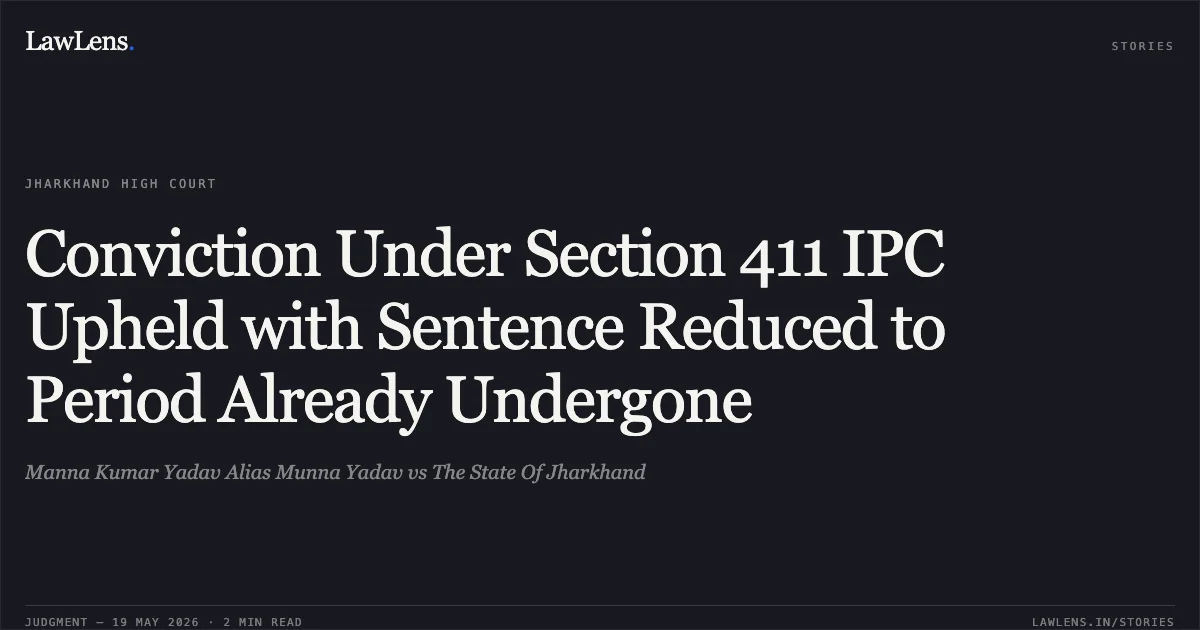
The High Court dismissed the revision on merits but modified the sentence. It upheld the conviction under Section 411 IPC.
However, the sentence of two years R.I. was reduced to the period of imprisonment already undergone (3 months and 7 days). The petitioner was discharged from his bail bonds and sureties.
Source reference: para. 13, 15Acts & Sections Cited
2 provisions across 1 statute referred to in this judgment. Each provision opens on LawLens.
Indian Penal Code, 18602
Original Court PDF
Manna Kumar Yadav Alias Munna YadavvsThe State Of Jharkhand
Click to open original judgment
Original judgment, available to read, download and summarize on LawLens.in