Facts
The Appellant and his wife were tenants in the house of the prosecutrix.
Source reference: p. 2The prosecution alleged that in November 2006, the Appellant’s wife drugged the prosecutrix, enabling the Appellant to rape her.
Source reference: p. 2It was further alleged that the Appellant continued the sexual relationship through extortion and threats involving nude videos.
Source reference: p. 2Conversely, the Appellant’s version was that the prosecutrix invited him to impregnate her because her husband was infertile—an arrangement likened by the Court to the ancient ‘Niyog Pratha’—and that the dispute arose over financial demands.
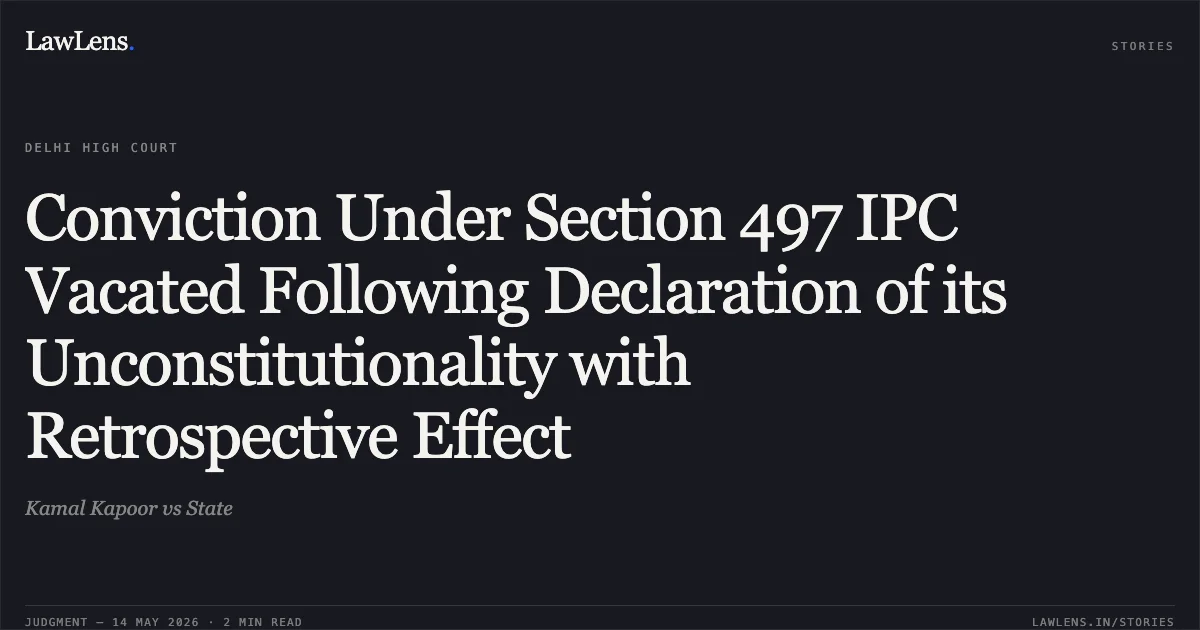
Source reference: p. 1-2The trial court acquitted both the Appellant and his wife of rape (Section 376 IPC) and extortion (Section 384 IPC), but convicted the Appellant under Section 497 IPC (Adultery), sentencing him to three years of rigorous imprisonment.
Source reference: p. 3The Appellant challenged this conviction on the ground that the provision has been struck down by the Supreme Court.
Source reference: p. 3Issues
1. Whether a conviction under Section 497 of the IPC can be sustained following its declaration as unconstitutional by the Supreme Court.
Source reference: p. 3, para 72. Whether the Supreme Court's declaration regarding the unconstitutionality of Section 497 IPC has a retrospective effect on pending appeals.
Source reference: p. 3, para 7 & 13Law Applied
The court primarily applied the precedent set in Joseph Shine v. Union of India (2019) 3 SCC 39, which declared Section 497 IPC unconstitutional for violating Articles 14, 15, and 21 of the Constitution of India.
Source reference: p. 3, para 10It further relied on Ashok Kumar Singh v. State (2025) SCC OnLine Del 2456 to establish that this declaration of unconstitutionality has retrospective effect.
Source reference: p. 3, para 7Additionally, the court noted that under Article 141 of the Constitution of India, the law laid down by the Supreme Court is binding on all courts in India.
Source reference: p. 4, para 11Reasoning
The Court observed that the trial court had acquitted the Appellant of the primary charges of rape and extortion but had convicted him for adultery under Section 497 IPC.
Source reference: p. 3However, the legal landscape shifted during the pendency of the matter due to the Supreme Court's ruling in Joseph Shine, which struck down the offence of adultery as ultra vires to the Constitution.
Source reference: p. 3-4The Court reasoned that since Section 497 IPC is no longer part of the statute, it cannot serve as a valid basis to punish any individual.
Source reference: p. 3Furthermore, citing Ashok Kumar Singh, the Court clarified that the invalidation of the section applies retrospectively, thereby encompassing the present appeal and rendering the lower court’s conviction legally unsustainable.
Source reference: p. 3-4Holding
The Court answered the issues in the negative, holding that the conviction under Section 497 IPC cannot be sustained.
The High Court allowed the appeal, set aside the impugned judgment of conviction, and acquitted the Appellant.
Source reference: p. 4, para 13The Appellant’s bail bonds were discharged, and the appeal was disposed of accordingly.
Source reference: p. 4, para 14Acts & Sections Cited
7 provisions across 1 statute referred to in this judgment. Each provision opens on LawLens.
Indian Penal Code, 18607
Original Court PDF
Kamal KapoorvsState
Click to open original judgment
Original judgment, available to read, download and summarize on LawLens.in