Facts
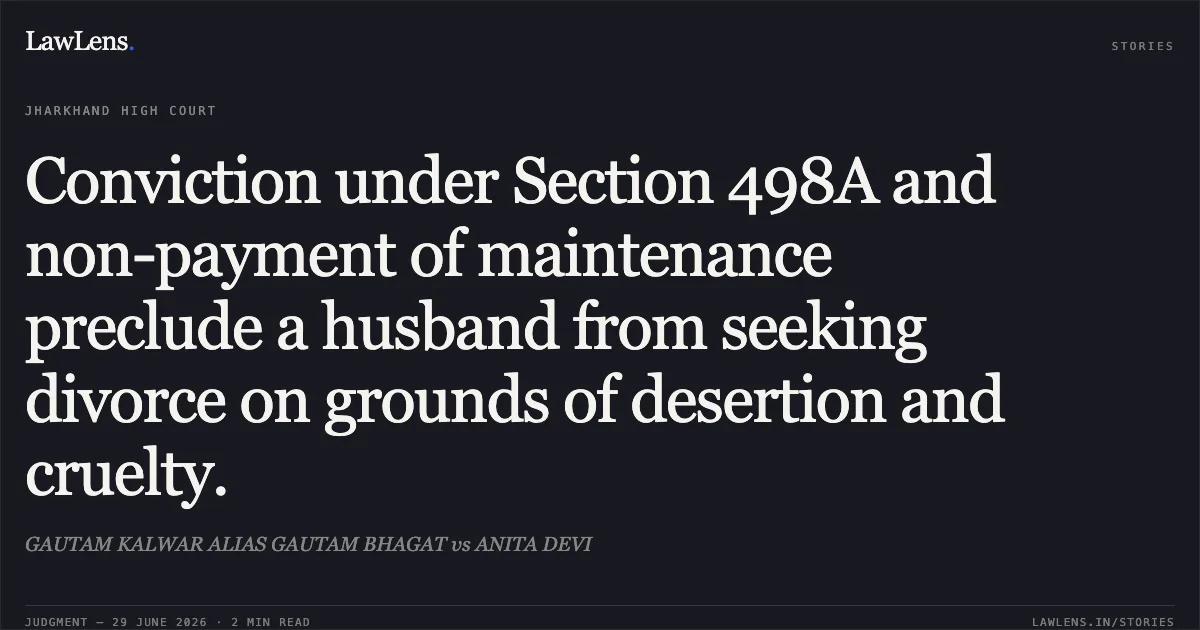
The parties married on May 1, 2001, and have one daughter
Source reference: p. 1-2The appellant-husband filed for divorce in 2019 under Section 13(1)(i-a) and (i-b) of the Hindu Marriage Act, 1955, alleging the respondent-wife deserted him on May 30, 2005, and subjected him to cruelty through criminal litigation and physical assault during a reconciliation attempt in 2017
Source reference: p. 2-3The wife contested, alleging she was ousted due to unmet dowry demands; she successfully prosecuted the husband and his family under Section 498A IPC, leading to their conviction (currently under revision)
Source reference: p. 7She further alleged the husband committed bigamy and defaulted on maintenance payments
Source reference: p. 8The Additional Family Court, Rajmahal, dismissed the suit on July 19, 2022, finding no evidence of cruelty or desertion
Source reference: p. 1, 9Issues
1. Whether the findings of the lower court were "perverse" regarding the evidence on record
Source reference: p. 282. Whether the respondent-wife subjected the appellant to mental or physical cruelty justifying a decree of divorce
Source reference: p. 333. Whether the respondent-wife deserted the appellant without reasonable cause for a continuous period of at least two years
Source reference: p. 40Law Applied
Section 13(1)(i-a) (cruelty) and 13(1)(i-b) (desertion) of the Hindu Marriage Act, 1955
Source reference: p. 36-37The court relied on Arulvelu v. State, defining "perverse" findings as those unsupported by evidence or against the law
Source reference: p. 29Regarding cruelty, it applied Dr. N.G. Dastane v. Mrs. S. Dastane (reasonable apprehension of harm) and Joydeep Majumdar v. Bharti Jaiswal Majumdar (conduct must be grave and weighty, not ordinary wear and tear)
Source reference: p. 31-33For desertion, it followed Lachman Utamchand Kirpalani v. Meena and Debananda Tamuli v. Kakumoni Kataky, requiring the proof of both factum deserdendi (separation) and animus deserendi (intention to end cohabitation) without reasonable cause
Source reference: p. 39-40Reasoning
The High Court found the husband’s allegations of cruelty vague and lacking specific dates or descriptions of the alleged harassment
Source reference: p. 35The court noted that the wife’s initiation of criminal proceedings under Section 498A IPC did not constitute cruelty as the husband had been convicted by the trial court, indicating a prima facie valid cause for litigation
Source reference: p. 19, 27Regarding desertion, the court observed that the separation in 2005 was not voluntary on the wife’s part but a result of being ousted for dowry, providing her with a "reasonable cause" to live separately
Source reference: p. 34, 40Furthermore, the wife expressed a continuous willingness to return provided her safety was guaranteed, negating the required animus deserendi
Source reference: p. 40The court held that the appellant failed to prove perversity in the lower court's judgment as his own testimony revealed he never sought the wife's return and refused to maintain her
Source reference: p. 19-20Holding
The appellant failed to prove the statutory grounds for divorce
The court specifically answered that the respondent did not desert the appellant without cause (the cause being dowry harassment) and that the husband failed to produce cogent evidence of cruelty
Source reference: p. 35, 40The High Court dismissed the appeal and upheld the Family Court's judgment; the decree of divorce was denied
Source reference: p. 41Acts & Sections Cited
14 provisions across 4 statutes referred to in this judgment. Each provision opens on LawLens.
Hindu Marriage Act, 19551
Indian Penal Code, 1860
Code of Criminal Procedure, 19731
Original Court PDF
GAUTAM KALWAR ALIAS GAUTAM BHAGATvsANITA DEVI
Click to open original judgment
Original judgment, available to read, download and summarize on LawLens.in