Facts
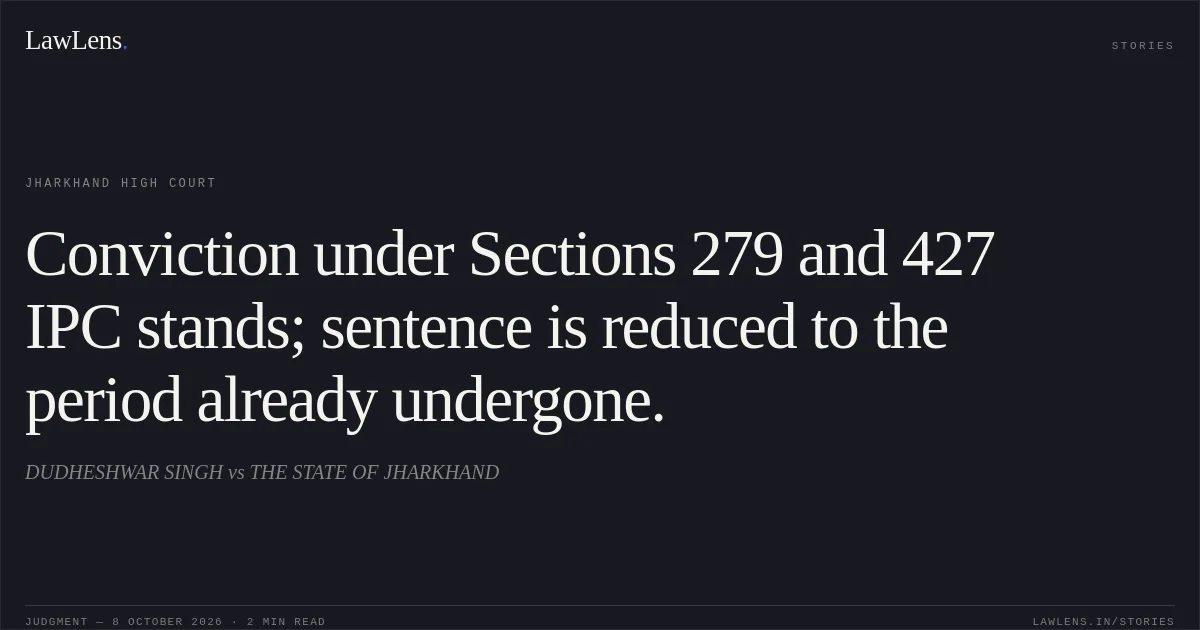
The petitioner was convicted by the Chief Judicial Magistrate, West Singhbhum at Chaibasa, under Sections 279 and 427 of the Indian Penal Code (IPC), and sentenced to three months’ simple imprisonment and one year’s rigorous imprisonment, respectively, to run concurrently.
Source reference: pp. 1–4, paras. 1–8The Sessions Judge affirmed the conviction and sentence on appeal.
Source reference: pp. 1–4, paras. 1–8The petitioner sought revision after a delay of 978 days, which he attributed to being away in Nagpur for work and not receiving proper communication.
Source reference: pp. 1–4, paras. 1–8He did not press the revision on the merits of conviction and confined his challenge to the sentence, citing, among other matters, his role as sole breadwinner, the length of the criminal proceedings, and the period of custody already undergone.
Source reference: pp. 1–4, paras. 1–8The State did not seriously oppose condonation of delay.
Source reference: p. 1, para. 3Issues
Whether the delay of 978 days in filing the criminal revision should be condoned
Source reference: p. 1, paras. 1–4Whether, while maintaining the concurrent findings of conviction, the sentences should be reduced to the period already undergone in light of the circumstances advanced by the petitioner
Source reference: pp. 3–4, paras. 8–10, 18Law Applied
Sections 279 and 427 IPC were the provisions under which the petitioner stood convicted.
Source reference: p. 2, para. 5In sentencing, a court must exercise its discretion judiciously and consider the offence’s nature and circumstances, the offender’s age, mental state, background, and prospects of reform, while balancing proportionality, deterrence, societal protection, and the harm caused [quoting State of Punjab v. Prem Sagar, (2008) 7 SCC 550].
Source reference: pp. 5–8, para. 12The Court also relied on Pramod Kumar Mishra v. State of U.P., (2023) 9 SCC 810, for the principle that sentencing should account for the offender’s circumstances and potential for rehabilitation, and should not be treated as vengeance.
Source reference: p. 8, para. 13Sentencing remains a case-specific exercise; no uniform formula applies to every case.
Source reference: p. 9, paras. 15–16Reasoning
The petitioner expressly abandoned any challenge to the conviction, and the State submitted that no basis had been shown to disturb the concurrent findings.
Source reference: pp. 3–4, paras. 8–10The Court therefore focused on sentence.
Source reference: pp. 3–4, paras. 8–10It considered the petitioner’s prolonged criminal prosecution—approximately seven years—as well as the Court’s record that he had undergone three months and four days in custody against a substantive sentence of one year.
Source reference: pp. 4, 8–10, paras. 11, 17–18Finding no material indicating a criminal bent of mind or that his conduct posed a threat to society, the Court considered a reformative approach appropriate in the circumstances.
Source reference: pp. 4, 8–10, paras. 11, 17–18It concluded that the sentences could be reduced without disturbing the conviction.
Source reference: p. 10, para. 18Holding
The Court condoned the 978-day delay and allowed the revision in part.
It maintained the conviction under Sections 279 and 427 IPC but modified the sentences to the period already undergone.
Source reference: pp. 1, 10, paras. 4, 18–20The petitioner was directed to be released from custody if not required in any other case; pending applications, if any, were also disposed of.
Source reference: pp. 1, 10, paras. 4, 18–20Acts & Sections Cited
8 provisions across 2 statutes referred to in this judgment. Each provision opens on LawLens.
Indian Penal Code, 18602
Code of Criminal Procedure, 19736
Original Court PDF
DUDHESHWAR SINGHvsTHE STATE OF JHARKHAND
Click to open original judgment
Original judgment, available to read, download and summarize on LawLens.in