Facts
On the day of Eid in 1999, an altercation arose after informant Mubej Ali was allegedly detained and assaulted over a monetary dispute.
Source reference: pp. 4–6; paras. 3–5When the informant and others were returning, the deceased, Abidur Ali, was attacked near the house/old premises of the accused.
Source reference: pp. 4–6; paras. 3–5The prosecution alleged that co-accused Moinuddin/Mohimuddin inflicted a spear or ballam blow on the deceased’s chest, allegedly at the appellant Md. Motibur Rahman Laskar’s instigation.
Source reference: pp. 4–6; paras. 3–5The deceased was taken to hospital and died from the chest injury, which the post-mortem doctor opined was homicidal and caused by a sharp-pointed weapon.
Source reference: pp. 14–16; para. 21The Trial Court convicted Moinuddin under Section 302 IPC, Motibur Rahman Laskar under Sections 302/109 IPC, and Mour @ Moub Uddin Laskar under Section 324 IPC, while acquitting the remaining accused.
Source reference: pp. 2–3, 6; paras. 1, 6During the appeal, Moinuddin and Mour died, resulting in abatement of the appeals qua them; the appeal proceeded only in respect of Motibur.
Source reference: pp. 3–4; paras. 1–2Issues
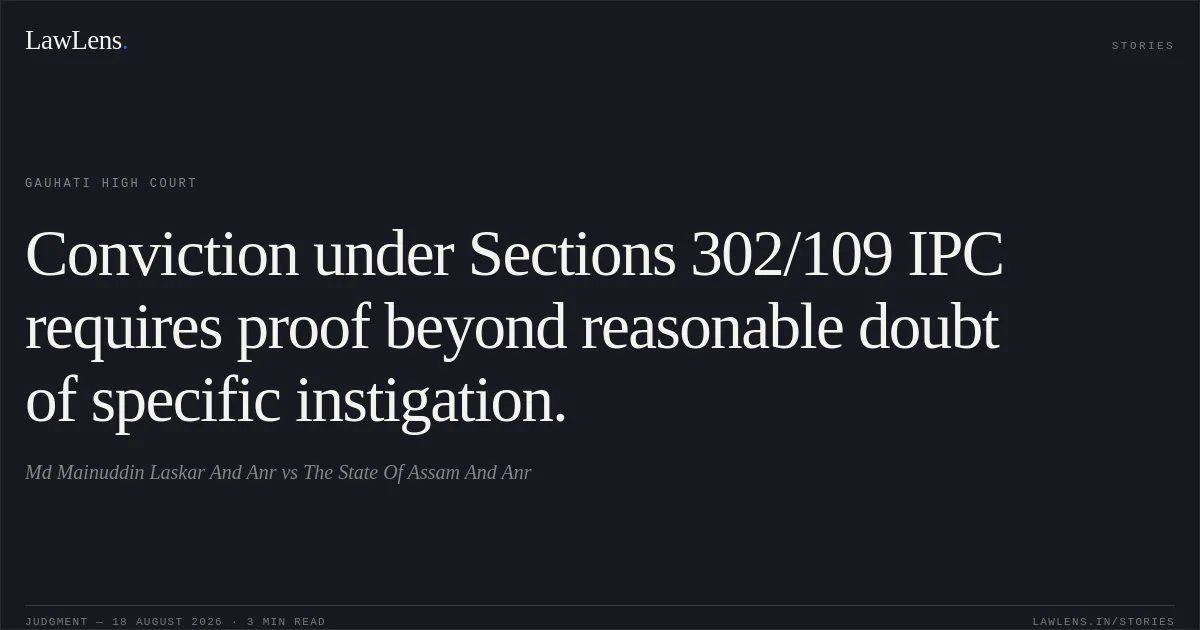
1. Whether the evidence established beyond reasonable doubt that the appellant instigated or abetted the co-accused to murder the deceased, thereby attracting Sections 302/109 IPC?
Source reference: pp. 34–40; paras. 43–482. Whether the appellant could validly be convicted under Sections 302/109 IPC when no specific charge under Section 109 IPC had been framed, although the charge had been framed under Section 302 read with Section 149 IPC?
Source reference: pp. 17–22, 37–40; paras. 26–28, 47–483. Whether the material inconsistencies concerning the identity of the assailant and the person who allegedly instigated the assault entitled the appellant to acquittal?
Source reference: pp. 30–40; paras. 38–48Law Applied
The Court applied Section 302 IPC concerning murder and Section 109 IPC, under which a person who abets an offence committed in consequence of that abetment may be punished with the punishment prescribed for the principal offence where no express provision otherwise applies.
Source reference: pp. 34–35; para. 43It distinguished Section 109 from Section 149 IPC, observing that Section 149 creates liability for members of an unlawful assembly, whereas Section 109 requires proof of abetment, including instigation, conspiracy, or intentional aid.
Source reference: pp. 37–38; para. 46The Court also considered Sections 221 and 464 CrPC, holding that absence or error in framing a charge is not automatically fatal unless it causes prejudice or failure of justice, in accordance with Willie Slaney v. State of Madhya Pradesh, AIR 1956 SC 116.
Source reference: pp. 20–22, 38–40; paras. 28, 47–48In assessing the evidence, it relied on Shahaja @ Shahajan Ismail Mohd. Shaikh v. State of Maharashtra, 2022 INSC 724, for the principles governing appreciation of ocular testimony.
Source reference: pp. 24–26; para. 30It relied on Neeraj Dutta v. State of NCT of Delhi, (2023) 4 SCC 731, and Shyam Lal Ghosh v. State of West Bengal, (2012) 7 SCC 646, for the rule that reliable portions of hostile-witness testimony may be relied upon.
Source reference: pp. 28–29; paras. 34–35Where two reasonable views are possible, the view favourable to the accused must be adopted.
Source reference: p. 36; para. 44Reasoning
The Court found that the prosecution evidence was inconsistent on both essential components of the charge.
Source reference: no citationPW1, the deceased’s daughter, stated that Motibur instigated Moinuddin to kill the deceased.
Source reference: pp. 7–8; paras. 7–8However, PW6 and PW9 attributed the instigation to “Motor,” an acquitted accused, and also differed regarding whether Moinuddin or Mohimuddin was the actual assailant.
Source reference: pp. 11–13, 35–36; paras. 13, 16, 44The other witnesses generally proved that the deceased had sustained a fatal spear injury but did not reliably establish Motibur’s instigation.
Source reference: pp. 9–16, 30–33; paras. 11–15, 23–24, 38–41The Court held that PW6’s attribution of instigation to Motibur arose only in response to a defence suggestion and could not overcome his substantive statement naming Motor as the instigator.
Source reference: pp. 35–36; para. 44Although the absence of a specific Section 109 charge did not, by itself, invalidate the trial—because the alleged instigation had been put to the appellant in his Section 313 CrPC examination—the prosecution still had to prove abetment beyond reasonable doubt.
Source reference: pp. 38–40; paras. 47–48In view of the conflicting versions regarding both the principal offender and the instigator, that burden was not discharged.
Source reference: p. 40; para. 48Holding
The Court held that the prosecution failed to prove beyond reasonable doubt that Motibur Rahman Laskar abetted or instigated the murder.
The conviction under Sections 302 read with 109 IPC and the corresponding sentence were set aside and quashed qua the appellant.
Source reference: p. 41; para. 49Motibur Rahman Laskar was acquitted, and his bail bonds were directed to be discharged.
Source reference: p. 41; para. 50The appeals filed by the deceased appellants stood abated qua them, and the Trial Court Records were ordered to be returned.
Source reference: pp. 3–4, 41; paras. 1, 51Acts & Sections Cited
18 provisions across 2 statutes referred to in this judgment. Each provision opens on LawLens.
Indian Penal Code, 1860
Code of Criminal Procedure, 19736
Original Court PDF
Md Mainuddin Laskar And AnrvsThe State Of Assam And Anr
Click to open original judgment
Original judgment, available to read, download and summarize on LawLens.in