Facts
Nayanaben, the deceased, married respondent No. 1, Pravinbhai Khushalbhai Rohit, on 25 March 2010, after an earlier marriage had ended in divorce. She thereafter resided in a joint family with respondents Nos. 1 to 3, while respondent No. 4, her sister-in-law, resided on the first floor of the same house.
Source reference: p. 2; para. 9The prosecution alleged that the respondents subjected Nayanaben to cruelty and harassment on the ground that she could not cook and that respondent No. 1 had an illicit relationship with respondent No. 4.
Source reference: p. 2; para. 11On 1 October 2010, the complainant’s family was allegedly informed that Nayanaben was involved in disputes with her matrimonial family. She was brought to her parental home on 2 October 2010. On 3 October 2010, she allegedly consumed a poisonous substance and was taken to Dhanvantari Hospital, where she died during treatment.
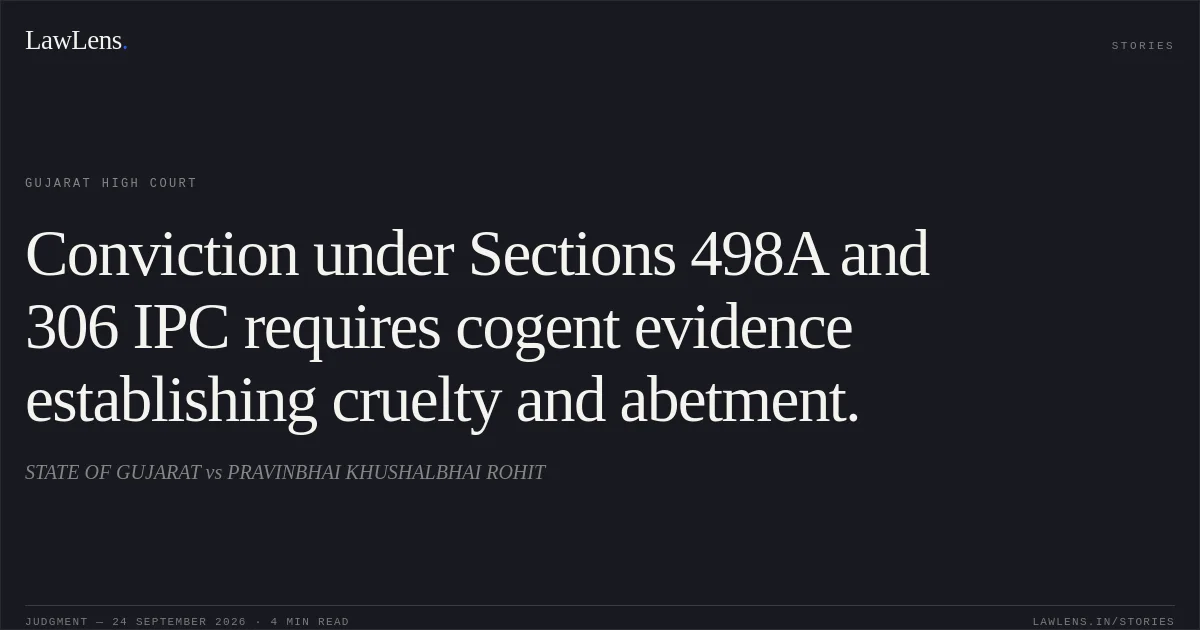
Source reference: pp. 2–3; para. 10Her father lodged a complaint, resulting in registration of offences under Sections 498A and 306 read with Section 114 of the Indian Penal Code.
Source reference: p. 3The prosecution examined the complainant, relatives, medical and police witnesses, and relied on documentary evidence. After recording the accused persons’ statements under Section 313 of the Code of Criminal Procedure, the Sessions Court acquitted all respondents in Sessions Case No. 195 of 2010 by judgment dated 31 August 2012.
Source reference: pp. 3–4The State preferred the present appeal under Section 378(1) and (3) of the Code of Criminal Procedure.
Source reference: p. 1Issues
Whether the trial Court was justified in acquitting the respondents of offences under Sections 498A and 306 read with Section 114 of the IPC?
Source reference: para. 8(1)Whether the trial Court properly appreciated the oral and documentary evidence led by the prosecution?
Source reference: para. 8(2)Whether the acquittal suffered from any illegality, irregularity, perversity, or manifest error warranting interference by the appellate Court?
Source reference: para. 8(3)Whether the prosecution established, beyond reasonable doubt, the alleged cruelty, harassment, abetment of suicide, or the foundational facts necessary to invoke the presumptions under Sections 113-A and 113-B of the Indian Evidence Act, 1872?
Source reference: paras. 14–15Law Applied
The Court applied Sections 498A, 306 and 114 of the IPC, requiring proof of legally cognisable cruelty and abetment of suicide beyond reasonable doubt.
Source reference: paras. 13–15It held that statutory presumptions under Sections 113-A and 113-B of the Indian Evidence Act cannot be invoked unless the prosecution first establishes the foundational facts of cruelty, harassment, or other requisite circumstances.
Source reference: para. 14Relying on Ram Pyarey v. State of Uttar Pradesh, [2025] 6 SCC 820, and Naresh Kumar v. State of Haryana, [2024] 3 SCC 573, the Court reiterated that cogent and clinching evidence of harassment or cruelty is necessary for offences under Sections 498A and 306 IPC.
Source reference: para. 14In an appeal against acquittal under Section 378 CrPC, the appellate Court may fully reappreciate the evidence, but the accused benefit from a reinforced or “double presumption” of innocence; where two reasonable views are possible, the acquittal should not be disturbed.
Source reference: paras. 16–19These principles were drawn from Chandrappa v. State of Karnataka, (2007) 4 SCC 415; Rajesh Prasad v. State of Bihar, [2022] 3 SCC 471; Babu Sahebagouda Rudragoudar v. State of Karnataka, (2024) 8 SCC 149; and Ramesh v. State of Karnataka, [2024] 9 SCC 169.
Source reference: paras. 16–19Reasoning
The Court found that the complainant’s allegations regarding cruelty arising from cooking-related disputes and the alleged illicit relationship between respondent Nos. 1 and 4 were material improvements, as they were absent from his statement recorded immediately after the incident and were introduced later in the complaint and trial testimony.
Source reference: para. 11The evidence of the complainant and his wife regarding the information received about the deceased’s matrimonial dispute was materially inconsistent, while witnesses who brought Nayanaben to her parental home stated that no quarrel or cruelty was apparent at that time.
Source reference: para. 12The evidence concerning the alleged poisonous substance was also inconsistent: although one version referred to a paper packet in the deceased’s hand, the relevant witnesses had not seen such a packet and the inquest panchnama contained no reference to it.
Source reference: para. 13The Court further noted contradictions concerning the deceased’s removal to hospital and the absence of reliable evidence connecting the respondents with her suicide.
Source reference: paras. 12–15Since the prosecution failed to establish cruelty, harassment, abetment, or the necessary foundational facts for statutory presumptions, the trial Court’s view was considered reasonable and neither perverse nor legally unsustainable.
Source reference: paras. 14–18, 20–21Holding
The High Court answered the issues against the State. It held that the prosecution failed to prove the offences under Sections 498A and 306 read with Section 114 IPC beyond reasonable doubt and that the trial Court had correctly appreciated the evidence.
The State’s appeal was dismissed, the order of acquittal dated 31 August 2012 was confirmed, the bail bonds were cancelled, and the record and proceedings were directed to be returned to the trial Court.
Source reference: para. 22Acts & Sections Cited
6 provisions across 2 statutes referred to in this judgment. Each provision opens on LawLens.
Code of Criminal Procedure, 19733
Indian Penal Code, 18603
Original Court PDF
STATE OF GUJARATvsPRAVINBHAI KHUSHALBHAI ROHIT
Click to open original judgment
Original judgment, available to read, download and summarize on LawLens.in