Facts
The Appellant was convicted by the Special Judge (POCSO), Karbi Anglong, under Section 6 of the POCSO Act for the alleged sexual assault of a 14-year-old minor
Source reference: p. 3The prosecution’s case was based on an FIR lodged by the victim’s mother (PW2) alleging two instances of assault and blackmail
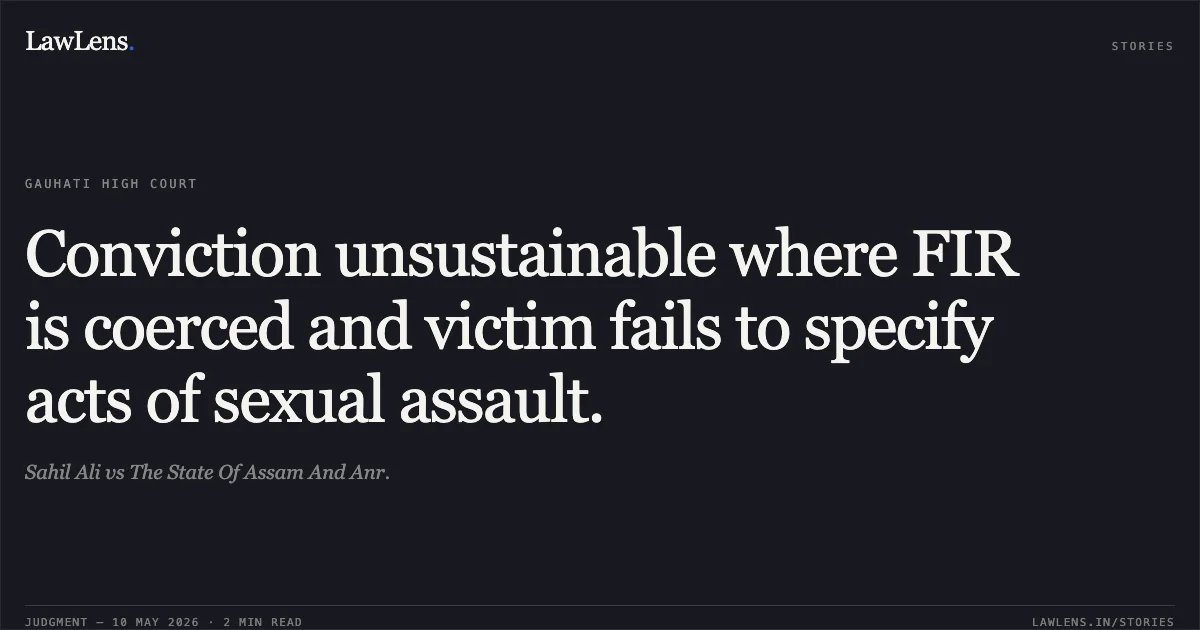
Source reference: p. 3During the trial, the victim (PW1) and her mother (PW2) admitted that the FIR was lodged under coercion and threats from a religious group, rather than free will
Source reference: p. 4, 7, 8The victim also refused a medical examination
Source reference: p. 4, 9The Trial Court convicted the appellant primarily based on the victim’s statement under Section 164 Cr.P.C. and the failure of the defense to shake the credibility of PW1
Source reference: p. 6Issues
1. Whether the FIR and subsequent prosecution were initiated voluntarily or under external coercion and pressure
Source reference: p. 4, 82. Whether the term "physical relationship" in the victim's testimony, without specific details of the act, is sufficient to constitute "penetrative sexual assault" under Section 6 of the POCSO Act
Source reference: p. 9, 103. Whether statements recorded under Section 164 Cr.P.C. constitute substantive evidence for conviction if not corroborated by oral testimony or put to the accused during Section 313 Cr.P.C. examination
Source reference: p. 10Law Applied
The court applied Section 6 and Section 7 of the POCSO Act, 2012, which distinguish between "penetrative sexual assault" and "sexual assault" based on specific physical acts and intent
Source reference: p. 9The court relied on the evidentiary principle that statements made under Section 164 of the Cr.P.C. are not substantive evidence but can only be used for corroboration or contradiction
Source reference: p. 10The court emphasized Section 313 of the Cr.P.C., which mandates that incriminating circumstances must be put to the accused to be used against them
Source reference: p. 10Reasoning
The High Court found that the foundational facts for a conviction under Section 6 were not established. It noted that the victim and informant (PW1 and PW2) explicitly testified that the case was filed due to the "pressure of a religious group" and that they did not know the contents of the English-written FIR
Source reference: p. 7, 8The Court observed that the victim’s testimony regarding a "physical relationship" lacked any description of a sexual act, penetration, or contact with specific body parts as required by Sections 5 and 7 of the POCSO Act
Source reference: p. 9, 10Critically, the Court held that the Trial Judge erred by treating the Section 164 Cr.P.C. statement as substantive evidence, especially since those specific allegations were never put to the Appellant during his Section 313 examination, thereby violating the principles of a fair trial
Source reference: p. 10Holding
The Court allowed the appeal and set aside the conviction. It held that when the foundational facts of penetrative sexual assault under Section 5(l) are not established, a conviction under Section 6 cannot be sustained
The Court acquitted the Appellant of all charges, ordered the discharge of his bail bonds, and directed the return of the Trial Court record
Source reference: p. 11Acts & Sections Cited
6 provisions across 2 statutes referred to in this judgment. Each provision opens on LawLens.
Code of Criminal Procedure, 19733
Original Court PDF
Sahil AlivsThe State Of Assam And Anr.
Click to open original judgment
Original judgment, available to read, download and summarize on LawLens.in