Facts
The appellants (five surviving out of seven originally convicted) were convicted under Sections 323, 448, and 307/34 of the IPC and Section 27 of the Arms Act by the Trial Court on 10.02.2005.
Source reference: p. 1-3The prosecution alleged that on 16.04.1989, the accused entered the informant’s courtyard and, upon the exhortation of Appellant No. 1, Appellants No. 5 and 6 fired pistols at the informant’s head at close range, causing bleeding injuries.
Source reference: p. 4-5The defense contended the case was fabricated due to long-standing property disputes and pointed to medical evidence contradicting the oral testimony.
Source reference: p. 10-13The Trial Court relied solely on the testimony of the informant, his son, and his brother-in-law while ignoring 14 defense witnesses.
Source reference: p. 10, 18Issues
1. Whether the testimony of "interested" or "related" witnesses can form the sole basis of conviction in the presence of admitted prior enmity without independent corroboration?
Source reference: p. 11 / para. 132. Whether the conviction under Section 307 IPC can be sustained when medical evidence contradicts the ocular version regarding the nature and distance of firearm injuries?
Source reference: p. 12 / para. 143. Whether the non-production of material evidence (pellets and weapons) and the failure to examine independent witnesses at the scene are fatal to the prosecution's case?
Source reference: p. 14-15 / para. 17-18Law Applied
The Court applied the rule of prudence regarding "interested witnesses" as established in Dalip Singh v. State of Punjab and Gangabhavani v. Rayapati Venkat Reddy, holding that while related witnesses are not incompetent, their testimony requires "heightened caution" and "discerning scrutiny" if a motive to falsely implicate exists.
Source reference: para. 26-28Regarding medical contradictions, the Court relied on Ram Narain Singh v. State of Punjab and Mohinder Singh v. State, which dictate that if direct evidence is totally inconsistent with medical or expert evidence, it constitutes a fundamental defect discrediting the prosecution.
Source reference: para. 37The principle from State of Gujarat v. Jayrajbhai Punjabhai Varu was applied, asserting that if two views are possible, the one favourable to the accused must be adopted.
Source reference: para. 38Reasoning
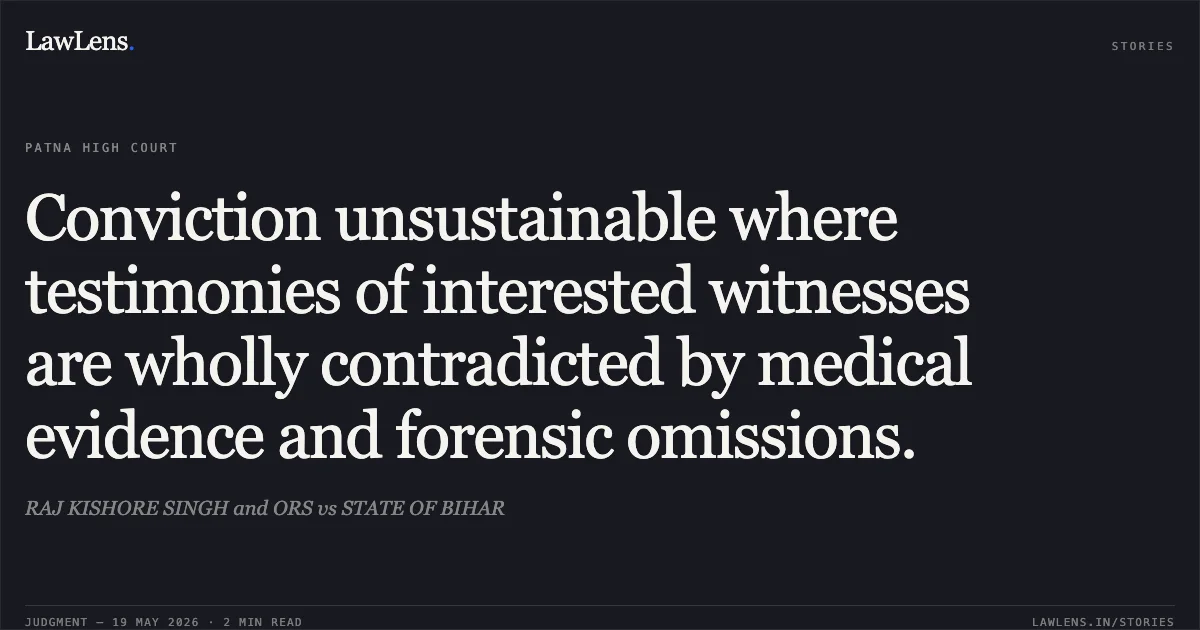
The Court found that the prosecution's case rested on three highly interested witnesses (PW1, PW3, PW5) embroiled in property litigation with the appellants.
Source reference: para. 25, 30The ocular version—alleging two close-range pistol shots to the head—was found to be "wholly out of consonance" with the medical report (Ext. 1/1), which described only superficial, muscle-deep lacerated wounds without fractures or penetrating depth.
Source reference: para. 33Crucially, the Medical Officer (PW6) admitted the absence of charring, tattooing, or blackening (indicators of close-range fire) and conceded that pellets could have been manually inserted into the wounds to fabricate evidence.
Source reference: para. 34-35The Court highlighted the prosecution's failure to produce the recovered pellets or the alleged firearms in court and the unexplained non-examination of independent villagers present at the scene.
Source reference: para. 31, 36Holding
The Court held that the prosecution failed to prove the guilt of the accused beyond reasonable doubt due to the "propensity to weaponize criminal law" by the informant and the fatal contradictions between ocular and medical evidence.
The Court set aside the judgment of conviction and order of sentence dated 10.02.2005. The surviving appellants (Nos. 1, 4, 5, 6, and 7) were acquitted of all charges and discharged from their bail bonds.
Source reference: para. 40-41Acts & Sections Cited
11 provisions across 3 statutes referred to in this judgment. Each provision opens on LawLens.
Code of Criminal Procedure, 19732
Indian Penal Code, 18608
Arms Act, 19591
Original Court PDF
RAJ KISHORE SINGH and ORSvsSTATE OF BIHAR
Click to open original judgment
Original judgment, available to read, download and summarize on LawLens.in