Facts
On 5 October 2002 at approximately 10:00 p.m., the informant alleged that the appellants assaulted him when he went outside his house to urinate. Appellant No. 5, Bhusi Paswan, allegedly inflicted a head injury with a gandasa, while the other accused allegedly assaulted the informant with lathis; the prosecution further alleged robbery of ₹2,200 and a wristwatch
Source reference: para. 3, p. 2The prosecution examined five witnesses, including the injured informant, alleged eyewitnesses, and the doctor, who found a fracture injury, an incised head wound, and blunt-force injuries
Source reference: para. 4, p. 3The defence examined one witness, who referred to the informant’s habitual drinking and an existing land dispute between the parties
Source reference: para. 5, p. 3The trial court convicted Appellant No. 5 under Section 324 of the Indian Penal Code and the remaining appellants under Section 323 IPC, sentencing them to three years’ and one year’s rigorous imprisonment, respectively
Source reference: para. 2, p. 1Issues
Whether the appellants’ convictions under Sections 323 and 324 IPC could be sustained despite the non-examination of the Investigating Officer, the alleged discrepancies in the prosecution evidence, and the admitted prior enmity and land dispute between the parties
Source reference: para. 7, p. 3–4Whether, having regard to the age of the case, the appellants’ circumstances, and their conduct after registration of the FIR, the substantive sentences should be reduced
Source reference: paras. 7–9, pp. 3–4Law Applied
The Court applied Section 324 IPC concerning voluntarily causing hurt by means of a dangerous weapon or means, and Section 323 IPC concerning voluntarily causing hurt.
Source reference: no citationIt also applied the principle that non-examination of the Investigating Officer may prejudice the defence where it prevents effective confrontation of witnesses regarding material discrepancies
Source reference: para. 7, p. 3–4In sentencing, the Court considered the age of the occurrence, the appellants’ age and circumstances, the absence of any subsequent complaint, and the principle that punishment must be proportionate and consistent with the ends of justice
Source reference: paras. 7–9, pp. 3–4Reasoning
The Court noted that the Investigating Officer had not been examined, thereby limiting the defence’s opportunity to explain discrepancies and contradict the prosecution witnesses
Source reference: para. 7, p. 3–4It also recognised the admitted prior enmity and land dispute, the possibility of false implication, and the fact that the prosecution witnesses were interested witnesses
Source reference: para. 7, p. 4Nevertheless, the Court did not disturb the trial court’s findings of guilt.
Source reference: no citationConsidering that the occurrence was approximately twenty-four years old, that there had been no subsequent complaint against the appellants, and the relevant personal circumstances, the Court concluded that continued incarceration was unnecessary to meet the ends of justice
Source reference: paras. 7–8, p. 4Holding
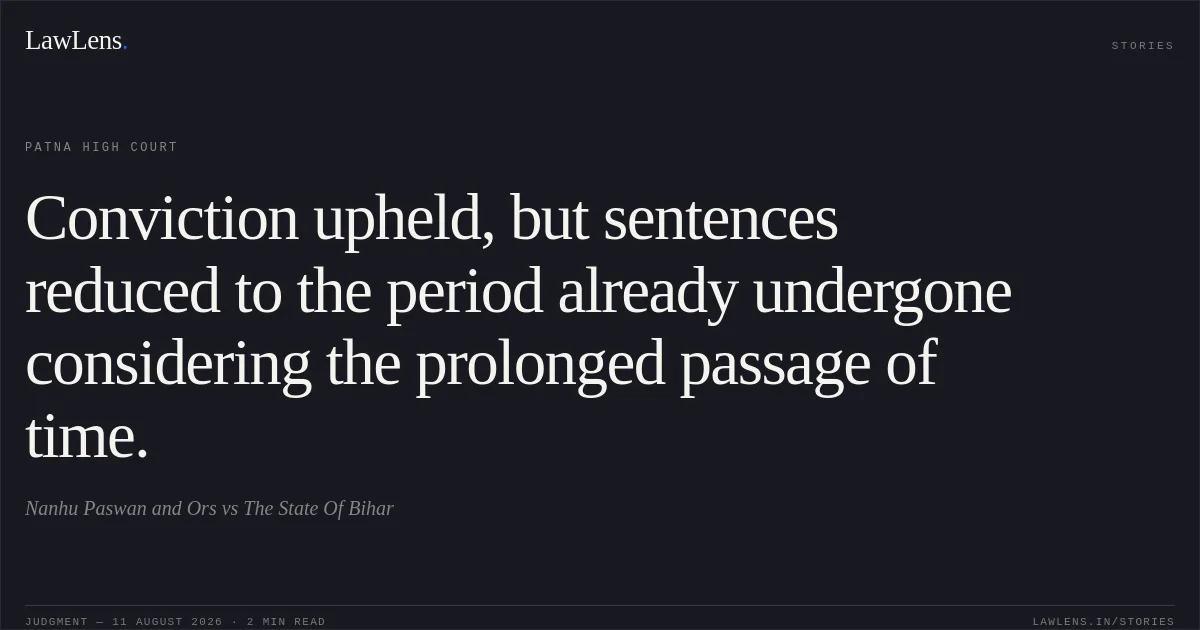
The convictions under Sections 323 and 324 IPC were upheld, but the sentences imposed by the trial court were reduced to the periods already undergone
The appeal was partly allowed in relation to sentence.
Source reference: no citationThe appellants were discharged from the liability of their bail bonds, and the appeal, along with any pending interlocutory applications, was disposed of
Source reference: paras. 10–12, pp. 4–5Acts & Sections Cited
2 provisions across 1 statute referred to in this judgment. Each provision opens on LawLens.
Indian Penal Code, 18602
Original Court PDF
Nanhu Paswan and OrsvsThe State Of Bihar
Click to open original judgment
Original judgment, available to read, download and summarize on LawLens.in