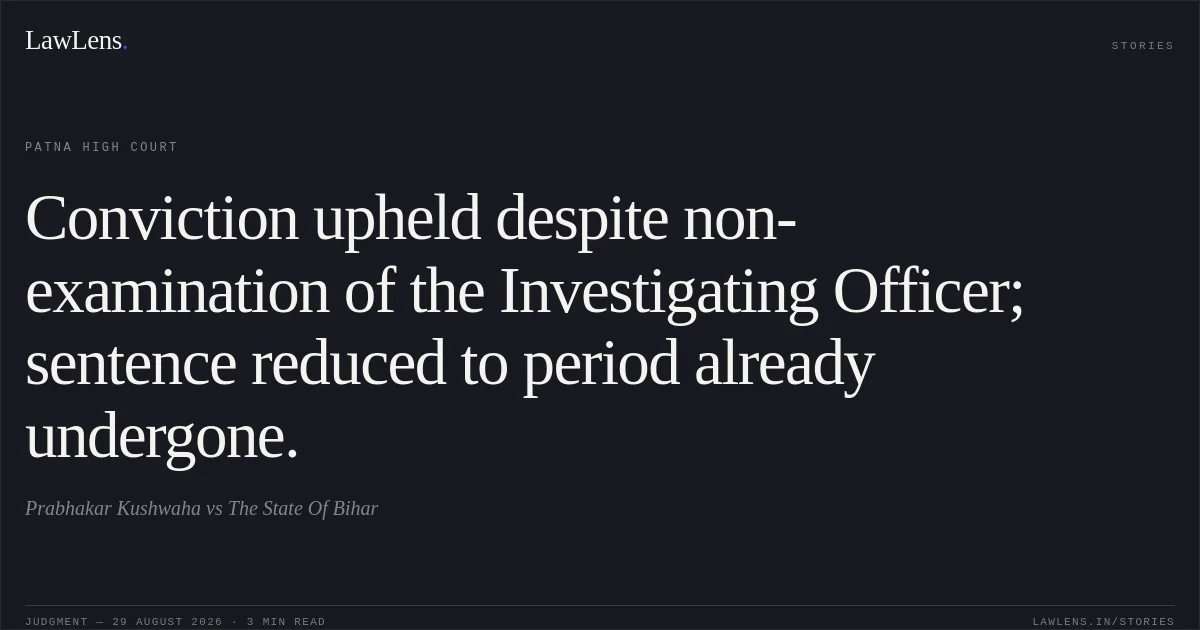
Facts
The appellant was prosecuted for allegedly hurling a bomb at the vehicle of the Superintendent of Police, Munger, causing substantial smoke, temporary blindness among members of the police party, and simple injuries to some police personnel. The appellant and co-accused Upendra Mishra were allegedly apprehended while fleeing from the spot.
Source reference: p.2, para. 3On the basis of the fardbeyan of Sikandar Singh, the driver of the Superintendent of Police, a criminal case was registered for offences under Sections 307, 353 and 34 of the Indian Penal Code and Sections 3 and 4 of the Explosive Substances Act; the judgment also refers to the case as Kotwali P.S. Case No. 102 of 2006. After investigation, chargesheet was submitted against both accused. The co-accused absconded and the trial proceeded against the appellant alone.
Source reference: p.2, para. 4The prosecution examined nine witnesses, including police personnel, the informant, the Superintendent of Police, a doctor, and formal witnesses. Witnesses P.Ws. 8 and 9 turned hostile.
Source reference: p.2–3, paras. 5–6The Trial Court relied principally on the evidence of P.W.5, the informant, and P.W.6, the Superintendent of Police, as well as medical, seizure and forensic evidence, and convicted the appellant under Section 353 IPC and Sections 3 and 4 of the Explosive Substances Act. He was sentenced to ten years’ imprisonment under the Explosive Substances Act and two years’ imprisonment under Section 353 IPC.
Source reference: p.1, para. 2; p.3, para. 6Issues
Whether the appellant’s conviction under Section 353 IPC and Sections 3 and 4 of the Explosive Substances Act was sustainable on the prosecution evidence, particularly in the absence of independent supporting witnesses and the Investigating Officer.
Source reference: p.4, paras. 7–9Whether the sentence imposed by the Trial Court warranted reduction in light of the appellant’s period of custody and the passage of time since the occurrence.
Source reference: p.4, para. 7; p.5, paras. 10–11Law Applied
The Court applied Section 353 of the Indian Penal Code, which criminalises assault or use of criminal force against a public servant to deter or prevent the discharge of official duty, and Sections 3 and 4 of the Explosive Substances Act, which penalise causing an explosion likely to endanger life or property and possessing or making explosive substances in circumstances giving rise to a reasonable suspicion of unlawful use, respectively.
Source reference: p.1, para. 2The Court applied the evidentiary principle that the testimony of police witnesses is not inherently unreliable and may sustain a conviction if found trustworthy and corroborated by surrounding evidence.
Source reference: p.5, para. 9It also considered the principle that non-examination of the Investigating Officer may cause prejudice where the defence is thereby prevented from proving material contradictions, although such omission is not automatically fatal to the prosecution.
Source reference: p.5, para. 9Reasoning
The Court acknowledged that the prosecution case substantially rested on P.W.5, the informant, and P.W.6, the Superintendent of Police, while the formal witnesses had turned hostile and no independent witness supported the prosecution.
Source reference: p.5, para. 9It also noted that the doctor found only simple injuries and that the Investigating Officer had not been examined, potentially preventing the defence from proving contradictions in the witnesses’ statements. Nevertheless, the Court found the evidence of the material witnesses “completely trustworthy” and saw no reason to disbelieve it. Their testimony was supported by the medical, seizure and forensic materials relied upon by the Trial Court, and the appellant’s apprehension immediately after the occurrence further supported the prosecution version.
Source reference: p.3, para. 6; p.5, paras. 8–9Accordingly, the Court held that the evidentiary deficiencies did not undermine the finding of guilt.
Source reference: p.5, paras. 8–9On sentencing, however, it took into account that the occurrence had taken place in 2006, that the appellant had remained in custody for approximately three years, and that there had been no subsequent complaint against him.
Source reference: p.5, para. 10Holding
The appeal was partly allowed in relation to sentence but not conviction. The Court upheld the judgment of conviction dated 19 July 2018 and the order of sentence dated 20 July 2018 insofar as they found the appellant guilty under Section 353 IPC and Sections 3 and 4 of the Explosive Substances Act.
Considering the appellant’s custody of approximately three years, the age of the incident, and the absence of any subsequent complaint, the Court reduced the sentence to the period already undergone.
Source reference: p.5, para. 10; p.6, para. 11The appellant was discharged from the liability of his bail bond, and the appeal was disposed of accordingly.
Source reference: p.6, paras. 12–13Acts & Sections Cited
5 provisions across 2 statutes referred to in this judgment. Each provision opens on LawLens.
Indian Penal Code, 18603
Original Court PDF
Prabhakar KushwahavsThe State Of Bihar
Click to open original judgment
Original judgment, available to read, download and summarize on LawLens.in
![A police constable cannot be removed for unauthorized absence without a Rule 359-compliant inquiry.. Mohammad Sidiq Khan vs D/o Home Ut Of Jammu & Kashmir. CAT - ['Srinagar']. LawLens](/stories/thumbnails/a-police-constable-cannot-be-removed-for-unauthorized-absence-without-a-rule-359-compliant-7b43fc316bd94f22a62676153bbc9d54.webp)
![A Review DPC lacks authority to determine or alter inter se seniority.. SAURABH KUMAR vs REVENUE. CAT - ['Patna']. LawLens](/stories/thumbnails/a-review-dpc-lacks-authority-to-determine-or-alter-inter-se-seniority-4b21640f20af46fcabdfc8273d2ce959.webp)