Facts
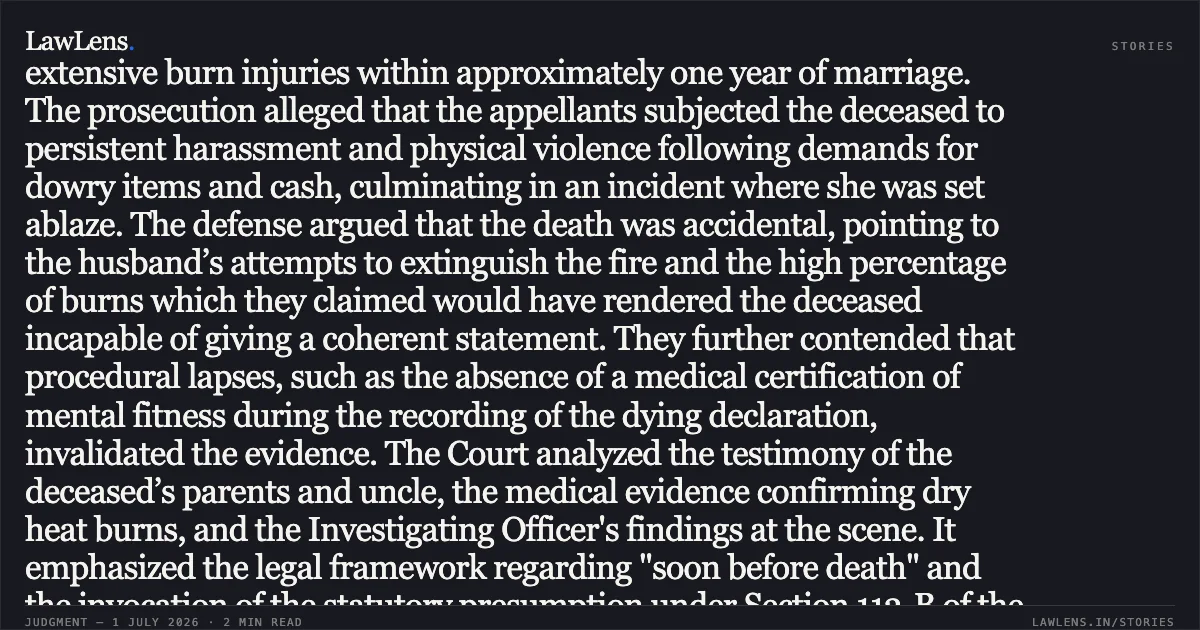
The deceased, Bindu Devi, married appellant Vikash Kumar Saw on February 18, 2009.
Source reference: para 3Allegations were made that she was subjected to cruelty and dowry demands (television, bed, and cash) by her husband and mother-in-law, Krishni Devi.
Source reference: para 3On April 5, 2010, the deceased sustained over 80% burn injuries and gave a fardbeyan (dying declaration) at Sadar Hospital, Nawada, alleging her husband poured kerosene and set her ablaze.
Source reference: para 3, 16(VI)She died en route to PMCH, Patna.
Source reference: para 3The Trial Court (Nawada) convicted the appellants under Sections 498A/34 and 304B/34 IPC, sentencing them to seven years rigorous imprisonment for the latter.
Source reference: para 2The appellants challenged the conviction, claiming the death was accidental while cooking.
Source reference: para 8Issues
1. Whether the prosecution established the foundational facts of dowry death to attract the statutory presumption under Section 113-B of the Evidence Act.
Source reference: para 19, 252. Whether the dying declaration of the deceased was reliable and sufficient to form the basis of conviction despite medical evidence of 80% burns.
Source reference: para 7, 10, 263. Whether the conviction of the appellants under Sections 498A and 304B/34 IPC is sustainable based on the evidence of interested witnesses.
Source reference: para 24, 27Law Applied
The court applied Section 304-B IPC (Dowry Death) and Section 498-A IPC (Cruelty).
Source reference: para 18It relied on Section 113-B of the Indian Evidence Act, which mandates a presumption of dowry death if cruelty "soon before death" in connection with dowry is proven.
Source reference: para 19The court invoked the "proximity test" and definition of "soon before death" as established in Rajinder Singh v. State of Punjab (2015) and Surinder Singh v. State of Haryana (2014).
Source reference: para 20It further applied the broader interpretation of "dowry" property as per State of Madhya Pradesh v. Jogendra (2022).
Source reference: para 21Reasoning
The Court found that the prosecution successfully established the marriage occurred within seven years of the death and that the death was unnatural.
Source reference: para 26Although the defense argued the deceased was unconscious, the Court relied on the testimony of P.W.-6 (Doctor), who stated a patient with 80% burns could remain capable of speaking in the initial stages.
Source reference: para 16(VI), 26The testimonies of P.W.-3 (Uncle), P.W.-4 (Mother), and P.W.-7 (Father) consistently detailed a course of harassment and a specific demand for dowry, including a payment of Rs. 35,000/- which failed to stop the torture.
Source reference: para 16, 24The Investigating Officer’s discovery of kerosene smells at the washed crime scene further corroborated the homicidal nature of the incident.
Source reference: para 16(V), 26The Court concluded that the proximity between the harassment and the death created a "live link," thereby shifting the burden to the accused, which they failed to discharge.
Source reference: para 25-27Holding
The High Court upheld the conviction of both appellants under Sections 498-A/34 and 304-B/34 IPC, finding no merit in the challenge against the dying declaration or the testimonies of the relatives.
The Court modified the sentence to the period already undergone (1.7 years for mother-in-law and 4.5 years for husband) and discharged them from their bail bonds, partly allowing the appeals regarding sentence modification.
Source reference: para 28-29Acts & Sections Cited
3 provisions across 3 statutes referred to in this judgment. Each provision opens on LawLens.
Indian Penal Code, 18601
Code of Criminal Procedure, 19731
Dowry Prohibition Act, 19611
Original Court PDF
Vikash Kumar SawvsThe State Of Bihar
Click to open original judgment
Original judgment, available to read, download and summarize on LawLens.in


