01Facts
The appellant, aged about 65, was a cultivating tenant on land adjoining the house of the victim, a minor (DOB 16.09.2004) studying in Class 11.
p. 3 · p. 7The victim lived with her mother (PW2), a widowed agricultural labourer, and her sister (PW3), in a hut without a proper door.
pp. 3-4 · p. 20The prosecution alleged that the appellant committed penetrative sexual assault on the victim on 19.08.2019 and 07.09.2019, both Saturdays, when she was alone at home, and threatened her with death if she disclosed the incidents.
pp. 3-4 · p. 8On 23.03.2020 the victim fainted at school, was taken to Namagiripettai Government Hospital, found pregnant, and was referred to Mohan Kumaramangalam Government Medical College Hospital, Salem, where she delivered a girl baby at about 5.30 p.m. and disclosed the appellant's involvement.
p. 4 · pp. 8-9Crime No. 3 of 2020 was registered on 24.03.2020 under Sections 5(l) and 5(j)(ii) r/w 6 POCSO Act and Section 506(ii) IPC.
pp. 4-5The victim's statement under Section 164 CrPC was recorded on 10.06.2020.
p. 9The prosecution examined PW1 to PW12; the defence led no evidence.
p. 5The trial court convicted the appellant under Section 449 IPC (two counts, 10 years RI each), Section 506(ii) IPC (3 years RI), and Sections 5(l) and 5(j)(ii) r/w 6 POCSO Act (20 years RI each), with concurrent sentences and compensation of Rs. 2,00,000 under Section 33(8) POCSO Act.
pp. 2-3The appellant contended that he was physically unfit and that the 218-day interval between the alleged assault and delivery makes the pregnancy medically implausible.
pp. 5-6The appellant contended that the baby, a 3 kg child, was surrendered under the Cradle Baby Scheme and that no DNA test was conducted.
p. 6The appellant contended that he was falsely implicated after a dispute over corn theft.
p. 6The appellant contended that the child was born very pre-term (28-32 weeks), which the medical evidence does not support.
pp. 6-7The appellant sought a DNA test and volunteered to submit to one.
p. 14The prosecution countered that the child had been adopted and that post-adoption DNA testing was barred or unwarranted under the J.J. Act and Adoption Regulations, 2022.
p. 10 · p. 13The Court appointed an Amicus Curiae.
p. 1402Issues
i.1. Whether, after the child was surrendered under the Cradle Baby Scheme and legally adopted, the appellant's request for a post-adoption DNA test to establish paternity can be entertained.
pp. 14-18 · p. 18 (para. 8.1)ii.2. Whether the prosecution evidence, comprising the victim's testimony, the corroborating witnesses and the medical records, establishes the offences under Section 449 and Section 506(ii) IPC and Sections 5(l) and 5(j)(ii) r/w 6 POCSO Act beyond reasonable doubt, so as to sustain the conviction.
pp. 19-21 (paras. 8.2-8.9)03Law Applied
Section 5(l) and 5(j)(ii) r/w Section 6 of the POCSO Act for aggravated penetrative sexual assault on a child.
p. 2 · p. 4Section 449 and Section 506(ii) IPC for house-trespass to commit an offence punishable with death or life imprisonment and criminal intimidation.
p. 2Section 33(8) POCSO Act for victim compensation.
p. 3Section 164 CrPC as to the admissibility and consistency of the victim's prior statement.
p. 9 · p. 21Section 74 of the J.J. Act, which protects the identity of children.
p. 14Regulations 39 and 48 of the Adoption Regulations, 2022, under which DNA sampling is contemplated before adoption and adoption records must remain confidential.
p. 10 · p. 15R. Rajendran v. Kamar Nisha, 2025 SCC OnLine SC 2372, which holds that DNA testing requires a direct and demonstrable nexus to the offence and may not be ordered for collateral questions.
p. 16Bhabani Prasad Jena v. Orissa State Commission for Women, (2010) 8 SCC 633, on the principles governing DNA test directions and the primacy of the child's best interests.
pp. 17-18The principle that the question of paternity is collateral and not an ingredient of the offences.
pp. 16-17Provisions in the judgment · 9 · Linked ones open on LawLens
Code of Criminal Procedure, 1973 Section 374Section 428Section 164
Protection of Children from Sexual Offences Act, 2012 Section 5Section 6Section 33
Indian Penal Code, 1860 Section 506
Juvenile Justice (Care and Protection of Children) Act, 2015. Section 68Section 74
04Reasoning
Paternity was not an ingredient of the offences charged. The relevant question was whether the sexual assault occurred, and the child's biological parentage did not determine that.
pp. 16-17 (paras. 7.7-7.8, as adopted at 8.1)Because the child had been surrendered and lawfully adopted, and the prosecution case rested on other evidence, a post-adoption DNA test would be an intrusive, non-indispensable step that would compromise the child's privacy and the adoptive family's confidentiality.
p. 18 (para. 8.1)The victim's consistent account across her Section 164 statement and her deposition, including the threats she received, was relied upon.
p. 21 (para. 8.8)The victim's account was corroborated by the medical records (Ex. P7), the Accident Register recording the history of assault (Ex. P8), the Maternal Referral Slip (Ex. P9) and the Labour Register, which together establish pregnancy and delivery.
pp. 19-20 (paras. 8.3-8.4)The appellant's potency certificate (Ex. P5) was noted, along with the tenancy relationship and the proximity of the victim's home.
pp. 20-21 (para. 8.6) · p. 20 (para. 8.5)The victim's minority was proved by the school certificate (Ex. P12).
p. 21 (para. 8.8)05Holding
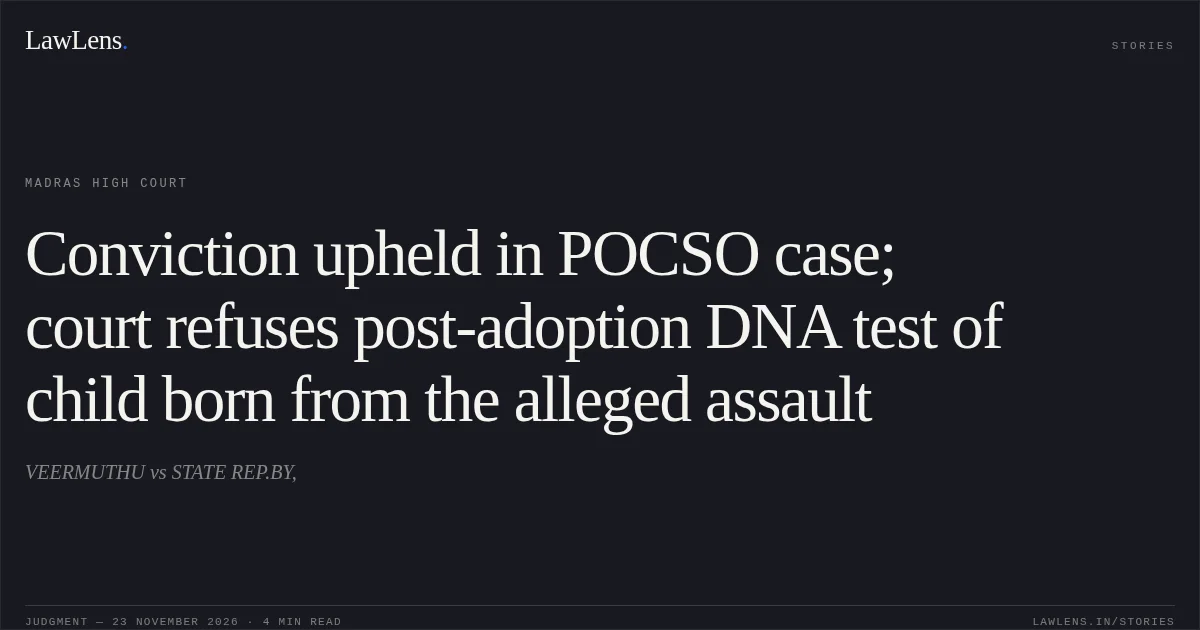
Issue 1 is answered in the negative: a post-adoption DNA test cannot be ordered at this stage, as paternity is collateral to the offences and the prosecution case can be proved through oral and medical evidence.
p. 18 (para. 8.1)On Issue 2, the victim's testimony, corroborated by the medical records and the testimony of PW2 and PW3, establishes the offences, and the Trial Court rightly convicted the appellant.
p. 21 (para. 8.9)The Criminal Appeal is dismissed, and the connected Miscellaneous Petition (CRL MP No. 2363 of 2026) is dismissed.
pp. 21-22 (para. 9.1)The Court placed on record its appreciation for the Amicus Curiae's assistance.
p. 22 (para. 9.2)The conviction and sentences imposed by the Sessions Judge, Magalir Neethi Mandram (Fast Track Mahila Court), Namakkal, in Spl. C.C. No. 36 of 2020 are affirmed.
pp. 2-3 · pp. 21-22Original Court PDF
VEERMUTHUvsSTATE REP.BY,
Click to open original judgment
Original judgment, available to read, download and summarize on LawLens.in