01Facts
The 2nd respondent, de facto complainant and President of Puduvai Environment and Consumer Protection Forum, alleged that the petitioner institution filled a storm water drain and irrigation canal on Government poramboke land with gravel, sand and concrete. This allegedly encroached on about 150 feet of the public water channel, disrupted irrigation and drainage, caused monsoon flooding and endangered public safety and health.
¶ 3 · pp. 2–3On that complaint, Crime No. 191 of 2025 was registered on 16.12.2025 against the petitioners for offences under Sections 290 and 430 IPC and Section 3(2)(a) of the Prevention of Damage to Public Property Act, 1984 (PDPP Act), read with Section 34 IPC.
¶ 3 · p. 3The petitioners argued that the complainant habitually files frivolous PILs to extract money, that a Division Bench dismissed one of his writs with costs of Rs. 25,000 (W.P. No. 25792 of 2018), and that this Court dismissed his quash petition in Crl.O.P. No. 23135 of 2017 against a prosecution in S.T.C. No. 159 of 2017.
¶ 4 · pp. 3–4The Court found that the structure is a cement/concrete culvert of about 150 feet, built about two decades ago (approx. 3 ft wide) for access by patients, ambulances and the public. No irrigation channel exists at that location, and the underlying channel continues to function as a storm water drain without hindrance to the public.
¶ 6 · pp. 4–5The National Highways Authority of India reported that a 45.7-metre stretch lies within NH land and will be removed during RCC drain works.
¶ 6 · p. 5The complaint contains no allegation that any person was affected.
¶ 7 · p. 502Issues
i.1. Whether the essential ingredients of public nuisance under Section 290 IPC are made out where the complaint alleges no common injury, danger or annoyance to the public.
¶ 7 · p. 5ii.2. Whether the essential ingredients of mischief under Section 430 IPC are made out where the water channel is not alleged to be used for agricultural irrigation, food or drink, or manufacturing.
¶ 7 · p. 5iii.3. Whether the offence under Section 3(2)(a) of the PDPP Act is made out where the channel is not alleged to be public property used in the production, distribution or supply of water.
¶ 7 · pp. 5–6iv.4. Whether the FIR constitutes an abuse of the process of law warranting quashing under Section 528 BNSS.
¶ 8 · p. 603Law Applied
The petition was filed under Section 528 of the BNSS, the inherent power to quash FIRs.
p. 2Section 290 IPC requires an act or illegal omission causing common injury, danger or annoyance to the public or people in general in the vicinity.
¶ 7 · p. 5Section 430 IPC requires that the water channel be used for agricultural irrigation, food or drink for humans or animals, or manufacturing purposes.
¶ 7 · p. 5Section 3(2)(a) of the PDPP Act requires damage to public property used in connection with the production, distribution or supply of water, light, power or energy.
¶ 7 · pp. 5–6Proceedings lacking the essential ingredients of the alleged offences amount to an abuse of process, which may be quashed.
¶ 8 · p. 6Provisions in the judgment · 5 · Linked ones open on LawLens
Bharatiya Nagarik Suraksha Sanhita, 2023 Section 528
Indian Penal Code, 1860 Section 290Section 430Section 34
Prevention of Damage to Public Property Act, 1984 Section 3
04Reasoning
The Court tested the FIR against the statutory ingredients rather than the disputed facts. On Section 290 IPC, it noted that the complaint contains "not even a whisper" of any person being affected, so no public nuisance arises.
¶ 7 · p. 5On Section 430 IPC, the complaint does not allege any use of the water for irrigation, drinking, food or manufacturing, so that offence fails.
¶ 7 · p. 5On Section 3(2)(a) PDPP Act, there is no allegation or material that the channel supplies or distributes water, so the statutory nexus to public utility property is absent.
¶ 7 · pp. 5–6The Court relied on the factual findings that the culvert has caused no hindrance for about two decades and that the NHAI report confirms the structure lies on NH land and is slated for removal.
¶ 6 · pp. 4–5The Court did not rely on the petitioners' submissions regarding the complainant's antecedents or prior litigation.
¶ 4 · pp. 3–4The decision rests on the absence of essential ingredients, and the Court concluded that continuing the prosecution would be an abuse of process.
¶ 8 · p. 605Holding
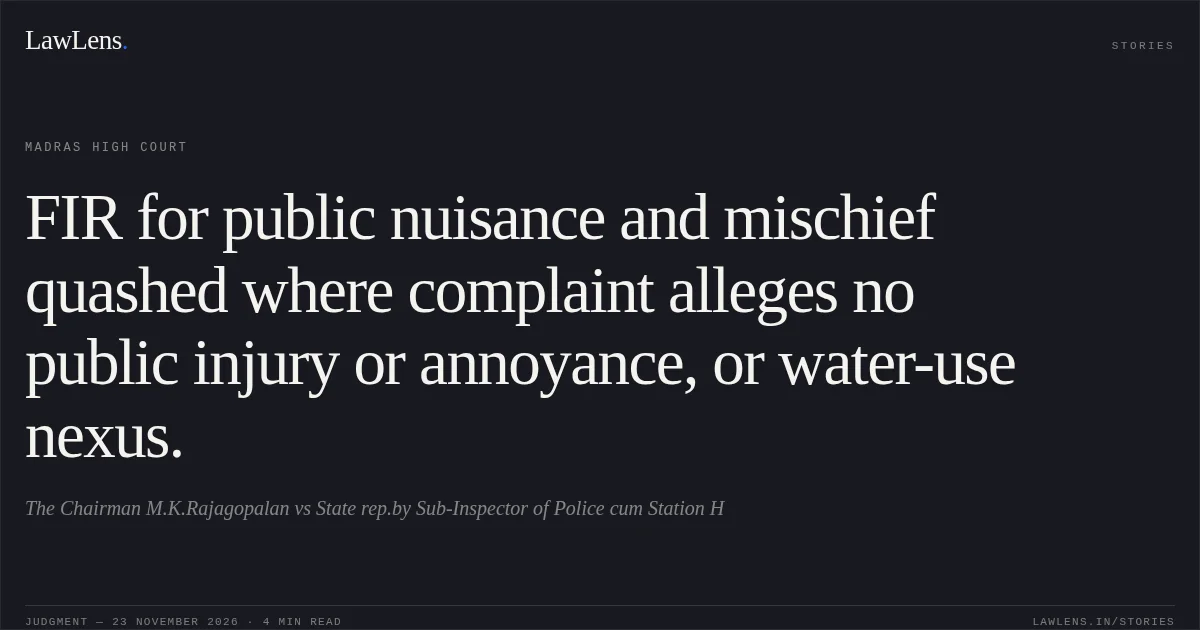
The Court held that none of the essential ingredients of Sections 290 and 430 IPC or Section 3(2)(a) of the PDPP Act are made out on the complaint's allegations. Continuing the FIR is therefore a clear abuse of the process of law.
¶ 7–8 · pp. 5–6The FIR in Crime No. 191 of 2025 dated 16.12.2025 on the file of Kirumampakkam Police Station is quashed in its entirety.
¶ 8 · p. 6The Criminal Original Petition is allowed and the connected Crl.M.P. is closed.
¶ 9 · p. 6The operative order quashes the FIR without expressly limiting its effect to the petitioners, although the prayer was framed as "as against the petitioner".
p. 2 · ¶ 8Original Court PDF
The Chairman M.K.RajagopalanvsState rep.by Sub-Inspector of Police cum Station H
Click to open original judgment
Original judgment, available to read, download and summarize on LawLens.in