Facts
The petitioner filed a complaint (No. 1639/2016) under Section 138 of the Negotiable Instruments Act against three accused: a company (M/s Aggarwal Traders Doors Ltd) and its two Directors
Source reference: para. 1-2Though the cheques were signed by Mr. Shiv Narayan Agrawal (Accused No. 2) as an authorized signatory for the company, the Trial Court initially summoned only the Director and not the company itself
Source reference: para. 3, 9During the trial, at the stage of cross-examination, the complainant moved an application under Section 319 Cr.P.C. to summon the company
Source reference: para. 4-5The Trial Court dismissed this application on 24.09.2022, reasoning that no new evidence had surfaced and that it lacked the power to review its own previous summoning order
Source reference: para. 6The petitioner challenged both the original 2014 summoning order and the 2022 dismissal order
Source reference: para. 7Issues
1. Whether the company is a necessary party to the prosecution under Section 138 of the Negotiable Instruments Act when the cheques were issued on its behalf?
Source reference: para. 102. Whether the Trial Court’s refusal to summon the company on the grounds of lack of "review power" was legally sustainable in the context of a Section 138 proceeding?
Source reference: para. 10-11Law Applied
Section 138 and Section 141 of the Negotiable Instruments Act, 1881, which govern the liability of companies and their officers for dishonored cheques.
Source reference: no citationHimanshu v. B. Shivamurthy Anr. (2019) 3 SCC 797, which mandates that a Director cannot be prosecuted under the Act without the company being arraigned as an accused
Source reference: para. 10principle under the Code of Criminal Procedure (Cr.P.C.) that a Criminal Court does not possess the inherent power to review its own orders
Source reference: para. 6, 10Reasoning
The High Court observed that the cheques in question were explicitly signed by the Director for and on behalf of the company, and the legal notice had been appropriately addressed to the company
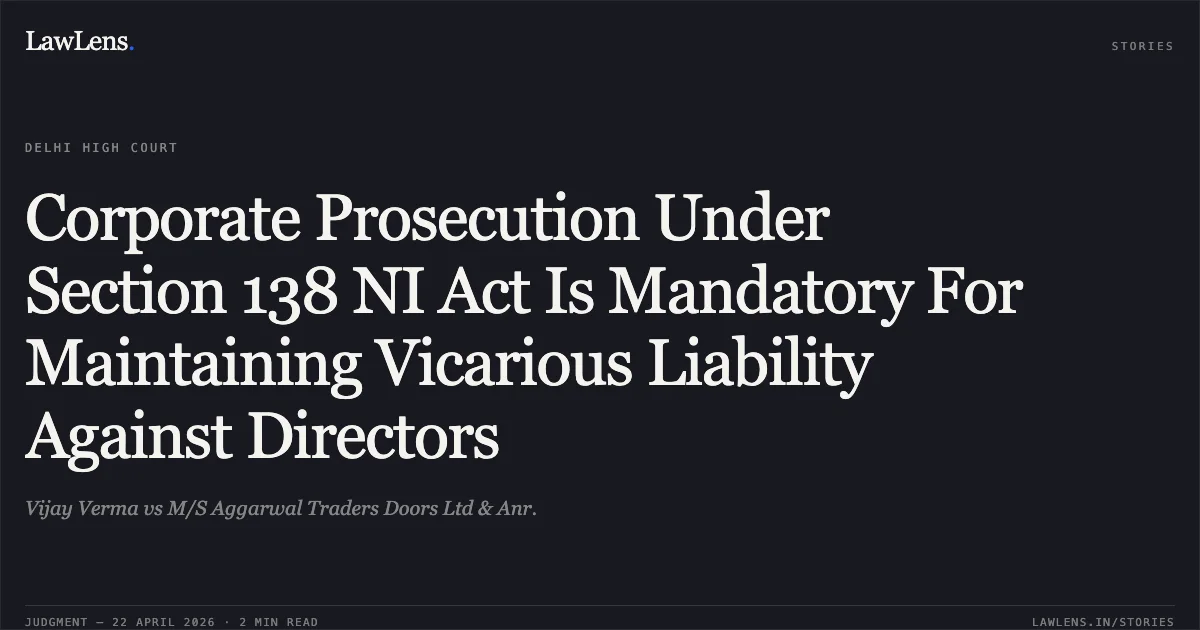
Source reference: para. 9The Court reasoned that if the company is not summoned to participate in the trial, the prosecution against the Director would be legally unsustainable under the doctrine of vicarious liability established in Himanshu v. B. Shivamurthy
Source reference: para. 10While the High Court agreed that the Trial Court cannot "review" its order, it found the original summoning order to be "bereft of any reason" for failing to include the company
Source reference: para. 11Since the respondent’s counsel eventually conceded to the summoning of the company to avoid prejudice to the entire case, the Court found it necessary to rectify the procedural lapse to ensure a valid trial
Source reference: para. 12-13Holding
The High Court allowed the petition in part, holding that the accused company must be summoned to ensure the trial's legal validity
The Court directed that M/s Aggarwal Traders Doors Ltd stands summoned as an accused and ordered its Authorized Representative to appear before the Trial Court on 29.04.2026. The Court granted the respondent liberty to raise all legal pleas and to cross-examine the complainant on behalf of the newly summoned company
Source reference: para. 12-13Acts & Sections Cited
3 provisions across 2 statutes referred to in this judgment. Each provision opens on LawLens.
Negotiable Instruments Act, 18811
Code of Criminal Procedure, 19732
Original Court PDF
Vijay VermavsM/S Aggarwal Traders Doors Ltd & Anr.
Click to open original judgment
Original judgment, available to read, download and summarize on LawLens.in