Facts
The petitioners filed a Contempt Petition (CP No. 706/2023) alleging non-compliance with the Tribunal's directions regarding the grant of benefits under the ACP/MACP Scheme
Source reference: para. 1-2The respondents filed a compliance affidavit on 13.11.2025, stating that the competent authority had approved the grant of benefits via an Office Memorandum dated 22.07.2025
Source reference: para. 2Consequently, arrears were paid to the petitioners
Source reference: para. 2However, the petitioners’ counsel argued that while the benefits were granted, the respondents failed to fix the pay in the correct scale of Rs. 15,600–39,100 with a Grade Pay (GP) of Rs. 5,400, allegedly due to an internal audit communication dated 09.09.2025
Source reference: para. 3Issues
Whether the correctness of pay scale calculation and fixation under the ACP/MACP Scheme can be examined by the Tribunal in the exercise of its contempt jurisdiction once substantial compliance through the grant of benefits has been effected
Source reference: para. 4Law Applied
The Tribunal applied the principle of limited jurisdiction in contempt proceedings as established by the Supreme Court in J.S. Parihar v. Ganpat Duggar and others (1996) 6 SCC 291
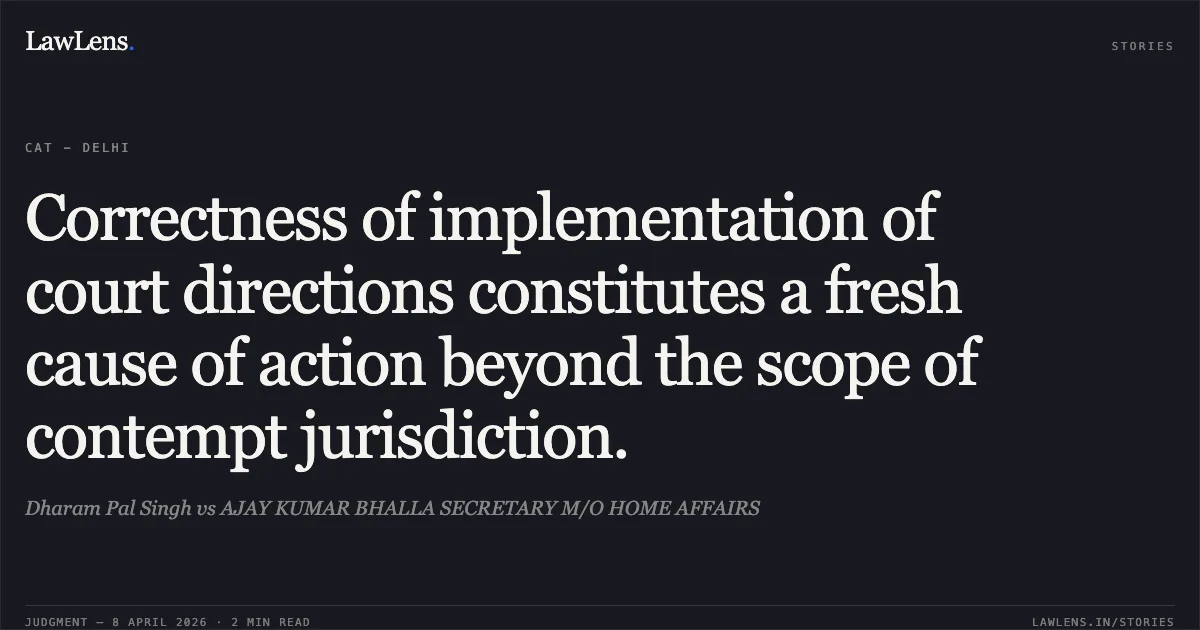
Source reference: para. 5The rule dictates that once the government passes an order to implement court directions, any dissatisfaction regarding the correctness or merits of that implementation (such as seniority lists or pay fixation) constitutes a fresh cause of action
Source reference: para. 5Such merits cannot be adjudicated under Section 12 of the Contempt of Courts Act, as the court's jurisdiction is confined to determining whether there was willful disobedience of the original order
Source reference: para. 5Reasoning
The Tribunal observed that the respondents had taken positive steps to implement the order, including obtaining competent authority approval and releasing financial arrears
Source reference: para. 2The core of the petitioners' current grievance was not a total failure to comply, but rather the "correctness" of the specific pay fixation and the resulting scale
Source reference: para. 3Relying on the J.S. Parihar precedent, the Tribunal reasoned that if a fresh order or calculation is made in purported compliance with a judicial direction, any error in that calculation—whether right or wrong—gives rise to a new legal grievance
Source reference: para. 5Redrawing scales or re-evaluating the merits of administrative pay fixation would exceed the scope of contempt jurisdiction, which is not an appellate or merit-based review of the compliance order itself
Source reference: para. 5Holding
The Tribunal held that since compliance had been effected by the grant of ACP/MACP benefits and payment of arrears, the contempt proceedings could not be used to litigate the accuracy of the pay fixation
The Contempt Petition (CP) was closed, and the notices issued to the respondents were discharged
Source reference: para. 6The Tribunal granted the petitioners liberty to agitate their specific grievances regarding pay scale fixation through fresh legal proceedings
Source reference: para. 6All associated Miscellaneous Applications (MAs) were disposed of accordingly
Source reference: para. 7Acts & Sections Cited
2 provisions across 1 statute referred to in this judgment. Each provision opens on LawLens.
Contempt of Courts Act, 19712
Original Court PDF
Dharam Pal SinghvsAJAY KUMAR BHALLA SECRETARY M/O HOME AFFAIRS
Click to open original judgment
Original judgment, available to read, download and summarize on LawLens.in


