Facts
On March 27, 1999, the body of Constable Rambir was found in a pit near Rajokri Pahari with gunshot and blunt force injuries.
Source reference: p.2An Election ID card belonging to Kuldeep was found five feet from the body.
Source reference: p.3Acting on secret information, police apprehended Kuldeep and Ajay near the house of Ishwar Singh in Gurgaon.
Source reference: p.3Pursuant to disclosure statements, police recovered the deceased’s scooter (with "Delhi Police" markings), a country-made pistol (ballistically matched to a cartridge at the scene), and blood-stained clothing from Ishwar’s residence.
Source reference: p.4-5The Trial Court convicted Kuldeep under Sections 302/201 IPC and Ishwar under Section 212 IPC, while acquitting two others.
Source reference: p.6Issues
Whether the circumstantial evidence, specifically the recovery of the ID card and weapon, is sufficient to sustain the conviction of Kuldeep under Section 302 IPC.
Source reference: p.15 / para. 49Whether the recovery of incriminating articles from a person’s residence, without evidence of giving physical shelter to the offenders, satisfies the ingredients of "harbouring" under Section 212 IPC.
Source reference: p.25 / para. 73Law Applied
The Court applied the "chain of circumstances" doctrine for circumstantial evidence, requiring that the evidence exclude every hypothesis of innocence.
Source reference: p.15, para. 50It applied Section 27 of the Indian Evidence Act, 1872, regarding the admissibility of facts discovered pursuant to a disclosure statement.
Source reference: p.21, para. 63For the charge of murder, Section 302 IPC was applied, noting that while motive is a relevant link in circumstantial cases, its absence is not fatal if the chain of evidence is otherwise complete.
Source reference: p.23, para. 68Regarding the charge against Ishwar, the Court interpreted Section 212 IPC, which requires the actual harboring or concealment of a person known to be an offender with the intent to screen them from legal punishment.
Source reference: p.26, para. 75Reasoning
Regarding Kuldeep, the Court found the "chain of circumstances" complete: (i) the recovery of his ID card at the scene was documented in the rukka before his arrest, ruling out planting; (ii) his disclosure led to the discovery of the victim's scooter and the weapon of offence; and (iii) ballistic reports matched the weapon to the scene.
Source reference: p.17, p.21, p.22The Court held that even if the motive was weak or associated with acquitted co-accused, the forensic and recovery links were clinching.
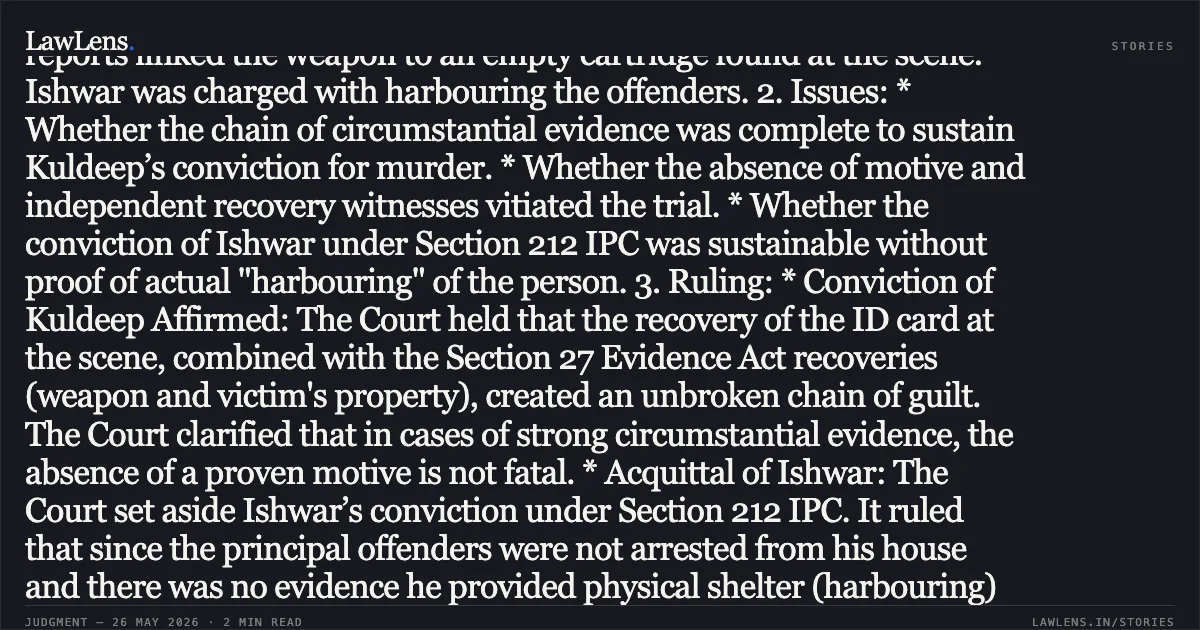
Source reference: p.24Regarding Ishwar, the Court found that while incriminating articles (scooter, bloody clothes) were found in his house, there was no evidence that Ishwar actually provided physical shelter or "harboured" the persons of the offenders.
Source reference: p.27The Court noted that while this might attract Section 201 IPC (disappearance of evidence), no such charge was framed, and Section 212 IPC could not be sustained solely on the recovery of objects without proof of sheltering the individuals.
Source reference: p.28Holding
The Court dismissed the appeal of Kuldeep, affirming his conviction and life sentence under Sections 302/201 IPC, holding that the forensic and recovery evidence formed an unbroken chain of guilt.
The Court allowed the appeal of Ishwar, setting aside his conviction under Section 212 IPC, holding that the prosecution failed to prove the essential ingredient of "harbouring the person" of the offender as distinct from concealing property.
Source reference: p.29, para. 79Acts & Sections Cited
30 provisions across 3 statutes referred to in this judgment. Each provision opens on LawLens.
Indian Penal Code, 1860
Code of Criminal Procedure, 19731
Arms Act, 19594
Original Court PDF
Kuldeep @ KalluvsState
Click to open original judgment
Original judgment, available to read, download and summarize on LawLens.in