Facts
The respondent, a Taluk Supply Officer (TSO), was prosecuted under Sections 7 and 13(1)(d) r/w 13(2) of the Prevention of Corruption Act, 1988.
Source reference: no citationThe complainant (PW1), an Authorized Ration Dealer, alleged that the respondent refused to countersign his "Abstract" register and demanded a bribe of ₹500
Source reference: p. 3A trap was laid by the Vigilance Department (PW17) where a marked ₹500 note was handed to the respondent.
Source reference: p. 6The note was recovered from the respondent’s shirt pocket, and his left-hand wash turned pink in the phenolphthalein test
Source reference: p. 6The Trial Court convicted the respondent, but the High Court acquitted him, holding that the "demand" was not established because PW1 turned hostile and gave inconsistent statements during cross-examination
Source reference: p. 2, 4The State appealed this acquittal to the Supreme Court.
Source reference: no citationIssues
1. Whether the demand for illegal gratification can be established when the complainant (PW1) turns hostile or gives prevaricating testimony
Source reference: p. 102. Whether the High Court erred in acquitting the accused despite proof of acceptance and corroborated evidence regarding the initial demand
Source reference: p. 15Law Applied
The Court applied Sections 7 and 13 of the Prevention of Corruption Act, 1988, noting that proof of demand and acceptance is a sine qua non for conviction as established in Neeraj Dutta v. State (NCT of Delhi)
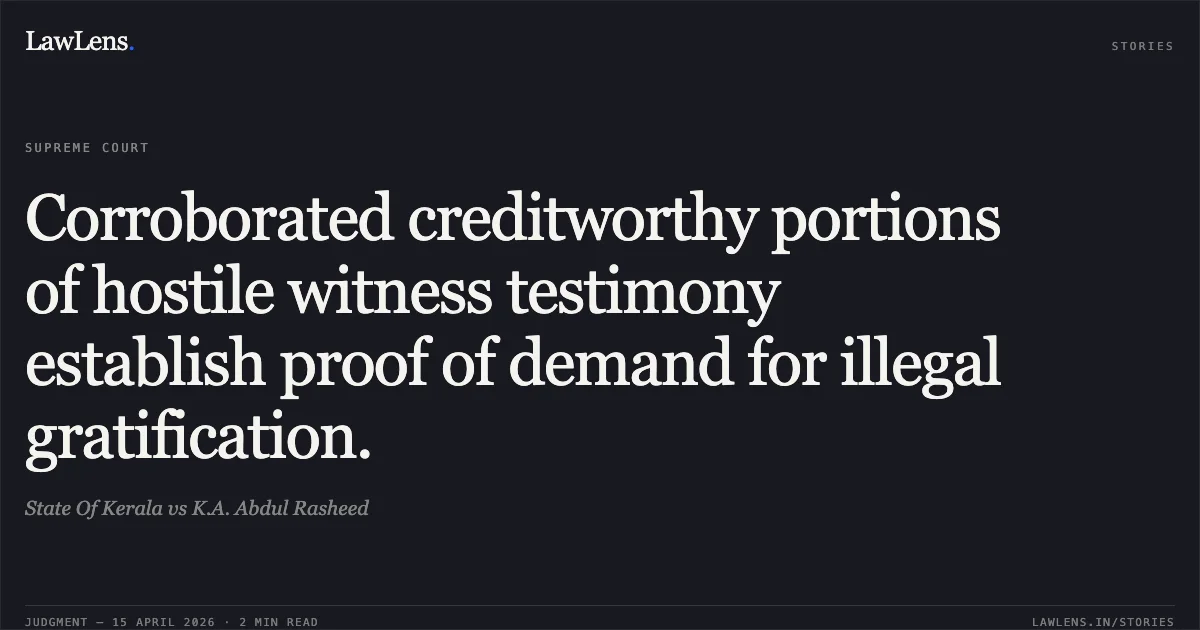
Source reference: p. 9It further relied on Sat Paul v. Delhi Administration, which holds that the evidence of a hostile witness is not "washed off the record" entirely; the Judge may accept the creditworthy parts of such testimony if corroborated by other evidence
Source reference: p. 10-11The Court also invoked the principle that a false explanation by the accused regarding the acceptance of money serves as an additional link in the chain of circumstances pointing toward guilt
Source reference: p. 15Reasoning
The Supreme Court held that the High Court failed to properly scrutinize the creditworthy portions of PW1's testimony.
Source reference: no citationAlthough PW1 prevaricated in cross-examination to favor the accused, he affirmed during his examination-in-chief that he had filed the oral complaint (Ext. P1) which detailed the demand of ₹500
Source reference: p. 12This was strongly corroborated by the independent witness (PW2) and the trap officer (PW17), both of whom witnessed PW1 confirming the truthfulness of the complaint at the time of the trap
Source reference: p. 13The Court distinguished Jayaraj B. v. State of Andhra Pradesh, noting that unlike that case, the complainant here did not disown the complaint itself
Source reference: p. 8Furthermore, the respondent admitted receiving the money but provided an inconsistent and false defense—claiming it was a loan repayment—which was contradicted by the alleged lender (PW8)
Source reference: p. 14The Court concluded that the demand was proved through the corroborated First Information Statement and the surrounding circumstances of the trap.
Source reference: no citationHolding
The Supreme Court allowed the appeal and set aside the High Court’s judgment of acquittal
The Court restored the Trial Court’s order of conviction and the sentence of two years (the statutory minimum) under Sections 7 and 13(1)(d) read with 13(2) of the Act
Source reference: p. 16The Court held that the demand was established beyond reasonable doubt by the affirmed contents of the initial complaint (Ext. P1) and the corroborative evidence of the trap team, notwithstanding the complainant’s subsequent hostility
Source reference: p. 15Acts & Sections Cited
5 provisions across 2 statutes referred to in this judgment. Each provision opens on LawLens.
Prevention of Corruption Act, 19883
Code of Criminal Procedure, 19732
Original Court PDF
State Of KeralavsK.A. Abdul Rasheed
Click to open original judgment
Original judgment, available to read, download and summarize on LawLens.in