Facts
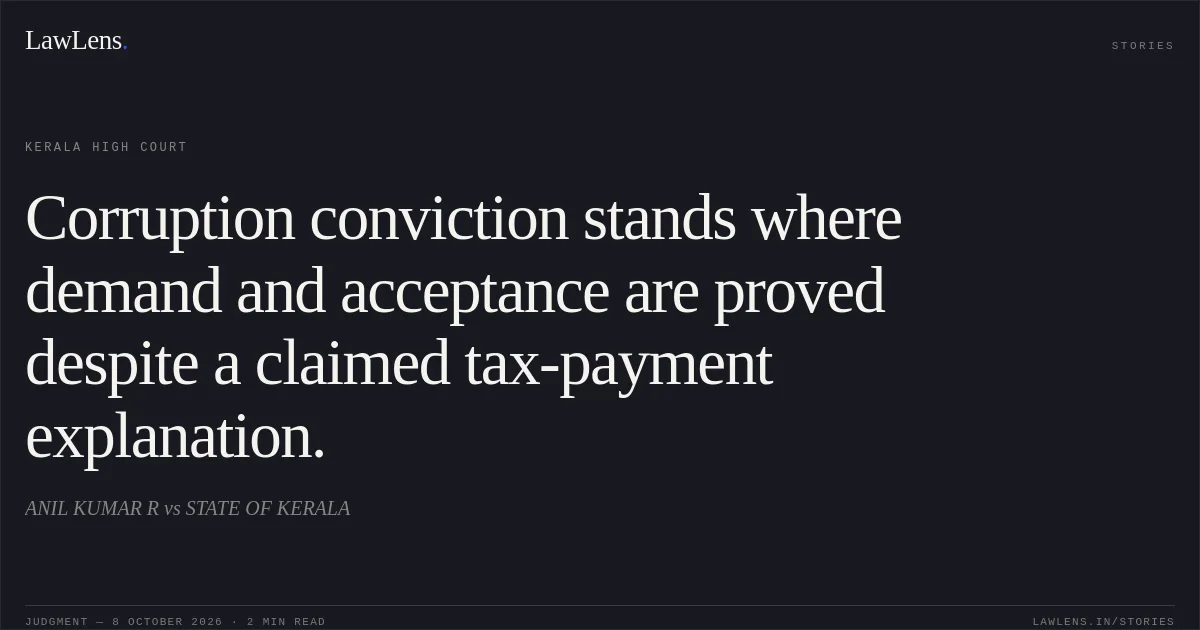
The appellant, a Village Assistant, was convicted by the Special Judge under Sections 7 and 13(2) read with Section 13(1)(d) of the Prevention of Corruption Act, 1988, for demanding ₹5,000 from PW1 to remit land tax and accepting it during a vigilance trap.
Source reference: p.2–4The appellant argued that the demand was unproved and that the money recovered was for tax and a welfare-fund contribution.
Source reference: p.5–7The prosecution relied principally on PW1’s evidence, corroboration by the trap witness PW2, and the recovery and phenolphthalein evidence.
Source reference: p.5–7, p.13–20The appeal challenged the conviction and sentence.
Source reference: no citationIssues
1. Whether the appellant committed the offence punishable under Section 7 of the Prevention of Corruption Act
Source reference: p.82. Whether the appellant committed the offence punishable under Section 13(2) read with Section 13(1)(d) of the Act
Source reference: p.83. Whether the conviction or sentence required appellate interference
Source reference: p.8Law Applied
The Court applied Sections 7 and 13(1)(d)(i)–(ii), read with Section 13(2), of the Prevention of Corruption Act, 1988.
Source reference: p.24–29Under Neeraj Dutta v. State (AIR 2023 SC 330), proof of demand and acceptance or obtainment of illegal gratification is necessary to establish the relevant offences; those facts may be proved by direct or circumstantial evidence, and a court may draw a factual inference from proved foundational facts.
Source reference: p.24–29For a Section 7 offence, Section 20 requires a rebuttable legal presumption once the facts in issue are proved; that presumption does not apply to Section 13(1)(d)(i)–(ii).
Source reference: p.24–29The Court also referred to Sunil Kumar K. v. State of Kerala, [2025 KHC OnLine 983], which reiterates that proof of demand is essential and recovery alone is insufficient.
Source reference: p.30–32Reasoning
The Court accepted PW1’s consistent evidence that the appellant demanded ₹5,000 on earlier occasions and again during the trap.
Source reference: p.9–12, p.14–20PW2 corroborated that the appellant took the treated ₹5,000 and put it in his pocket, while PW6 testified to hearing a telephone conversation in which the appellant demanded the money.
Source reference: p.9–12, p.14–20The Court rejected the defence that the ₹5,000 was for tax and welfare-fund contributions: Ext.P2 recorded tax of ₹3,017, and PW1 denied paying the additional ₹275.
Source reference: p.33–37PW1’s account that the tax amount was paid separately from the bribe was corroborated by PW2; the treated notes were recovered from the appellant’s pocket and tested positive.
Source reference: p.33–37The Court therefore found demand and acceptance proved, and the tax-receipt evidence did not rebut the prosecution case.
Source reference: p.33–37Holding
The Court held that the prosecution proved the offences under Sections 7 and 13(2) read with Section 13(1)(d) of the Prevention of Corruption Act.
It dismissed the appeal and confirmed the conviction and sentences of three years’ rigorous imprisonment and ₹50,000 fine under Section 7, and four years’ rigorous imprisonment and ₹50,000 fine under Section 13(2) read with Section 13(1)(d), with the substantive sentences to run concurrently.
Source reference: p.37–38The suspension of sentence and bail were vacated, and the appellant was directed to appear before the Special Court to undergo sentence.
Source reference: p.38Acts & Sections Cited
5 provisions across 2 statutes referred to in this judgment. Each provision opens on LawLens.
Prevention of Corruption Act, 19884
Code of Criminal Procedure, 19731
Original Court PDF
ANIL KUMAR RvsSTATE OF KERALA
Click to open original judgment
Original judgment, available to read, download and summarize on LawLens.in