Facts
The Respondent obtained an ex parte decree against the Appellants for ₹23,00,000, with interest and costs, after the Appellants—who had been served with summons—failed to file a written statement or appear in the suit
Source reference: para. 10–11The Appellants said they learned of the decree when execution proceedings reached them in September 2025.
Source reference: para. 12–16They filed an application under Order IX Rule 13 CPC, with an application under Section 5 of the Limitation Act, relying on their former counsel’s alleged failures and the death of Appellant No. 2’s brother.
Source reference: para. 12–16The Commercial Court dismissed the applications as time-barred and found no sufficient cause for non-appearance.
Source reference: para. 1, 17The Appellants appealed under Section 13 of the Commercial Courts Act, 2015, read with Order XLIII Rule 1(d) CPC.
Source reference: para. 1, 17Issues
Whether the Appellants established sufficient cause under Order IX Rule 13 CPC for their failure to appear when the suit proceeded ex parte.
Source reference: para. 25, 27–28Whether the Appellants established grounds to condone the delay in applying to set aside the ex parte decree, including whether limitation ran from the date of the decree or their asserted date of knowledge.
Source reference: para. 17, 29Law Applied
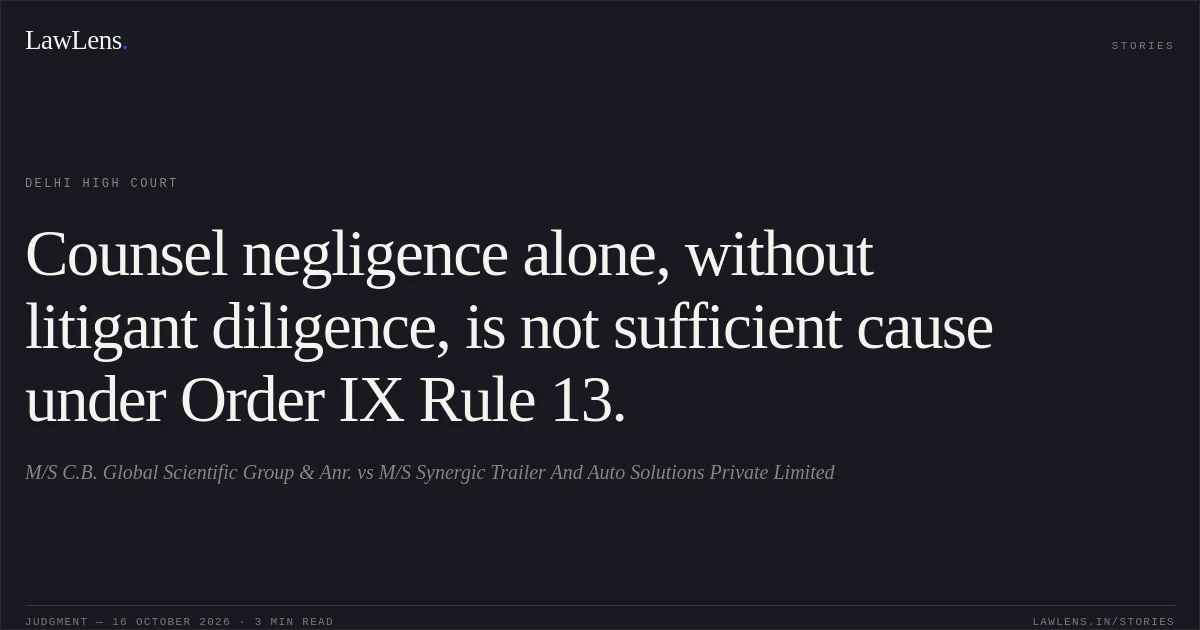
Under Order IX Rule 13 CPC, an ex parte decree may be set aside if summons were not duly served or the defendant was prevented by sufficient cause from appearing; where summons were duly served, the second proviso bars setting aside the decree merely for irregularity in service if the defendant had notice of the hearing date and sufficient time to appear.
Source reference: para. 25“Sufficient cause” is assessed contextually and requires the court to consider whether the defendant acted bona fide and diligently; it is not established by a bare assertion of counsel’s default.
Source reference: para. 26, 30The Court relied on *Parimal v. Veena*, *G.P. Srivastava v. R.K. Raizada*, and *Hira Sweets & Confectionary Private Ltd. v. Hira Confectioners* on the meaning and application of sufficient cause.
Source reference: para. 26It also considered the principle in *Rafiq v. Munshilal* that a litigant should not ordinarily suffer for counsel’s fault, while holding that the principle does not displace the requirement of the litigant’s own bona fide conduct and reasonable diligence.
Source reference: para. 22, 30Section 5 of the Limitation Act permits condonation of delay where sufficient cause is shown; the Court held that, given due service, limitation was to be reckoned from the date of the decree rather than the asserted date of knowledge.
Source reference: para. 17, 29Reasoning
The Court found that the brother’s death, though a serious personal tragedy, did not explain the Appellants’ continued absence over the months following the event, including their failure to appear after being proceeded ex parte.
Source reference: para. 27The allegations that counsel had repeatedly assured them the case was being handled were unsupported by particulars or evidence, and the later complaint against counsel did not establish sufficient cause for the earlier defaults.
Source reference: para. 28Although the Appellants took steps after learning of the decree, those steps did not explain why they failed to pursue the Order IX Rule 13 remedy sooner; in any event, due service meant limitation ran from the decree date.
Source reference: para. 29The Court therefore concluded that neither sufficient cause for non-appearance nor an adequate explanation for delay had been shown.
Source reference: para. 30–31Holding
The High Court held that the Appellants had not established sufficient cause under Order IX Rule 13 CPC or grounds to condone the delay.
It found no error in the Commercial Court’s dismissal of the applications, dismissed the appeal, disposed of the pending applications, and made no order as to costs.
Source reference: para. 31–33Acts & Sections Cited
3 provisions across 3 statutes referred to in this judgment. Each provision opens on LawLens.
Commercial Courts Act, 20151
Code of Civil Procedure, 19081
Limitation Act, 19631
Original Court PDF
M/S C.B. Global Scientific Group & Anr.vsM/S Synergic Trailer And Auto Solutions Private Limited
Click to open original judgment
Original judgment, available to read, download and summarize on LawLens.in