Facts
The plaintiffs (Respondents 1–7) filed a civil suit for partition, declaration, and permanent injunction regarding a residential property in Chomu, Jaipur, based on a family settlement dated 06.02.1994.
Source reference: para 8.3Defendants No. 1, 3, and 4 filed a written statement admitting the joint family nature of the property and submitted a counter-claim for partition of their respective shares based on the same settlement.
Source reference: para 8.5Petitioners (Defendants No. 2 and 5–11) contested the suit, alleging the settlement document was forged.
Source reference: para 8.4In 2014, the Petitioners moved an application to strike out the counter-claim, which was dismissed on 26.05.2015.
Source reference: para 19After the plaintiffs' evidence concluded, the Petitioners filed a second application (Annx. 11) seeking the same relief—striking out the counter-claim and related evidence—arguing a defendant cannot file a counter-claim against a co-defendant.
Source reference: para 1The trial court dismissed this second application on 28.03.2026, leading to this writ petition.
Source reference: para 1, 5Issues
Whether in a suit for partition, a defendant can set up a counter-claim against a co-defendant?
Source reference: para 7, 9Whether the order dated 26.05.2015 operates as res judicata against the petitioners, preventing them from re-agitating the same issue at a subsequent stage of the same suit?
Source reference: para 7, 21Law Applied
The Court applied Order VIII Rule 6-A of the CPC, which allows a defendant to set up a counter-claim to avoid multiplicity of proceedings.
Source reference: para 9-10The Court relied on Rohit Singh v. State of Bihar [(2006) 12 SCC 734], which generally prohibits counter-claims directed solely against co-defendants, but distinguished it using the principle that in partition suits,ทุก parties are deemed "suing persons" and their status is interchangeable, as held in A. Krishna Shenoy v. Ganga Devi G. [2023] and A. Mohamed Sulaiman v. A. Ameena Beevi.
Source reference: para 14-15Regarding the second issue, the Court applied the doctrine of "interlocutory res judicata" based on Satyadhyan Ghosal v. Deorajin Debi [AIR 1960 SC 941] and B.S. Lalitha v. Bhuvanesh [2026 SCC Online SC 860], which mandates that a decision at one stage of litigation is binding on the parties in subsequent stages of the same proceeding.
Source reference: para 21-22Reasoning
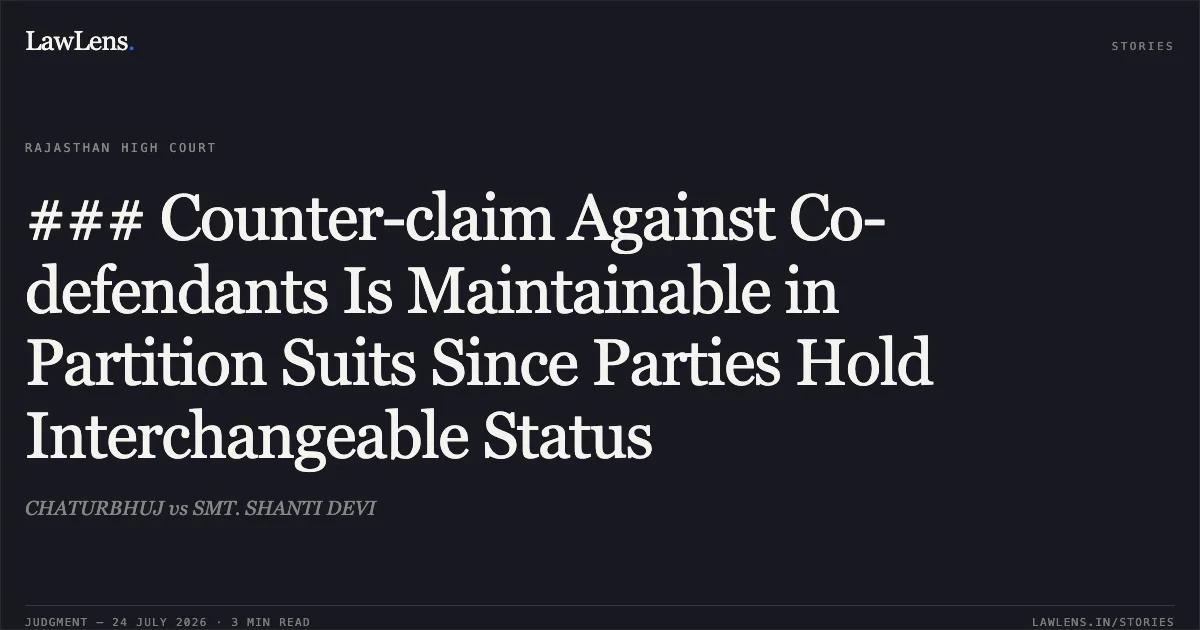
Regarding the first issue, the Court reasoned that while a counter-claim is typically directed against the plaintiff, the unique nature of partition suits—where defendants effectively seek the same relief as plaintiffs—allows for such claims against co-defendants.
Source reference: para 14-18It noted that the petitioners’ defense against both the main claim and the counter-claim was identical (denial of the settlement document), and thus resolving them together aligns with the legislative intent to prevent multiple trials.
Source reference: para 16Regarding the second issue, the Court found that the petitioners had already challenged the maintainability of the counter-claim in 2014 and lost via an order dated 26.05.2015.
Source reference: para 19-20Since that order reached finality and was decided on merits, the petitioners were legally barred from filing a second application for the same relief at the evidence stage under the principle of interlocutory res judicata.
Source reference: para 23Holding
The High Court dismissed the writ petition, holding that (i) in partition suits, a counter-claim by a defendant against a co-defendant is maintainable as the parties' roles are interchangeable; and (ii) the petitioners were estopped from re-challenging the counter-claim due to the prior binding order of 26.05.2015.
The trial court's order dated 28.03.2026 was upheld.
Source reference: para 24Acts & Sections Cited
1 provisions across 1 statute referred to in this judgment. Each provision opens on LawLens.
Code of Civil Procedure, 19081
Original Court PDF
CHATURBHUJvsSMT. SHANTI DEVI
Click to open original judgment
Original judgment, available to read, download and summarize on LawLens.in