Facts
The respondents (plaintiffs) filed a suit for declaration, injunction, and possession regarding ancestral property through their grandfather, Ram Sahay
Source reference: para. 2The appellant (Defendant No. 8) filed a counterclaim asserting sole ownership via a Will executed by Ram Sahay
Source reference: para. 2During the trial, a handwriting expert report found the Will's signatures to be forged; however, the Trial Court discarded the report and allowed the appellant’s counterclaim, effectively unsettling the recorded ownership of co-defendants No. 10 and 11
Source reference: para. 3, 4The co-defendants had previously been denied an application to amend their written statements to contest the counterclaim
Source reference: para. 2, 6On appeal, the First Appellate Court set aside the Trial Court's judgment and remanded the matter for a fresh decision after obtaining a new handwriting expert report comparing thumb impressions from the testator's service book
Source reference: para. 1The appellant challenged this remand order in the present Misc. Appeal
Source reference: para. 1Issues
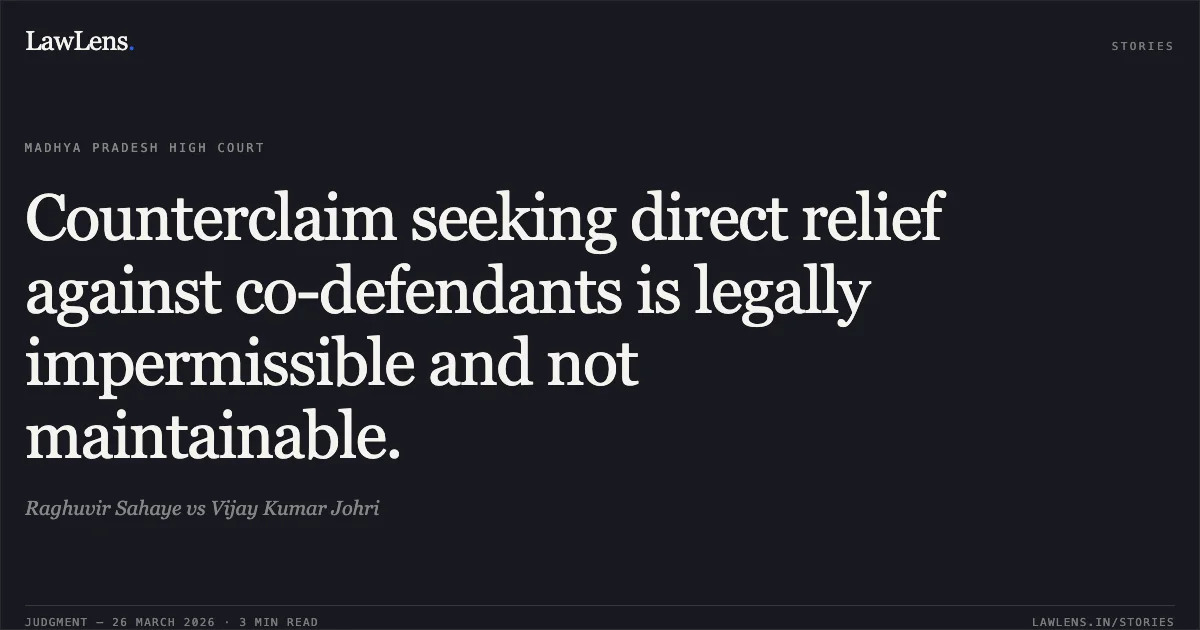
1. Whether a counterclaim filed by a defendant is maintainable when it seeks direct relief or has combative repercussions against the rights, title, and interest of co-defendants.
Source reference: para. 52. Whether the Trial Court’s decree on the counterclaim violated the principles of natural justice by unsettling the rights of co-defendants without allowing them to amend their pleadings.
Source reference: para. 6Law Applied
The Court primarily applied the principles governing counterclaims under the Code of Civil Procedure (CPC), specifically interpreting the limits of Order VIII Rule 6A.
Source reference: para. 5It relied on the Supreme Court precedents of Sanjay Tiwari v. Yugal Kishore Prasad Sao and others (AIR 2025 SCC 5576) and Rajul Manoj Shah @ Rajeshwari Rasiklal Sheth v. Kiran Bhai Shakra Bhai Patel and another (AIR 2025 SCC 4284), which establish that a counterclaim intended to claim direct relief against co-defendants is not permissible in law
Source reference: para. 5Furthermore, the Court exercised its remedial powers under Order 41 Rule 33 of the CPC (read with Order 43 Rule 2) to pass orders necessary for doing justice between the parties, even regarding issues not explicitly challenged during the trial
Source reference: para. 6, 7Reasoning
The High Court observed that while the appellant’s counterclaim was technically directed at the plaintiffs, its legal effect was to strip the co-defendants (No. 10 and 11) of their recorded ownership
Source reference: para. 5Following the Sanjay Tiwari doctrine, the Court reasoned that a counterclaim cannot survive if it seeks to decide rights and liabilities between co-defendants; the proper remedy for such a claim is an independent civil suit
Source reference: para. 5, 6The Court highlighted a "grim violation" of natural justice, noting that the Trial Court had passed a decree against co-defendants while simultaneously denying them the opportunity to amend their written statements to address the counterclaim
Source reference: para. 6Consequently, the Court found that the Trial Court's failure to address the maintainability of the counterclaim was a fundamental legal error that superseded the merits of the First Appellate Court's specific remand directions regarding the handwriting expert
Source reference: para. 7, 8Holding
The High Court held that a counterclaim cannot be used to litigate rights between co-defendants for direct relief
Without examining the propriety of the First Appellate Court's specific directions for expert evidence, the Court held that the entire trial of the counterclaim required a fresh hearing on the threshold of maintainability
Source reference: para. 7, 8The Court directed the Trial Court to first determine whether the counterclaim filed by the appellant is maintainable against the co-defendants and to decide the matter accordingly
Source reference: para. 8The appeal was disposed of with these directions
Source reference: para. 9Original Court PDF
Raghuvir SahayevsVijay Kumar Johri
Click to open original judgment
Original judgment, available to read, download and summarize on LawLens.in