Facts
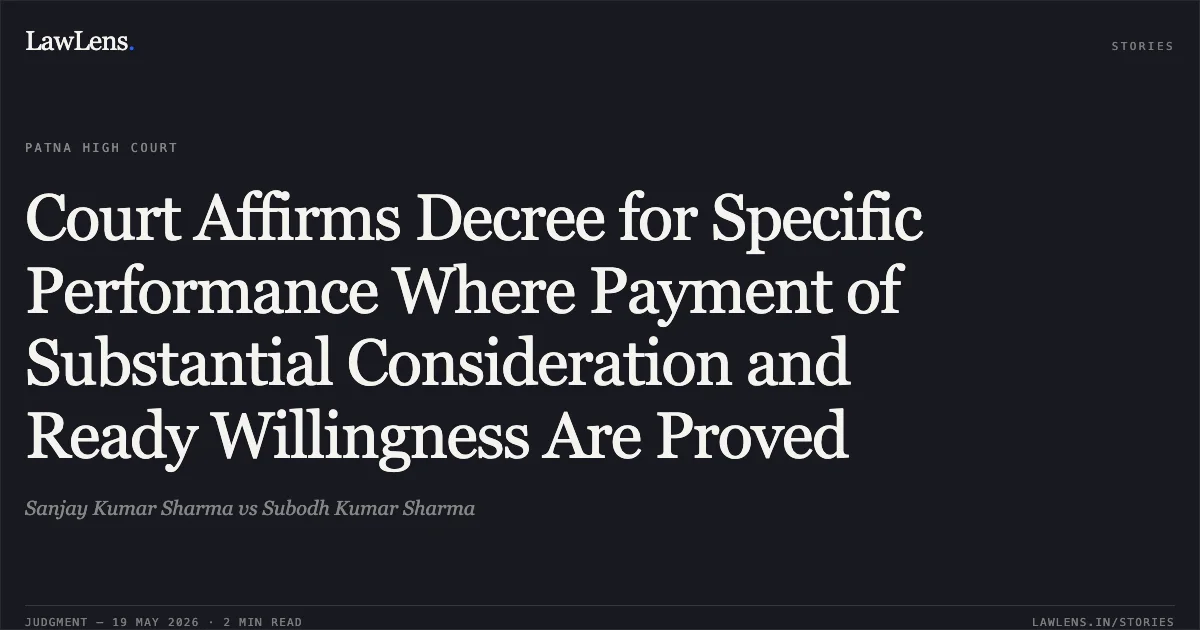
The Plaintiff (Respondent No. 1) filed a suit for specific performance based on a Baibeyana (agreement for sale) dated 10.02.2004 for land in Patna.
Source reference: p.2The Plaintiff alleged a total consideration of Rs. 3,00,000, of which Rs. 2,94,000 (98%) was paid over several installments.
Source reference: p.3The Defendant (Appellant) contended the suit land was never intended for sale; instead, he claimed he took a loan of Rs. 1,44,000 and the Plaintiff fraudulently converted blank signed stamp papers into a sale agreement.
Source reference: p.4During the trial, the Defendant’s father (D.W. 1) admitted the agreement was prepared in his presence and identified the signatures of the Defendant as a "vendor".
Source reference: p.14-15The trial court decreed the suit in favor of the Plaintiff on 22.03.2014.
Source reference: p.1During the pendency of the appeal, the sale deed was executed via the executing court, and the property was subsequently sold to Respondent No. 2.
Source reference: p.12-13Issues
1. Whether the Baibeyana deed dated 10.02.2004 was legally valid and genuine or a result of fraud.
Source reference: para. 8, Issue VI2. Whether the Plaintiff was ready and willing to perform his part of the contract as per Section 16(c) of the Specific Relief Act.
Source reference: para. 8, Issue V3. Whether the non-disclosure of a legal notice (Exhibit-3) by the Defendant requesting to return the "loan" rendered the suit non-maintainable.
Source reference: para. 11, 19Law Applied
Section 16(c) of the Specific Relief Act, 1963, which mandates that a plaintiff must aver and prove continuous readiness and willingness to perform the contract.
Source reference: p.22The principle from P. Ramasubbamma v. V. Vijayalakshmi (2022), establishing that once execution of the agreement and receipt of substantial consideration are admitted, the burden on the plaintiff is largely discharged.
Source reference: p.12, 20Section 96 of the Code of Civil Procedure, 1908, regarding the powers of the first appellate court to re-appreciate evidence.
Source reference: p.1, 24N.P. Thirugnanam v. Dr. R. Jagan Mohan Rao (1995) regarding the discretionary nature of specific performance.
Source reference: p.24Reasoning
The Court found the Defendant’s "loan agreement" defense untenable because the Defendant’s own father (D.W. 1) and the Defendant himself (D.W. 4) admitted to the signatures on Exhibit-1 and identified the Defendant as the "vendor".
Source reference: para. 27-29, 33The Court noted that the Defendant had made a handwritten endorsement "o"kqy ik;k" (received/realized) on the deed, which is inconsistent with a loan transaction.
Source reference: para. 35Regarding readiness and willingness, the Court observed that the Plaintiff had paid 98% of the consideration (Rs. 2,94,000 out of Rs. 3,00,000), which strongly corroborated his bona fides.
Source reference: para. 42The Defendant's reliance on Exhibit-3 (a notice offering to return money) was rejected as it did not constitute a valid unilateral rescission of a contract where substantial rights had already accrued to the Plaintiff.
Source reference: para. 52-53The Court concluded that the Plaintiff’s consistent legal notices (Exhibit-2 series) proved continuous willingness.
Source reference: para. 48Holding
The Court held that the agreement was genuine, the Plaintiff was ready and willing, and the Defendant’s evidence was contradictory.
The Court dismissed the appeal, affirmed the judgment and decree of the Sub-Judge-V, Patna City, and ordered the Defendant-Appellant to hand over possession of the suit property to the Plaintiff-Respondent within thirty days.
Source reference: para. 58-60Acts & Sections Cited
3 provisions across 2 statutes referred to in this judgment. Each provision opens on LawLens.
Code of Civil Procedure, 19082
Specific Relief Act, 19631
Original Court PDF
Sanjay Kumar SharmavsSubodh Kumar Sharma
Click to open original judgment
Original judgment, available to read, download and summarize on LawLens.in