Facts
Nawab Singh was the recorded bhumidhar and owner of the disputed agricultural land.
Source reference: no citationBabu Singh alleged that Nawab Singh executed an agreement to sell the property to him on 22 April 1972 for ₹7,500, received ₹3,500 as earnest money, and delivered possession in part performance.
Source reference: para. 4–5On Nawab Singh’s failure to execute the sale deed, Babu Singh instituted a suit for specific performance on 24 October 1973.
Source reference: para. 4–5Before the suit was instituted, Chhajju Ram had filed a money suit against Nawab Singh and obtained attachment before judgment over the property.
Source reference: para. 6After obtaining a money decree, Chhajju Ram purchased the property in a court auction held on 17 April 1974, during the pendency of the specific-performance suit.
Source reference: para. 6Babu Singh’s objection to the auction sale under Section 47 CPC and Order XXI Rule 58 CPC was dismissed on 14 December 1974; the sale was subsequently confirmed and possession was delivered to Chhajju Ram.
Source reference: para. 6Chhajju Ram was impleaded in the specific-performance suit and contended that the agreement to sell was fabricated, that the execution proceedings were valid, and that he had acquired indefeasible title as a bona fide court-auction purchaser.
Source reference: para. 7–8The Trial Court found the agreement genuine, the earnest-money payment and delivery of possession proved, and the plaintiff continuously ready and willing to perform his obligations.
Source reference: para. 9–10It decreed specific performance, directing payment of the balance consideration to Chhajju Ram.
Source reference: para. 9–10The First Appellate Court affirmed the decree.
Source reference: para. 11–13Chhajju Ram preferred the present second appeal under Section 100 CPC.
Source reference: no citationIssues
Whether a suit for specific performance of an agreement to sell immovable property can be enforced against a purchaser who acquired the property in execution of a decree against the original owner?
Source reference: para. 3; para. 30–40Whether the finding or order passed in the execution proceedings on the plaintiff’s objection to attachment and sale operated as res judicata against the plaintiff’s suit for specific performance?
Source reference: para. 3; para. 41–53Law Applied
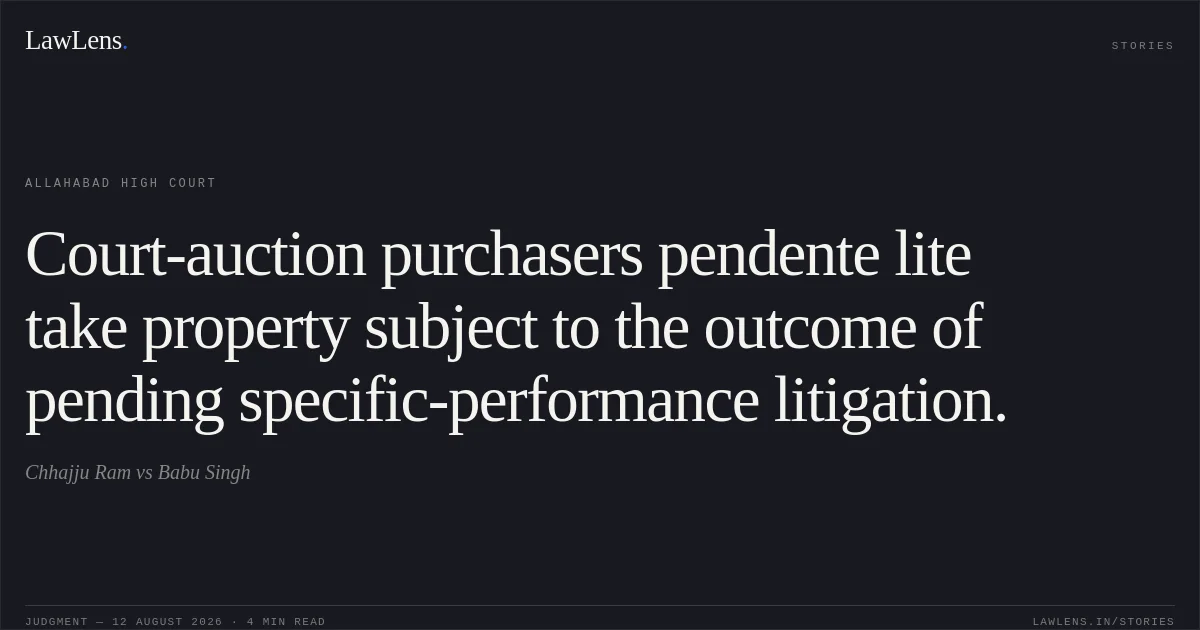
The Court applied Section 52 of the Transfer of Property Act, 1882, embodying the doctrine of lis pendens, under which a transferee acquiring property during the pendency of litigation takes it subject to the result of that litigation.
Source reference: para. 33–39The principle applies even to involuntary alienations such as court sales, as recognised in Samarendra Nath Sinha v. Krishna Kumar Nag and Kedarnath Lal v. Sheonarain.
Source reference: para. 33–39An agreement to sell does not itself create title or an interest in immovable property but creates an enforceable contractual right capable of specific performance.
Source reference: para. 31Under Section 100 CPC, concurrent findings of fact are not ordinarily interfered with unless shown to be perverse, unsupported by evidence, or vitiated by a substantial error of law.
Source reference: para. 54–57The discretionary nature of specific performance under Section 20 of the Specific Relief Act requires equitable and judicial exercise of discretion, including consideration of hardship and conduct, as explained in Her Highness Maharani Shantidevi P. Gaikwad v. Savjibhai Haribhai Patel, V. Muthusami v. Angammal, and Bal Krishna v. Bhagwan Das.
Source reference: para. 19–21Because the execution objection arose under the unamended Order XXI Rules 58 and 63 CPC, its dismissal had only the limited statutory conclusiveness prescribed by Rule 63 regarding the property’s liability to attachment and sale in execution of that particular decree; it did not operate as general res judicata over an independent contractual claim, as explained in Mangru Mahto v. Thakur Taraknathji Tarakeshwar Math.
Source reference: para. 42–46Reasoning
The specific-performance suit was instituted on 24 October 1973, whereas the court auction occurred on 17 April 1974. The auction purchaser therefore acquired the property pendente lite.
Source reference: para. 32–40Applying Section 52 TPA and the principles in Samarendra Nath Sinha and Kedarnath Lal, the Court held that the auction sale was not void, but Chhajju Ram’s title remained subject to the result of the pending specific-performance litigation; absence of notice could not defeat lis pendens.
Source reference: para. 32–40The dismissal of Babu Singh’s objection in the execution proceedings did not bar the suit.
Source reference: para. 47–52Under the then-applicable unamended Rule 63, the order was conclusive only on whether the property was liable to attachment and sale in execution of Chhajju Ram’s decree.
Source reference: para. 47–52It was not an adjudication of the entire contractual dispute or of Babu Singh’s independent right to specific performance, particularly since that suit had already been instituted before the execution objection was decided.
Source reference: para. 47–52The Court further found no basis under Section 100 CPC to disturb the concurrent factual findings that the agreement was genuine, earnest money had been paid, possession had been delivered, and Babu Singh remained ready and willing to perform.
Source reference: para. 54–62The higher auction price paid by Chhajju Ram did not, by itself, establish such hardship or inequity as to justify refusing specific performance.
Source reference: para. 54–62Holding
The first issue was answered in the affirmative: a purchaser at a court auction conducted during the pendency of a specific-performance suit takes the property subject to the result of that litigation, notwithstanding that the sale is involuntary.
The second issue was answered in the negative: dismissal of the execution objection under the unamended Order XXI Rule 58, read with Rule 63 CPC, did not operate as res judicata against the independent and already-pending suit for specific performance, though it had limited statutory conclusiveness concerning attachment and sale under the particular decree.
Source reference: para. 63The High Court found no ground for interference under Section 100 CPC, affirmed the judgments and decrees of the Trial Court and First Appellate Court, and dismissed the second appeal without costs.
Source reference: para. 64–65Acts & Sections Cited
5 provisions across 3 statutes referred to in this judgment. Each provision opens on LawLens.
Code of Civil Procedure, 19083
Transfer of Property Act, 18821
Specific Relief Act, 19631
Original Court PDF
Chhajju RamvsBabu Singh
Click to open original judgment
Original judgment, available to read, download and summarize on LawLens.in