Facts
The respondent (aggrieved person) married petitioner No. 1 in 2020 and alleged that upon joining her matrimonial home in 2021, she was subjected to domestic violence, mental agony, and molestation by her father-in-law (petitioner No. 2).
Source reference: p. 2Initially, the Trial Magistrate granted an ex-parte interim order for monetary compensation and residence.
Source reference: p. 2However, on 11.11.2023, the Trial Magistrate dismissed her application under Section 23 of the Protection of Women from Domestic Violence (DV) Act, citing inconsistencies in her testimony and the non-filing of an affidavit of assets.
Source reference: p. 3, 4The respondent appealed this dismissal. The Appellate Court (Additional Sessions Judge, Ganderbal) set aside the Trial Magistrate's order on 12.11.2025, awarding interim maintenance of Rs. 5,000 and a rent allowance of Rs. 2,500.
Source reference: p. 4The petitioners challenged this appellate order before the High Court.
Source reference: p. 4Issues
1. Whether the Trial Magistrate exceeded its jurisdiction by performing a meticulous analysis of evidence at the stage of deciding an interim application under Section 23 of the DV Act.
Source reference: p. 52. Whether the non-filing of an affidavit of assets and liabilities extinguishes the right to claim maintenance under the DV Act.
Source reference: p. 63. Whether a subsequent claim of divorce by the husband can be adjudicated during the challenge to an interim maintenance order.
Source reference: p. 6, 7Law Applied
Section 23 of the Protection of Women from Domestic Violence Act, which empowers the Magistrate to grant interim and ex-parte orders.
Source reference: p. 4The standard of proof for interim relief is only a prima facie satisfaction regarding the existence of a domestic relationship and the likelihood of domestic violence.
Source reference: p. 5Procedural requirements, such as the filing of an affidavit of assets (as per the guidelines in Rajnesh v. Neha), are essential but their absence does not automatically extinguish a statutory right to maintenance.
Source reference: p. 6Reasoning
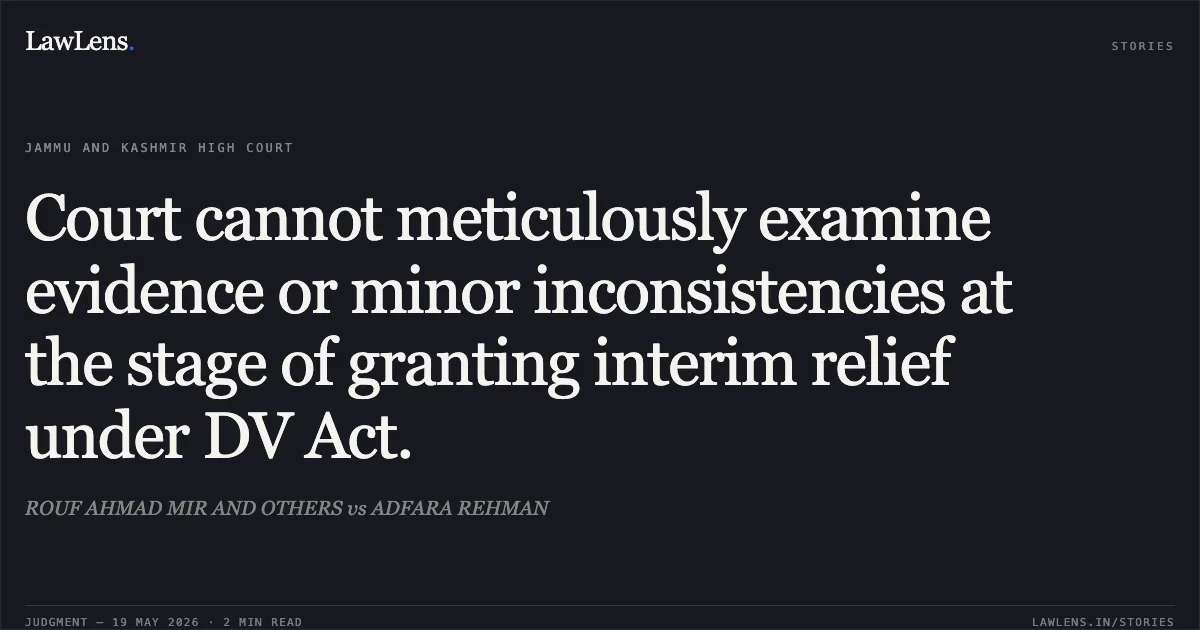
The High Court found that the Trial Magistrate erred by conducting a "minute" and "meticulous" analysis of the aggrieved person's statement, focusing on minor inconsistencies in dates to deny interim relief.
Source reference: p. 5The Court reasoned that such an evidentiary examination is premature at the Section 23 stage, where the Court need only be satisfied on a prima facie basis.
Source reference: p. 5, 6Regarding the procedural lapse claimed by the Trial Magistrate, the High Court noted that the Appellate Court found the requisite affidavit was already on record, and regardless, a procedural delay does not invalidate the right to protection.
Source reference: p. 6The Court refused to entertain the petitioner’s claim of a 2023 divorce deed, noting that its validity and its subsequent effect on the DV Act proceedings are matters of trial for the Magistrate to decide during final disposal.
Source reference: p. 6, 7Holding
The High Court dismissed the petition, holding that the Appellate Court’s order was well-reasoned and lucid.
Court affirmed the award of Rs. 5,000 per month as interim monetary assistance and Rs. 2,500 as rent/residential assistance to the respondent.
Source reference: p. 4, 7Trial Courts should avoid detailed appreciation of evidence while deciding interim maintenance applications under the DV Act.
Source reference: p. 6The petition was dismissed as being without merit.
Source reference: p. 7Acts & Sections Cited
3 provisions across 1 statute referred to in this judgment. Each provision opens on LawLens.
Protection of Women from Domestic Violence Act, 20053
Original Court PDF
ROUF AHMAD MIR AND OTHERSvsADFARA REHMAN
Click to open original judgment
Original judgment, available to read, download and summarize on LawLens.in