Facts
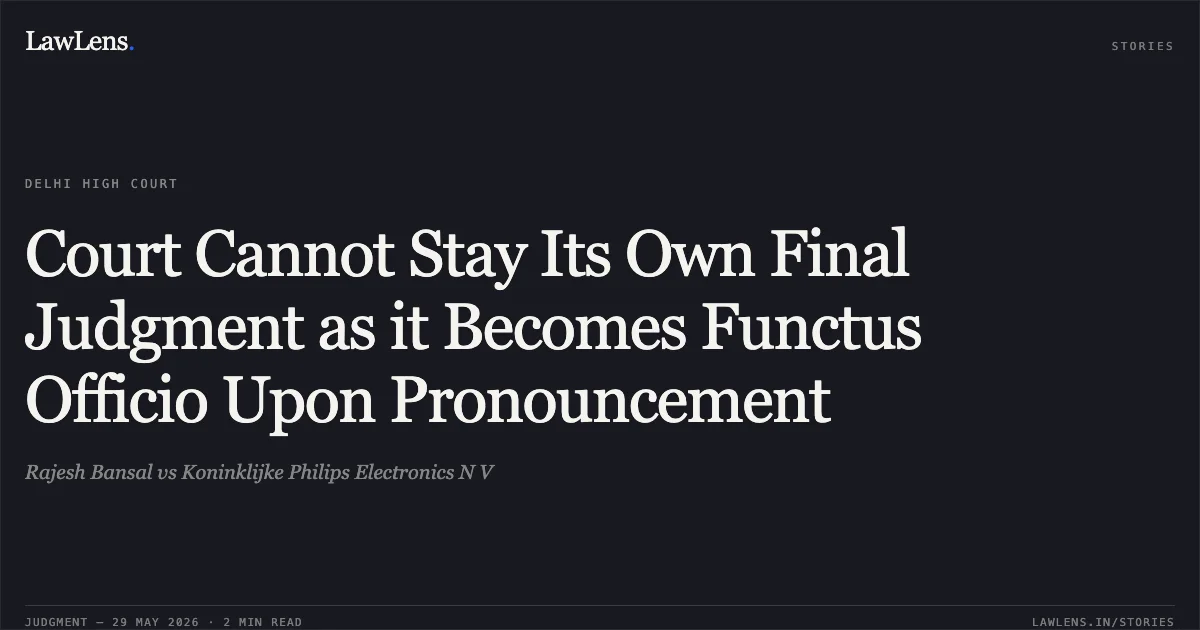
The Appellants (K.K. Bansal and Rajesh Bansal) succeeded in their appeals against the Respondent (Philips) via a judgment dated May 18, 2026.
Source reference: para. 2Following this judgment, the Respondent filed CM APPL. 36039/2026 seeking to keep the final judgment and decree in abeyance for eight weeks.
Source reference: para. 2Simultaneously, the Appellants filed CM APPL. 36038/2026 & 36040/2026 seeking refund of ₹4.5 crores that had been deposited in court and subsequently withdrawn by the Respondent against bank guarantees during the pendency of the appeal.
Source reference: paras. 17-20Issues
1. Whether a court has the jurisdiction to place its own final appellate judgment and decree in abeyance after it has been pronounced and signed.
Source reference: para. 32. Whether Section 151 of the Code of Civil Procedure (CPC) can be invoked to grant substantive relief or stay an order when the court has become functus officio.
Source reference: para. 10Law Applied
The court applied the doctrine of functus officio, which dictates that once a court renders a final decision, its authority over the matter is exhausted except for specific statutory exceptions.
Source reference: paras. 4, 106Section 152 of the CPC regarding the correction of clerical or arithmetical mistakes and Section 114 read with Order XLVII regarding review jurisdiction.
Source reference: para. 4Dwaraka Das v. State of Madhya Pradesh, establishing that Section 152 cannot be used to modify the merits of a judgment.
Source reference: para. 5State Bank of India v. S.N. Goyal, confirming a judge becomes functus officio the moment a judgment is pronounced, signed, and dated.
Source reference: para. 6Tecnimont (P) Ltd. v. State of Punjab, Section 151 (inherent powers) cannot be used to create new substantive rights or bypass specific prohibitions in the CPC.
Source reference: para. 10Reasoning
The Court reasoned that once an appellate judgment is signed and delivered, the court’s province is restricted solely to review or correcting ministerial errors; it cannot "tinker" with or postpone the effective date of the judgment.
Source reference: paras. 5-7To stay its own order would be "paradoxical," as a stay requires a prima facie finding of illegality, which a court cannot logically conclude about its own decision.
Source reference: para. 9The Court noted that the power to stay a decree vests exclusively with a higher Appellate Court under Order XLI of the CPC.
Source reference: para. 11Regarding the refund of the deposit, the Court observed that since the Appellants had succeeded in the appeal, the Respondent was legally obligated to return the withdrawn funds, though the Court granted a reasonable window of eight weeks for such repayment upon the Respondent’s request.
Source reference: para. 21-22Holding
The Court dismissed the Respondent's application for abeyance (CM APPL. 36039/2026), holding it was non-maintainable as the court was functus officio.
It allowed the Appellants' applications (CM APPL. 36038/2026 & 36040/2026) to the extent that the Respondent must return the ₹4.5 crores to the Appellants within eight weeks, following which the Respondent’s bank guarantees would be discharged.
Source reference: paras. 22-23Acts & Sections Cited
4 provisions across 2 statutes referred to in this judgment. Each provision opens on LawLens.
Code of Civil Procedure, 19083
Code of Criminal Procedure, 19731
Original Court PDF
Rajesh BansalvsKoninklijke Philips Electronics N V
Click to open original judgment
Original judgment, available to read, download and summarize on LawLens.in