Facts
The applicant sought to quash FIR No. 11206062210543 of 2021 registered at Satlasana Police Station for offences under Sections 406, 420, and 120B of the IPC; Sections 13 and 14 of the Securities Contracts (Regulation) Act (SCRA), 1956; and Sections 66(C) and 66(D) of the IT Act
Source reference: p. 1-2The prosecution alleged that several accused persons conspired to conduct unauthorized "Dabba trading" (illegal stock trading) using a mobile application to cause financial loss to the Government and violate SEBI rules
Source reference: p. 2-3The applicant's name surfaced during the investigation, though he was not named in the initial raid
Source reference: p. 11Issues
1. Whether a court can take cognizance of offences under the Securities Contracts (Regulation) Act, 1956 based on a police report (FIR/Charge-sheet)
Source reference: p. 82. Whether the allegations in the FIR satisfy the essential ingredients of Sections 406 and 420 of the IPC and Sections 66(C) and 66(D) of the IT Act regarding the applicant
Source reference: p. 11Law Applied
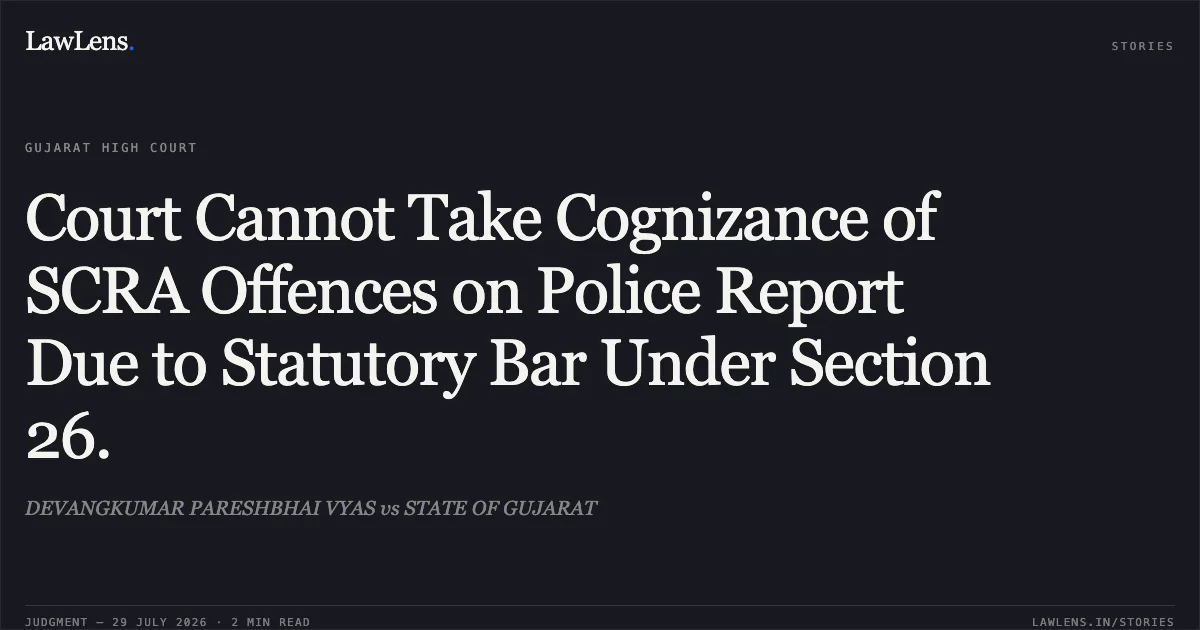
The court primarily applied Section 26 of the Securities Contracts (Regulation) Act, 1956, which provides a statutory bar against taking cognizance of any offence under the Act except upon a written complaint by the Central/State Government, SEBI, or a recognized stock exchange
Source reference: p. 9It relied on the precedent Vipulkumar Avantilal Shah v. State of Gujarat (2018), which held that while police may investigate cognizable offences under the Act, the court cannot take cognizance on a police report due to the specific bar in Section 26
Source reference: p. 10Regarding the IPC and IT Act, the court applied the principle that an FIR must prima facie disclose the ingredients of the alleged offences to proceed
Source reference: p. 11Reasoning
The court observed that while Section 25 of the SCRA makes certain offences cognizable, Section 26 explicitly mandates that cognizance can only be taken via a private "complaint" as defined under Section 2(d) of the CrPC, notably excluding police reports
Source reference: p. 10Consequently, even if a charge-sheet were filed, the trial court would be legally barred from acting upon it
Source reference: p. 10Regarding the IPC charges, the court found that even if the prosecution's story were accepted as true, the essential ingredients for criminal breach of trust (S. 406) and cheating (S. 420) were not established
Source reference: p. 11Similarly, the IT Act charges under Sections 66(C) and 66(D) were deemed inapplicable as the FIR failed to show how the applicant engaged in identity theft or personation
Source reference: p. 11Holding
The court held that the statutory bar under Section 26 of the SCRA precluded the court from taking cognizance on a police report and found the remaining IPC and IT Act allegations meritless
The court allowed the application and quashed the FIR and all consequential proceedings against the applicant, clarifying that materials collected by the investigation could still be used by the authorized agencies to initiate appropriate legal proceedings in the correct forum
Source reference: p. 11-12Acts & Sections Cited
5 provisions across 3 statutes referred to in this judgment. Each provision opens on LawLens.
Code of Criminal Procedure, 19732
Indian Penal Code, 18602
Securities and Exchange Board of India Act, 19921
Original Court PDF
DEVANGKUMAR PARESHBHAI VYASvsSTATE OF GUJARAT
Click to open original judgment
Original judgment, available to read, download and summarize on LawLens.in