Facts
The dispute arises from a contract awarded in 2009 to HCL for the Restructured Accelerated Power Development and Reforms Programme (RAPDRP), valued at approximately ₹528.20 crores.
Source reference: p. 6In 2019, HCL invoked arbitration seeking recovery for alleged arbitrary deductions.
Source reference: p. 7A three-member tribunal was constituted and began effective proceedings in March 2022.
Source reference: p. 8The mandate was extended by consent until 31.08.2023.
Source reference: p. 8On 17.09.2024, the Commercial Court granted a first extension until 30.04.2025, finding HCL largely responsible for delays and imposing conditions such as cost-capping and interest restrictions.
Source reference: p. 9, 31While these conditions were challenged and stayed in a separate writ, HCL filed a second extension application on 22.04.2025.
Source reference: p. 10The Commercial Court, via an order dated 24.02.2026, extended the mandate further until 30.09.2026 without imposing the previous rigorous conditions.
Source reference: p. 10, 29The State DISCOMs challenged this second extension under Article 227 of the Constitution.
Source reference: p. 11Issues
1. Whether the writ petition is maintainable under Article 227 of the Constitution against an order passed under Section 29A of the Arbitration Act?
Source reference: para. 352. Whether a successive (second) application for extension of the arbitral mandate under Section 29A is maintainable?
Source reference: para. 393. Whether "sufficient cause" existed for the extensions and whether the Tribunal’s conduct adhered to statutory discipline under Sections 24 and 29A?
Source reference: para. 44, 474. Whether the financial structure (per-sitting fees) and change in venue contributed to unjustifiable delay and prejudice?
Source reference: para. 53Law Applied
The Court applied the principles of Article 227 regarding supervisory jurisdiction over tribunals where no statutory appeal exists.
Source reference: para. 36It primarily relied on Section 29A of the Arbitration and Conciliation Act, 1996, which mandates that extensions be granted only for "sufficient cause" and permits the court to reduce fees if delay is attributable to the tribunal.
Source reference: para. 41Sections 24 and 18 were applied regarding the requirement for day-to-day hearings and equal treatment of parties.
Source reference: para. 47, 64Key precedents included Rohan Builders (India) Pvt. Ltd. v. Berger Paints India Ltd. (2025), establishing that Section 29A applications are maintainable post-expiry but must meet the "sufficient cause" threshold.
Source reference: para. 40ONGC v. Afcons Gunanusa JV (2024), regarding the rationalization of arbitral fees and party autonomy.
Source reference: para. 14, 58Union of India v. Singh Builders Syndicate (2009), cautioning against exorbitant per-sitting fees in ad hoc arbitrations.
Source reference: para. 56, 180Reasoning
The Court observed that while successive extensions are maintainable in law, they cannot be granted mechanically.
Source reference: para. 42In this case, the Tribunal's conduct reflected a "lethargic and casual approach," with hearings often spaced five months apart despite the mandate of Section 24 for day-to-day proceedings.
Source reference: para. 47, 50, 71.2The Court found that the substantial delay was squarely attributable to the Arbitral Tribunal, which ignored the Commercial Court's earlier direction to conclude within 14 sittings.
Source reference: para. 48, 72.4Furthermore, the shifting of the venue from Rajasthan to Delhi contrary to the agreement (GCC Clause 8.2) imposed an unfair financial burden on the State entities.
Source reference: para. 65The Court noted that ₹13 crores had already been spent on fees for a ₹528 crore dispute, creating a "perverse incentive" for delay under a per-sitting fee model.
Source reference: para. 54, 72.4.3The second extension order was found to be an impermissible review of the first order's conditions without fresh "sufficient cause".
Source reference: para. 45, 71.4Holding
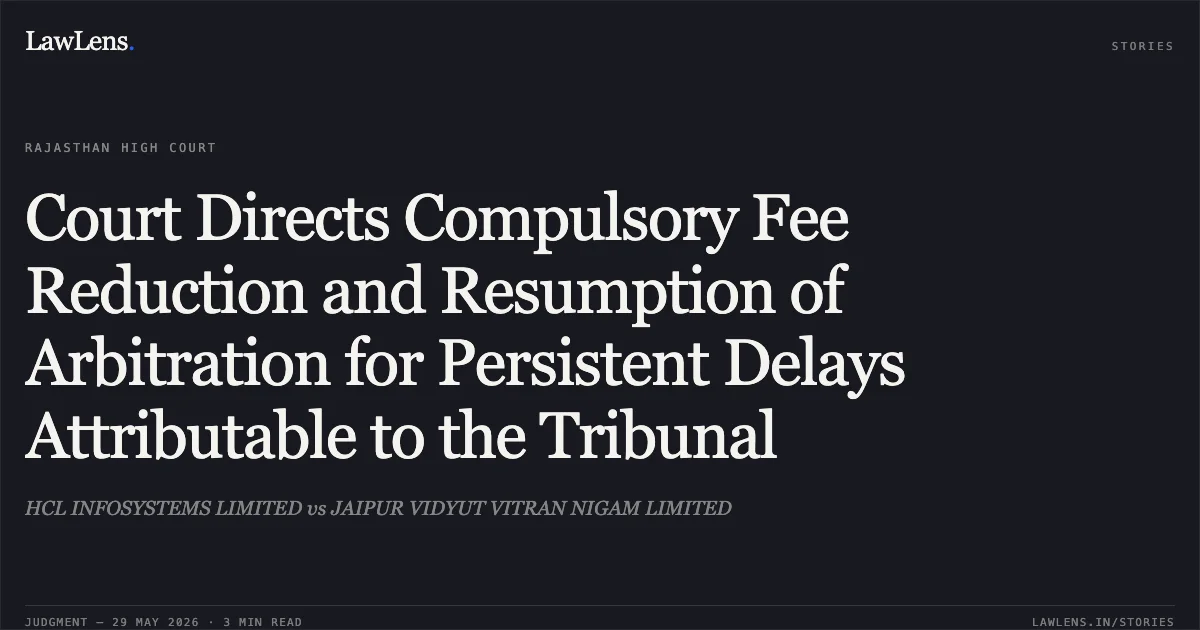
The Court held the petition maintainable and modified the impugned orders.
It directed the Tribunal to resume proceedings in Jaipur (not Delhi) on 31.05.2026 on a day-to-day basis, with a final deadline of 30.06.2026 to conclude arguments and 15 days thereafter to pass the award.
Source reference: para. 72.2, 72.5Finding the Tribunal responsible for the delay, the Court ordered a 5% monthly reduction in arbitral fees for the period beyond 30.04.2025, to be refunded to the parties.
Source reference: para. 72.4.4The petitioners were granted liberty to raise objections regarding arbitrator impartiality under Sections 12-14 as a preliminary issue.
Source reference: para. 72.3All future expenses were capped at actual pocket expenses with no additional session fees permitted.
Source reference: para. 72.6Acts & Sections Cited
22 provisions across 2 statutes referred to in this judgment. Each provision opens on LawLens.
Arbitration and Conciliation Act, 1996
Code of Civil Procedure, 19081
Original Court PDF
HCL INFOSYSTEMS LIMITEDvsJAIPUR VIDYUT VITRAN NIGAM LIMITED
Click to open original judgment
Original judgment, available to read, download and summarize on LawLens.in