Facts
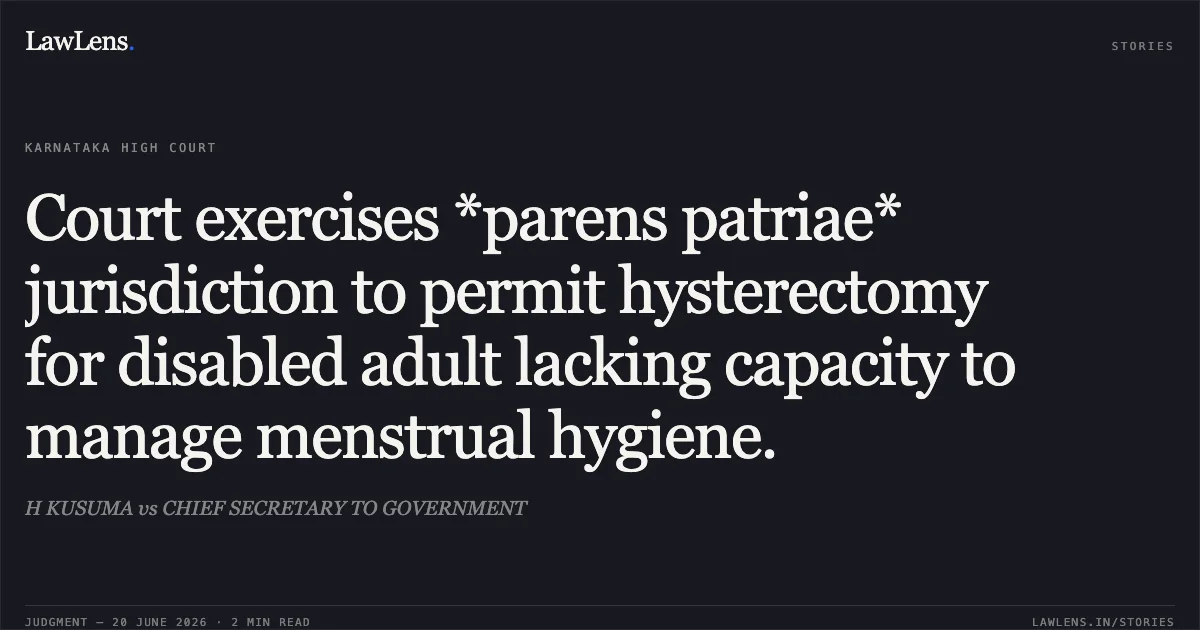
The petitioners, parents of a 23-year-old woman (X), sought a writ of mandamus permitting a Total Abdominal Hysterectomy for their daughter
Source reference: p. 2Medical assessments revealed that X suffers from Global Developmental Delay, cerebral palsy, and a seizure disorder, with an IQ of 36 and a social age of approximately 5 years
Source reference: para. 10-12, 16Her social maturity and drawing abilities were functioning significantly below her chronological age
Source reference: para. 3The petitioners contended that X is incapable of managing menstrual hygiene, leading to recurring infections, fever, and health risks, which would worsen as they age and their caregiving capacity declines
Source reference: para. 4-6The Court constituted a multidisciplinary Medical Board at Vanivilas Hospital, which recommended the procedure as necessary due to her permanent intellectual disability
Source reference: para. 8-16Issues
1. Whether the court should exercise its parens patriae jurisdiction to permit a permanent, invasive medical procedure (hysterectomy) on a person with intellectual disabilities who lacks the capacity to provide informed consent
Source reference: para. 17, 232. Whether the proposed procedure is in the "best interest" of the patient, balancing her bodily integrity and autonomy against her health, dignity, and long-term welfare
Source reference: para. 23, 36Law Applied
The Court primarily relied on the constitutional guarantees of personal liberty and reproductive autonomy under Article 21 of the Constitution of India, as interpreted by the Hon’ble Supreme Court in Suchita Srivastava v. Chandigarh Administration
Source reference: para. 19This precedent establishes that reproductive choices are a facet of personal liberty and that the rights of persons with disabilities cannot be curtailed solely due to their disability
Source reference: para. 20The Court also applied the doctrine of parens patriae, which empowers the judiciary to act as the guardian of those unable to care for themselves, necessitating a "best-interests" determination
Source reference: para. 23, 36Reasoning
The Court reasoned that while reproductive autonomy is a fundamental right, the clinical evidence established that X lacks the cognitive capacity to exercise informed consent or manage her own hygiene
Source reference: para. 18, 22Distinguishing this from eugenic sterilization, the Court found the procedure was not sought for the convenience of the parents but to resolve chronic medical complications—including recurring infections and seizure-related hygiene management—that X could neither communicate nor control
Source reference: para. 24-25, 32The Court emphasized that the recommendation came from a multidisciplinary Medical Board, not a single practitioner, confirming the condition was irreversible and that no less-intrusive alternative was viable
Source reference: para. 26-27, 33By applying the "best-interests" test, the Court concluded that the procedure would safeguard X’s long-term health and dignity, especially in light of the eventual decline of her primary caregivers
Source reference: para. 29, 36Holding
The Court answered the issues in the affirmative, holding that the procedure was in the patient's best interest.
It granted the writ petition and permitted the Total Abdominal Hysterectomy
Source reference: Order (i)-(ii)The Court directed the Medical Superintendent of Vanivilas Hospital to carry out the procedure, ensure pre- and post-operative psychological support/counseling for X, and protect her dignity throughout the process
Source reference: Order (ii)-(iii)The Court further mandated that a post-operative report be submitted to the Registrar General within eight weeks of the procedure
Source reference: Order (vi)Original Court PDF
H KUSUMAvsCHIEF SECRETARY TO GOVERNMENT
Click to open original judgment
Original judgment, available to read, download and summarize on LawLens.in