01Facts
On the intervening night of 23/24.07.2016, 10-12 masked miscreants armed with weapons entered the house of PW1, assaulted the family, and looted jewelry
p. 3The miscreants allegedly committed sexual assault on two minor victims, PW3 (Victim S) and PW5 (Victim U), by inserting fingers into their vaginas
pp. 3-4Initial medical examinations on 24.07.2016 revealed no external injuries, but a second examination on 26.07.2016 recorded various contusions
pp. 4, 13-14Following a purported self-incriminating statement by appellant Rohit, the other appellants were arrested
p. 4Stolen articles and a knife were allegedly recovered from appellant Nizamuddin
pp. 4-5The Trial Court convicted the appellants for dacoity, gang rape, and offenses under the POCSO Act
p. 202Issues
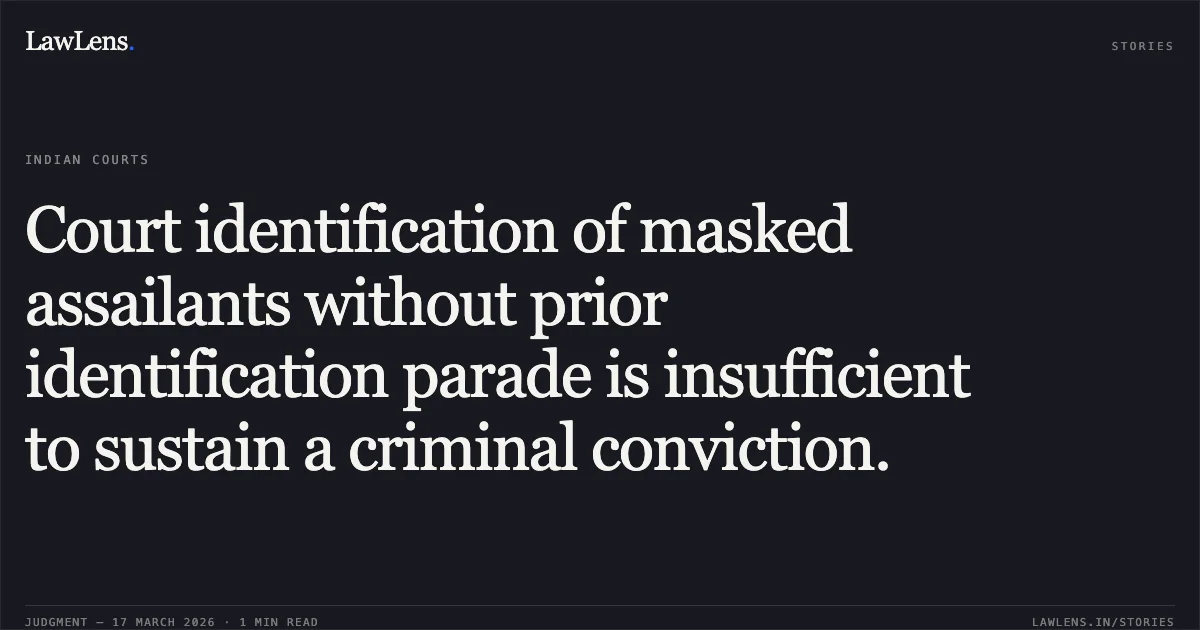
i.1. Whether the dock identification of the appellants is sustainable in law given that the assailants were masked at the time of the incident and no Test Identification Parade (TIP) was conducted
pp. 16-17ii.2. Whether the recovery and identification of looted articles are admissible when the identification occurred in the presence of the Investigating Officer (IO)
p. 18iii.3. Whether the conviction under Section 25 of the Arms Act is valid despite the absence of independent witnesses and procedural lapses during the search
p. 1903Law Applied
Section 162 of the Code of Criminal Procedure (CrPC), which renders statements or identifications made in the presence of the police during an investigation inadmissible
p. 9, 18Chunthuram v. State of Chattisgarh, which held that identification proceedings in police presence are hit by the ban under Section 162
p. 9Dana Yadav v. State of Bihar, establishing that dock identification is inherently weak evidence and generally requires a prior TIP for corroboration
pp. 9-10Evidentiary requirements for Section 376-D (Gang Rape), Section 395 (Dacoity) of the IPC, and Sections 5(g)/6 of the POCSO Act
p. 2Provisions in the judgment · 14 · Linked ones open on LawLens
Indian Penal Code, 1860 Section 395Section 412Section 34
Protection of Children from Sexual Offences Act, 2012 Section 5Section 6Section 3Section 4Section 16
Arms Act, 1959 Section 4Section 25
Code of Criminal Procedure, 1973 Section 164Section 162Section 313Section 437
04Reasoning
The Court found the identification of the accused entirely unreliable. Witnesses PW1, PW3, and PW5 admitted the assailants were masked with only their eyes visible
p. 16Consequently, the court held that their subsequent identification of the appellants in court lacked a credible foundation, especially since the IO admitted that no TIP was conducted because the miscreants were masked
p. 17The testimony of PW15 (sister), who claimed Rohit was her maternal uncle, was discarded because she failed to report this identity to her mother or the police immediately
pp. 16-17Regarding the medical evidence, the court noted a critical discrepancy: the lack of injuries during the first exam on 24.07.2016 contradicted the injuries found on 26.07.2016, suggesting they were not related to the incident
p. 18Furthermore, the identification of recovered jewelry was vitiated under Section 162 CrPC as it was performed in the presence of the IO
p. 18Finally, the Arms Act recovery was dismissed due to the absence of independent public witnesses and the failure of the police party to conduct mutual searches before the recovery to prevent planting of evidence
p. 1905Holding
The Court answered the legal issues in the negative, holding that the prosecution failed to prove the case beyond reasonable doubt
p. 17, 20The High Court allowed all appeals and set aside the conviction and sentencing orders dated 21.01.2021
pp. 19-20The appellants were acquitted of all charges under Sections 395, 376-D, and 412 of the IPC, and Sections 5(g)/6 of the POCSO Act
p. 20Nizamuddin was further acquitted of the charge under Section 4/25 of the Arms Act
p. 20The Court ordered the immediate release of the appellants from jail
p. 20Original Court PDF
SHAUKIN MEWATIvsSTATE OF UTTARAKHAND
Click to open original judgment
Original judgment, available to read, download and summarize on LawLens.in