01Facts
The appellant (Oyo) challenged an arbitral award by filing applications under Section 34 of the Arbitration and Conciliation Act, 1996, before the Commercial Court at the City Civil Court, Ahmedabad
p. 4Despite a joint pursis by both parties consenting to the court's jurisdiction, the Commercial Court held that it lacked territorial jurisdiction because the arbitral proceedings were conducted at the arbitrator's residence, which falls within the territorial limits of the Ahmedabad District (Rural) Court
p. 6 · ¶ 19.1However, after finding it lacked jurisdiction, the Commercial Court proceeded to dismiss the Section 34 applications on their merits
p. 7, 17The appellant challenged the court's decision to rule on the merits after denying its own jurisdiction, while the respondent filed cross-objections (treated as cross-appeals) challenging the finding on the lack of territorial jurisdiction
p. 3, 502Issues
i.1. Whether the Commercial Court at the City Civil Court, Ahmedabad, had territorial jurisdiction to adjudicate the Section 34 applications
p. 5 / para. 19.1ii.2. Whether a court, after determining it lacks territorial jurisdiction, can legally proceed to decide the merits of the case
p. 4 / para. 3303Law Applied
Section 37 of the Arbitration and Conciliation Act, 1996, regarding appeals
p. 2The "seat of arbitration" doctrine established in BGS SGS Soma JV v. NHPC Ltd. (2020) 4 SCC 234, which holds that the designation of a seat operates as an exclusive jurisdiction clause, conferring supervisory jurisdiction only to the courts where the seat is located
¶ 19.1, 16Section 20 of the Arbitration Act to distinguish between "seat" and "venue"
p. 12Order 7 Rule 10 of the Code of Civil Procedure, which mandates the return of a plaint/application if the court lacks jurisdiction
¶ 33, 34Provisions in the judgment · 6 · Linked ones open on LawLens
Arbitration and Conciliation Act, 1996 Section 2Section 20Section 34Section 37
Code of Civil Procedure, 1908 Section 7
Commercial Courts Act, 2015 Section 10
04Reasoning
The High Court observed that while the agreement fixed the "seat" generally as Ahmedabad, the city is split into two distinct judicial territories: City Civil and Rural. Since the arbitral proceedings actually took place and the award was signed within the Rural limits, that location became the specific "seat" under Section 20(2), conferring exclusive supervisory jurisdiction to the Ahmedabad Rural Court
p. 10, 15The Court rejected the respondent's argument regarding "party autonomy" and "consent," noting that consent cannot confer jurisdiction upon a court that lacks it under the law
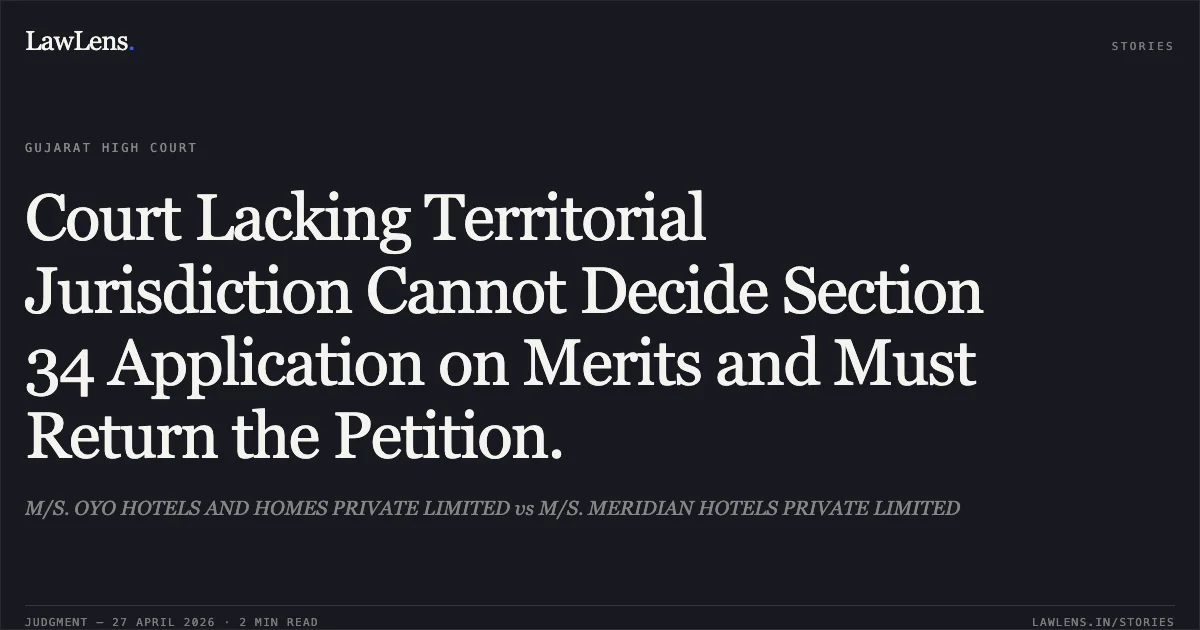
¶ 19.1Critically, the High Court held that once the Commercial Court concluded it had no territorial jurisdiction, its power was exhausted except for the ministerial act of returning the application. Entering into the merits of the Section 34 case after finding a lack of jurisdiction was a jurisdictional error
¶ 3305Holding
The High Court upheld the finding that the City Civil Court lacked territorial jurisdiction but set aside the judgment insofar as it decided the merits of the case
¶ 34The Court held that the applications must be returned to the appellant under Order 7 Rule 10 of the CPC for presentation before the competent Ahmedabad District (Rural) Court. The First Appeals were allowed to this extent, and the cross-objections/appeals were dismissed
¶ 34, 35Original Court PDF
M/S. OYO HOTELS AND HOMES PRIVATE LIMITEDvsM/S. MERIDIAN HOTELS PRIVATE LIMITED
Click to open original judgment
Original judgment, available to read, download and summarize on LawLens.in