Facts
The Petitioner was awarded a contract for security services by the Respondent. Following disputes, arbitration was invoked under the aegis of the Delhi International Arbitration Centre (DIAC).
Source reference: p. 1The High Court had extended the arbitrator's mandate until 01.11.2024. Due to Diwali holidays between 31.10.2024 and 03.11.2024, the arbitrator pronounced the award on 04.11.2024.
Source reference: p. 2The Respondent challenged the award under Section 34 of the Arbitration and Conciliation Act, 1996 ("the Act"), alleging it was passed after the mandate expired. The Petitioner subsequently filed an application under Section 29A seeking a retrospective extension.
Source reference: para. 2.1While the High Court initially dismissed the Section 29A petition and set aside the award, the Supreme Court, in Civil Appeal No. 2346-47 of 2026, set aside those orders and restored the Section 29A application for fresh consideration in light of the C. Velusamy precedent.
Source reference: para. 2.2Issues
1. Whether a court has the power to extend the mandate of an arbitrator under Section 29A(5) of the Act after the award has already been pronounced.
Source reference: p. 32. Whether the intervening public holidays, causing a delay in the pronouncement of an award prepared within the mandate, constitute "sufficient cause" for extension.
Source reference: p. 4-5Law Applied
Section 29A of the Arbitration and Conciliation Act, 1996, which governs the time limit for arbitral awards and the court's power to extend the mandate.
Source reference: p. 1The Supreme Court precedent C. Velusamy v. K. Indhera (2026 INSC 112), which established that an application under Section 29A(5) is maintainable even after the expiry of the mandate and after the rendering of an award.
Source reference: para. 5The principle that technicalities should not defeat substantial justice.
Source reference: para. 7Standards of "sufficient cause" as distinguished from cases like Balwant Singh v. Jagdish Singh and Basawaraj v. Special Land Acquisition Officer.
Source reference: para. 8Reasoning
The court reasoned that since the award was to be pronounced at the DIAC premises, which were closed for Diwali holidays from 31.10.2024 to 03.11.2024, the arbitrator could not physically pronounce the award before the 01.11.2024 deadline.
Source reference: para. 7The court held that this did not constitute "intentional inaction" by the Petitioner.
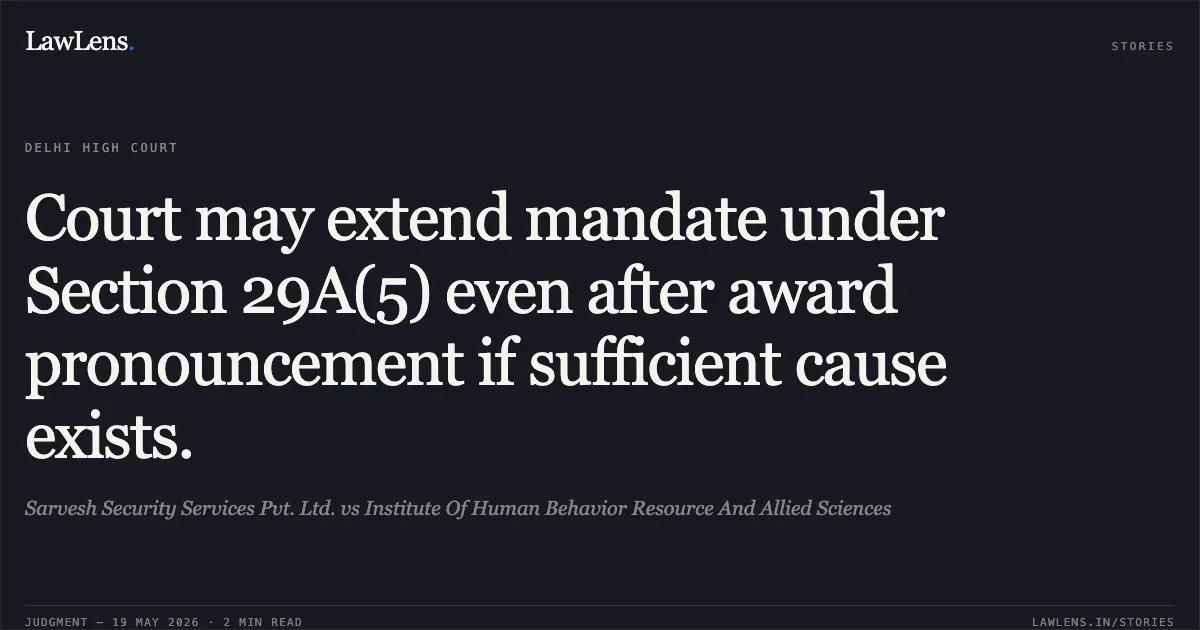
Source reference: para. 8Applying C. Velusamy, the court clarified that the power to extend the mandate is not impaired by the fact that the award is already rendered; rather, the extension "validates" the otherwise unenforceable award by allowing the mandate to cover the date of pronouncement.
Source reference: para. 10The court rejected the Respondent’s argument that the Petitioner was a "fence sitter," noting that Section 29A(5) prescribes no limitation period and grants either party the right to seek an extension regardless of the outcome of the proceedings.
Source reference: para. 9-10Holding
The court answered both issues in the affirmative, holding that sufficient cause existed for the extension and that such an extension is legally permissible post-award.
The court allowed the application under Section 29A, granting the extension of the mandate up to the date of pronouncement (04.11.2024) and ruled that no reduction in arbitrator fees or substitution of the tribunal was necessary.
Source reference: para. 13-14Acts & Sections Cited
2 provisions across 1 statute referred to in this judgment. Each provision opens on LawLens.
Arbitration and Conciliation Act, 19962
Original Court PDF
Sarvesh Security Services Pvt. Ltd.vsInstitute Of Human Behavior Resource And Allied Sciences
Click to open original judgment
Original judgment, available to read, download and summarize on LawLens.in