Facts
The appellant, Khageswar Sa, was the Sarpanch of Sardhapali Grampanchayat. In 1987, he and the Panchayat Secretary (co-accused) withdrew Rs. 15,000 and Rs. 5,000 from the joint Postal Savings Bank account for the purported purpose of depositing it into a Co-operative Bank to facilitate agricultural loans
Source reference: p. 3, 7The appellant took custody of the cash and the passbook but never deposited the funds, which was discovered during an audit on 08.07.1987
Source reference: p. 3, 4Additionally, the appellant misappropriated Rs. 500 received from a Peon (P.W. 2) for fishing rights
Source reference: p. 4The trial court (Special Judge, Vigilance) convicted the appellant on 18.08.2000 under Section 5(2) of the Prevention of Corruption Act, 1947, and Section 409 of the IPC, sentencing him to three years' rigorous imprisonment
Source reference: p. 1-2The appellant challenged the conviction and sentence via this appeal
Source reference: p. 2Issues
1. Whether the prosecution established the charges of criminal misconduct and criminal breach of trust against the appellant beyond reasonable doubt
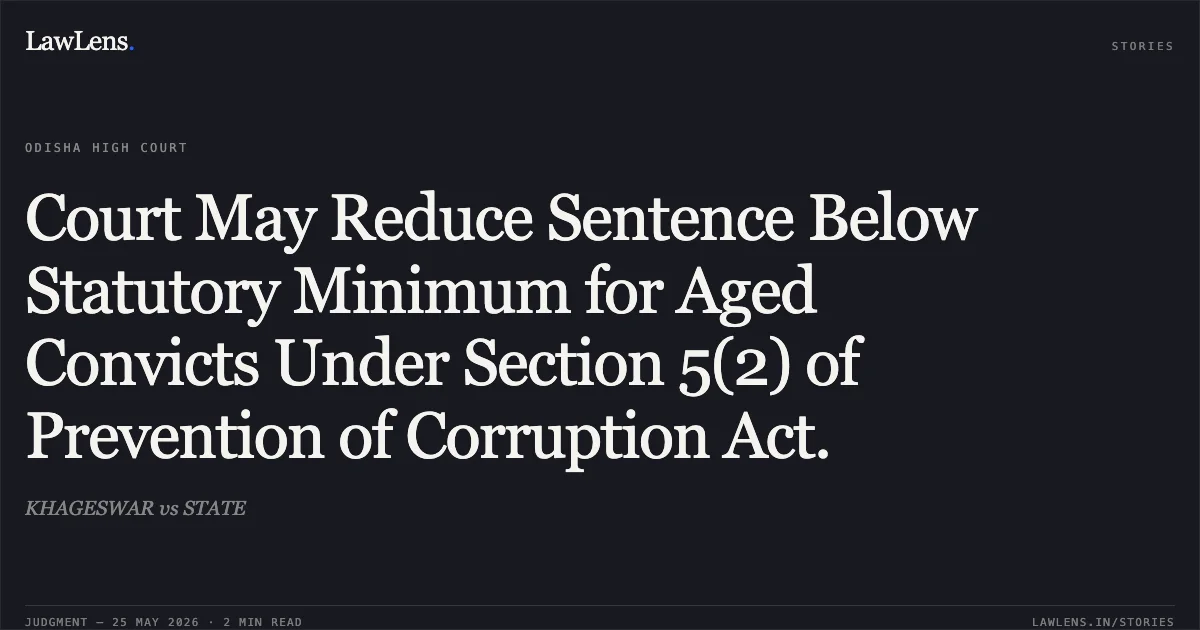
Source reference: p. 52. Whether the substantive sentence should be reduced below the statutory minimum given the appellant’s advanced age and the long duration of the proceedings
Source reference: p. 9-10Law Applied
Section 5(2) of the unamended Prevention of Corruption Act, 1947, which prescribes a minimum sentence of one year for criminal misconduct but contains a proviso allowing the court to impose a lesser sentence for "special reasons recorded in writing"
Source reference: p. 10-11Section 409 of the Indian Penal Code regarding criminal breach of trust by a public servant
Source reference: p. 13The precedent set in Abdul Hamid v. State of Orissa (CRA No. 150 of 1992), which established that the advanced age of a convict (over 75-80 years) and a trial duration spanning decades constitute valid "special reasons" for sentence reduction
Source reference: p. 10-11Reasoning
The Court noted that the appellant did not contest the merits of the conviction but sought leniency based on mitigating circumstances
Source reference: p. 9The Court observed that the occurrence dated back to 1987, and the appellant, who was 30 at the time of the offence, is now over 75 years old
Source reference: p. 9, 11Regarding the Analysis of the law, the Court found that while the evidence of misappropriation was "prodigious" and supported by written acknowledgments and audit reports, the four-decade-long "ordeal of criminal prosecution" and the lack of prior criminal antecedents justified a shift from a punitive to a reformative perspective
Source reference: p. 8, 12The Court determined that the appellant’s advanced age and the 39-year lapse since the incident were "special reasons" under the proviso to Section 5(2) to deviate from the mandatory minimum sentence
Source reference: p. 11-12Holding
To Issue 1, the court affirmed the trial court's finding of guilt
To Issue 2, the court reduced the sentence for the offence under Section 5(2) of the P.C. Act to rigorous imprisonment for one week and a fine of Rs. 5,000
Source reference: p. 13For the offence under Section 409 IPC, the sentence was reduced to one month of simple imprisonment and a fine of Rs. 25,000. The sentences are ordered to run concurrently, with a set-off for any prior detention. The appeal was partly allowed
Source reference: p. 13Acts & Sections Cited
4 provisions across 2 statutes referred to in this judgment. Each provision opens on LawLens.
Code of Criminal Procedure, 19732
Indian Penal Code, 18602
Original Court PDF
KHAGESWARvsSTATE
Click to open original judgment
Original judgment, available to read, download and summarize on LawLens.in