Facts
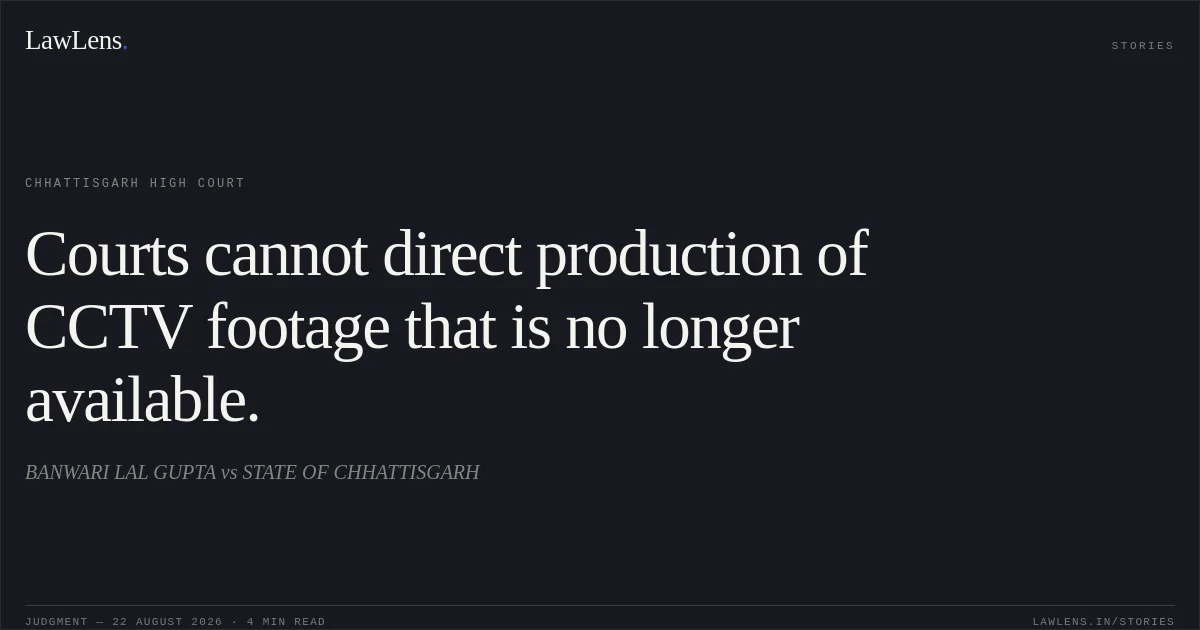
The petitioners were accused in Crime No. 304/2024 registered at Police Station Gaurela for offences under Sections 20(b) and 29 of the NDPS Act and Section 111 of the BNS.
Source reference: para. 3–4The prosecution alleged that they were transporting ganja, while the petitioners claimed that they had been illegally detained at the police station on 14 September 2024 and falsely implicated in the subsequent seizure dated 15 September 2024.
Source reference: para. 3–4During the pending NDPS trial, the petitioners applied under Section 94 of the BNSS seeking CCTV footage of the police station for 13–15 September 2024 and CDRs, including tower-location data, for their mobile numbers for 14 September 2024.
Source reference: para. 5The Trial Court called for a report from the Station House Officer and rejected the application after being informed that the CCTV footage had not been preserved and had been automatically deleted after the prescribed 18-month storage period; the CDRs had subsequently been produced and taken on record.
Source reference: para. 5, 17–18The petitioners challenged that order under Article 226 of the Constitution, relying on the State’s obligations concerning CCTV preservation under Shafhi Mohammad and Paramvir Singh Saini.
Source reference: para. 6, 11–15Issues
1. Whether the Trial Court was justified in rejecting the petitioners’ application under Section 94 of the BNSS seeking production of CCTV footage from Police Station Gaurela for 13–15 September 2024 and CDR/tower-location details for 14 September 2024?
Source reference: para. 102. Whether the High Court should exercise its writ jurisdiction under Article 226 to direct a further inquiry into the alleged non-preservation of the CCTV footage or to interfere with the Trial Court’s interlocutory evidentiary order?
Source reference: para. 17–203. Whether the petitioners’ grievance regarding non-production of the CDRs survived after those records had been produced before and taken on record by the Trial Court?
Source reference: para. 18Law Applied
Section 94 of the BNSS empowers a criminal court to require production of documents or other things, including electronic records, which are necessary or desirable for an investigation, inquiry, trial, or other proceeding; however, the power is conditioned on the existence or availability of the material and its demonstrated relevance.
Source reference: para. 16Article 226 jurisdiction is discretionary and ordinarily is not exercised to interfere with interlocutory evidentiary orders in pending criminal trials, unless the order is without jurisdiction, manifestly arbitrary, perverse, or results in failure of justice.
Source reference: para. 19The Court relied on Shafhi Mohammad v. State of Himachal Pradesh, (2018) 5 SCC 311, and Paramvir Singh Saini v. Baljit Singh, (2021) 1 SCC 184, which require installation, functioning, monitoring, oversight, and preservation of CCTV systems in police establishments through appropriate oversight mechanisms.
Source reference: para. 11–15, 23The Court also recognised that the statutory presumptions under Sections 35 and 54 of the NDPS Act do not dispense with the ordinary requirements of proving and appreciating defence evidence in accordance with law.
Source reference: para. 18Reasoning
The High Court held that Section 94 of the BNSS did not authorise the Trial Court to compel production of footage that was no longer available.
Source reference: para. 17The Trial Court had sought a report regarding availability, and the SHO reported that the CCTV footage had been deleted after 18 months; the record did not establish perversity, jurisdictional error, or mechanical rejection of the application.
Source reference: para. 17Although the petitioners alleged that the footage would support their plea of illegal detention, the High Court held that the absence of preservation did not itself justify a writ directing production or a parallel inquiry by the High Court.
Source reference: para. 20Any evidentiary consequence arising from non-availability could be urged before the Trial Court at the appropriate stage.
Source reference: para. 20The position concerning the CDRs was different: those records had been obtained by the police, produced before the Trial Court, and taken on record.
Source reference: para. 18Consequently, the petitioners’ grievance regarding withholding or non-availability of the CDRs no longer survived, and their relevance and admissibility could be considered during trial.
Source reference: para. 18The Court further declined to interfere under Article 226 because the challenged order was interlocutory and no denial of a legally available opportunity to defend had been demonstrated.
Source reference: para. 19Holding
The High Court dismissed the writ petition and upheld the Trial Court’s order dated 15 May 2026.
It held that no direction could be issued for production of CCTV footage that was reported to be unavailable, and that no jurisdictional error or perversity had been shown warranting interference under Article 226.
Source reference: para. 20, 22The petitioners were permitted to rely on the CDRs already placed on record and to seek their proof, examination, and consideration in accordance with law; the Court expressed no opinion on the merits of the prosecution or the petitioners’ defence of illegal detention.
Source reference: para. 18, 21No order as to costs was made.
Source reference: para. 22The Court nevertheless directed that its order be circulated to the Chief Secretary and Director General of Police and emphasised strict, effective, and continuous compliance with the Supreme Court’s CCTV-preservation directions, including functional systems, adequate storage, regular monitoring, and fixing responsibility for lapses.
Source reference: para. 23–24Acts & Sections Cited
6 provisions across 3 statutes referred to in this judgment. Each provision opens on LawLens.
Narcotic Drugs and Psychotropic Substances Act, 19854
Bharatiya Nyaya Sanhita, 20231
Bharatiya Nagarik Suraksha Sanhita, 20231
Original Court PDF
BANWARI LAL GUPTAvsSTATE OF CHHATTISGARH
Click to open original judgment
Original judgment, available to read, download and summarize on LawLens.in