Facts
Dr. Sunil Kumar Singh, a Pediatrician serving at CHC Jaspur, was shot dead while discharging his official duties on April 20, 2016
Source reference: para. 3Following his death, his widow (the first respondent) sought extraordinary pension under the Uttar Pradesh Civil Services (Extraordinary Pension) Rules, 1981 ("Rules of 1981"), as adopted by Uttarakhand
Source reference: para. 3Although the Chief Secretary initially proposed ₹50,00,000 compensation and compassionate appointment, only ₹1,00,000 was paid, and the deceased’s son was appointed only on a contractual basis
Source reference: para. 3-4The first respondent filed a writ petition in the High Court of Uttarakhand seeking implementation of the proposal and further compensation
Source reference: para. 4The High Court awarded ₹1,99,09,000 as compensation with 7.5% interest and directed the grant of extraordinary pension under the Rules of 1981 with 8.5% interest
Source reference: para. 2, 5During the pendency of the appeal before the Supreme Court, the State paid a total of ₹1,00,00,000 to the first respondent as an interim measure
Source reference: para. 6, 9Issues
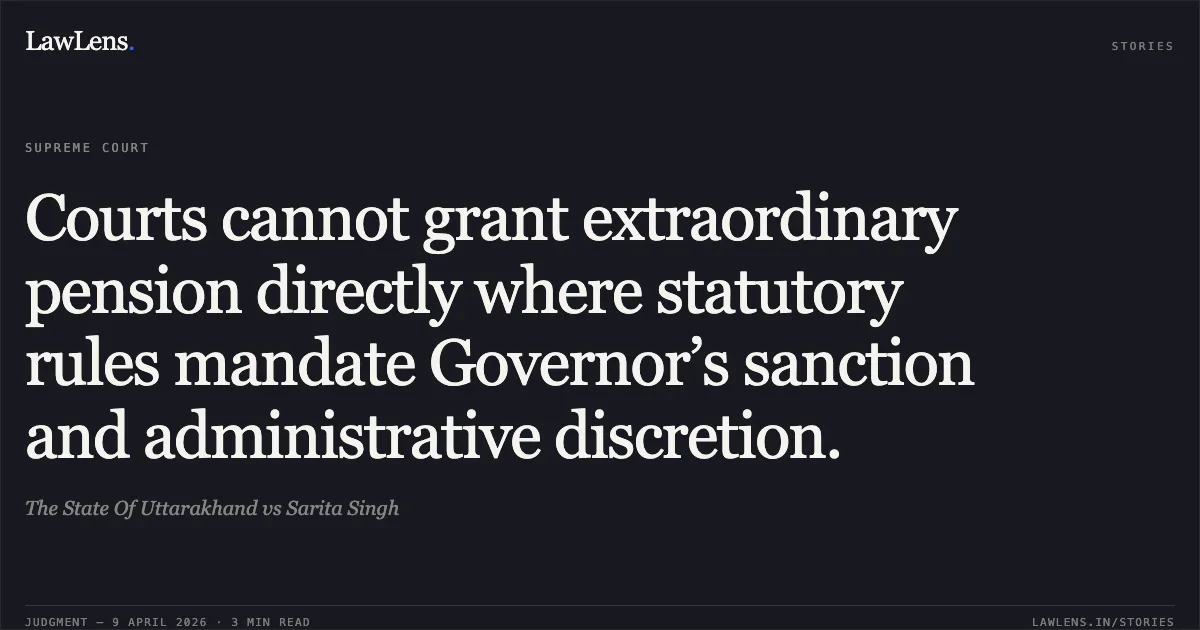
Whether the High Court was justified in directly ordering the grant of extraordinary pension without the sanction of the Governor as required under the Rules of 1981
Source reference: para. 12Whether a writ of mandamus can be issued to substitute a court’s decision for an administrative discretion vested in a statutory authority (the Governor) before that authority has exercised such discretion
Source reference: para. 12-14Law Applied
The court primarily applied the Uttar Pradesh Civil Services (Extraordinary Pension) Rules, 1981, specifically Rule 4, which mandates that no award shall be made except with the sanction of the Governor
Source reference: para. 10It further relied on Rule 13 (procedure for claims), Rule 14 (Governor’s discretion for awards in uncovered circumstances), and Rule 15 (discretion to redistribute pension)
Source reference: para. 10The Court applied the principle that when an authority is vested with discretionary administrative power, the Court should not substitute its own decision for that of the authority
Source reference: para. 12It cited State of West Bengal v. Nuruddin Mallik and Union of India v. S.B. Vohra, establishing that a Court may compel a statutory authority to exercise its discretion but should not usurp that jurisdiction itself
Source reference: para. 13Reasoning
The Court observed that the Rules of 1981 constitute a complete code for determining extraordinary pension, placing the power of sanction exclusively with the Governor
Source reference: para. 10, 12The High Court erred by undertaking the factual adjudication and determining the award itself without the Governor having had an opportunity to examine the matter under Rule 4
Source reference: para. 11-12The Supreme Court reasoned that administrative discretion must be exercised by the designated authority at the first instance, and judicial intervention is only appropriate if the authority refuses to act or acts arbitrarily
Source reference: para. 12Since the first respondent had not submitted a formal application in the prescribed Form B as required by Rule 13, and the Governor had never formally considered the claim, the High Court’s issuance of a mandamus was premature and unwarranted
Source reference: para. 11, 14However, the Court acknowledged the substantial compensation already paid (₹1 crore) and the other reliefs granted (housing and compassionate appointment) in balancing the equities
Source reference: para. 15Holding
The Supreme Court partly allowed the appeal and modified the High Court’s judgment
The Court set aside the direction to pay extraordinary pension but permitted the first respondent to file a formal application under the Rules of 1981 within four weeks
Source reference: para. 16(a)-(b)The Competent Authority was directed to decide this application on its own merits within twelve weeks
Source reference: para. 16(b)-(c)Finally, the Court held that the ₹1,00,00,000 already paid to the respondent shall be treated as final monetary compensation and shall not be recovered by the State
Source reference: para. 16(d)Original Court PDF
The State Of UttarakhandvsSarita Singh
Click to open original judgment
Original judgment, available to read, download and summarize on LawLens.in