Facts
The appellant, a Lab Technician, was promoted and posted on 15 March 2024 at Ramanuj Pratap Singhdev Shaskiya Snatakottar Mahavidyalaya, Baikunthpur, District Koriya, a Scheduled Area.
Source reference: para. 3By transfer order dated 4 July 2025, he was transferred to Navin Shaskiya Mahavidyalaya, Bortara, District Bemetara, a Non-Scheduled Area.
Source reference: para. 3He challenged the transfer in W.P.(S) No. 7860 of 2025, where the High Court stayed the transfer and directed him to submit a representation to the Transfer Committee.
Source reference: para. 3The Committee rejected or declined to grant relief on 7 October 2025.
Source reference: para. 3The appellant asserted that the transfer violated Clauses 1.8, 3.4, 3.7 and 3.10 of the Transfer Policy, 2025, as it was premature, involved transfer from a Scheduled to a Non-Scheduled Area, and was not accompanied by posting of a substitute.
Source reference: para. 3He also relied on his 60% permanent disability, family responsibilities, dependent parents, non-earning wife and children studying at Baikunthpur.
Source reference: para. 3The learned Single Judge dismissed W.P.(S) No. 162 of 2026 on 9 January 2026, holding that transfer was an incident of service, that the appellant had not established mala fides or violation of a mandatory statutory provision, and that the Transfer Policy was not statutory in nature.
Source reference: para. 8However, the respondents were directed to maintain the status quo regarding his posting until 31 March 2026 because his children’s examinations were approaching and he had not yet been relieved.
Source reference: para. 9The appellant thereafter filed the present writ appeal with a delay of 140 days and sought condonation of delay.
Source reference: para. 1Issues
Whether the learned Single Judge erred in declining to interfere with the appellant’s transfer despite his asserted 60% permanent disability, alleged premature transfer from a Scheduled Area to a Non-Scheduled Area, and claimed non-compliance with the Transfer Policy, 2025.
Source reference: paras. 3–4, 7–9Whether the transfer order or the Transfer Committee’s decision was vitiated by mala fides, violation of any mandatory statutory provision, perversity, or patent illegality warranting interference in writ jurisdiction.
Source reference: paras. 9–11Whether the appellant furnished sufficient and satisfactory grounds for condoning the 140-day delay in filing the writ appeal.
Source reference: paras. 1, 12Law Applied
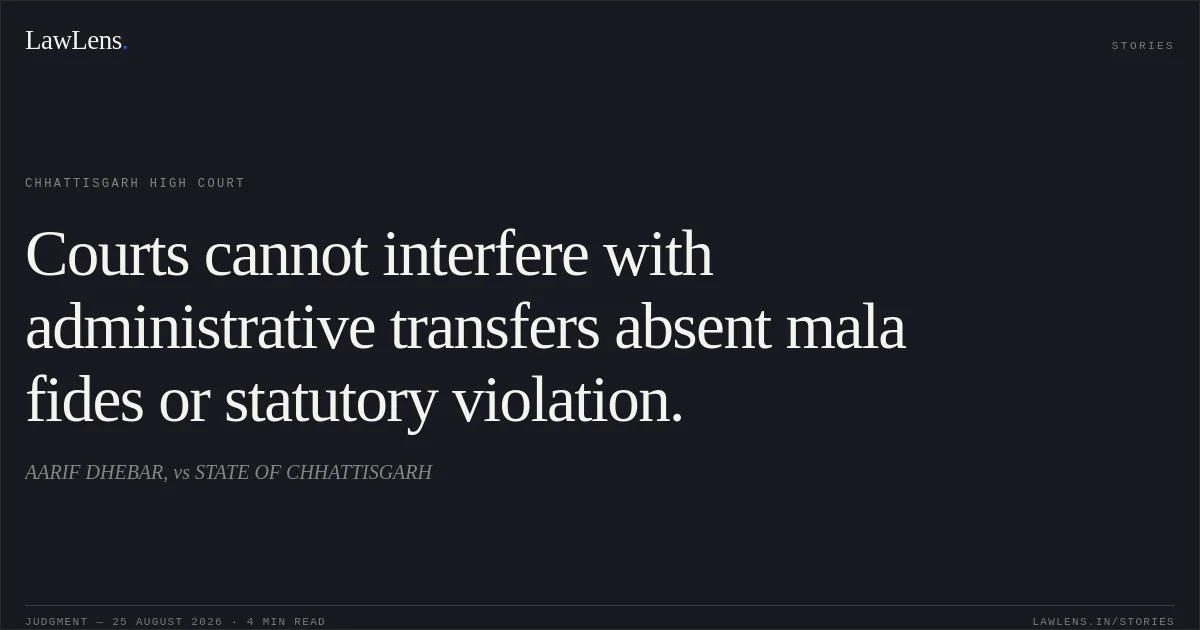
Transfer of a government servant holding a transferable post is an ordinary incident of service, and the employee has no vested right to remain posted at a particular place.
Source reference: para. 8Judicial interference is ordinarily justified only where the transfer is vitiated by mala fides or violates a statutory provision.
Source reference: para. 8The Court relied on Gujarat Electricity Board v. Atmaram Sungomal Poshani, 1989 AIR 1433, Union of India v. S.L. Abbas, (1993) 4 SCC 357, Mohd. Masood Ahmad v. State of U.P., (2007) 8 SCC 150, Rajendra Singh v. State of U.P., (2009) 15 SCC 178, and Namrata Verma v. State of U.P., SLP (C) No. 36717 of 2017, decided on 6 September 2021, for these principles.
Source reference: para. 8A transfer policy ordinarily does not confer an enforceable statutory right unless incorporated into a statutory rule; administrative authorities retain discretion to transfer employees in the interest of administration.
Source reference: para. 9In an intra-court appeal, interference is warranted only where the Single Judge’s order discloses a palpable infirmity, patent illegality, perversity, or other compelling error.
Source reference: para. 10Personal hardship, including the non-availability of a particular school for an employee’s children, ordinarily does not invalidate an otherwise lawful transfer.
Source reference: para. 8Reasoning
The Court held that the learned Single Judge had considered the appellant’s principal grounds, including his disability, family circumstances, tenure at Baikunthpur, alleged breach of the Transfer Policy, and the educational needs of his children.
Source reference: paras. 8–9The appellant had not established that the transfer was motivated by mala fides or that it violated any mandatory statutory provision.
Source reference: para. 9The alleged breach of the Transfer Policy could not, by itself, justify judicial interference because the policy was not statutory and did not create an enforceable right to remain at a particular posting.
Source reference: para. 9The appellant’s disability and personal hardship were relevant circumstances but did not demonstrate that the transfer was legally invalid.
Source reference: paras. 8–9The Court further found no palpable infirmity, perversity, patent illegality or non-application of mind in the Single Judge’s order or in the Transfer Committee’s decision.
Source reference: paras. 10–11Since the appellant also failed to provide a sufficient and satisfactory explanation for the 140-day delay, the application for condonation was not sustainable.
Source reference: para. 12Holding
The Division Bench dismissed the writ appeal, holding that the transfer order and the Transfer Committee’s decision did not warrant interference and that the learned Single Judge had assigned cogent and sustainable reasons for dismissing the writ petition.
The application for condonation of the 140-day delay was also rejected for want of a sufficient explanation.
Source reference: para. 12No order as to costs was made.
Source reference: para. 12Acts & Sections Cited
1 provisions across 1 statute referred to in this judgment. Linked provisions open on LawLens.
Persons With Disabilities (Equal Opportunities, Protection Of Rights And Full Participation) Act, 19951
Original Court PDF
AARIF DHEBAR,vsSTATE OF CHHATTISGARH
Click to open original judgment
Original judgment, available to read, download and summarize on LawLens.in
![Courts will not interfere with transfers absent mala fides or violation of statutory rules.. M Ramya vs EMPLOYEES STATE INSURANCE CORPORATION (ESIC). CAT - ['Chennai']. LawLens](/stories/thumbnails/courts-will-not-interfere-with-transfers-absent-mala-fides-or-violation-of-statutory-rules-a6845e9ca6f548fca284c51c8351957f.webp)
![Courts cannot direct one-time recruitment age relaxation absent authority in the governing rules or advertisement.. UT OF PUDUCHERRY vs M ANDAL. CAT - ['Chennai']. LawLens](/stories/thumbnails/courts-cannot-direct-one-time-recruitment-age-relaxation-absent-authority-in-the-governing-895d78fde47143e2a8ed0207c4b6a44f.webp)
![A review cannot correct an allegedly erroneous decision absent an error apparent on the record.. Ajit Kumar Jha vs RAILWAY BOARD. CAT - ['Delhi']. LawLens](/stories/thumbnails/a-review-cannot-correct-an-allegedly-erroneous-decision-absent-an-error-apparent-on-the-re-8ac952fd4eba470c92f7da20af72a220.webp)